Quotessence
Home / Authors / Milan Kundera
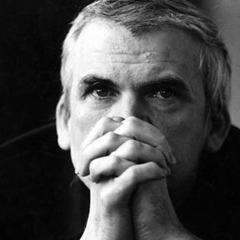
Milan Kundera

Milan Kundera Quotes

Writer

Filter quotes by topic

Famous Milan Kundera Quotes

“To put it another way, every love relationship is based upon unwritten conventions rashly agreed upon by the lovers during the first weeks of their love. On the one hand, they are living a sort of dream; on the other, without realizing it, they are drawing up the fine print of their contracts like the most hard-nosed of lawyers. O lovers! Be wary during those perilous first days! If you serve the other party breakfast in bed, you will be obliged to continue same in perpetuity or face charges of animosity and treason!”

“In the political jargon of those days, the word "intellectual" was an insult. It indicated someone who did not understand life and was cut off from the people. All the Communists who were hanged at the time by other Communists were awarded such abuse. Unlike those who had their feet solidly on the ground, they were said to float in the air. So it was fair, in a way, that as punishment the ground was permanently pulled out from under their feet, that they remained suspended a little above the floor.”

“The psychological and physiological mechanism of love is so complex that at a certain period in his life a young man must concentrate all his energy on coming to grips with it, and in this way he misses the actual content of the love: the woman he loves. (In this he is much like a young violinist who cannot concentrate on the emotional content of a piece until the technique required to play it comes automatically.)”

“The phrase "It's absolutely the same with me, I..." seems to be an approving echo, a way of continuing the other's thought, but that is an illusion: in reality it is a brute revolt against a brutal violence, an effort to free our own ear from bondage and to occupy the enemy's ear by force. Because all of man's life among his kind is nothing other than a battle to seize the ear of others.”

“A great deal has been said about love at first sight; I am perfectly aware of love's retrospective tendency to make a legend of itself, turn its beginnings into myth; so I don't want to assert that it was love; but I have no doubt there was a kind of clairvoyance at work: I immediately felt, sensed, grasped the essence of Lucie's being or, to be more precise, the essence of what she was later to become for me; Lucie had revealed herself to me the way religious truth reveals itself.”

“While people are fairly young and the musical composition of their lives is still in its opening bars, they can go about writing it together and sharing motifs (the way Tomas and Sabina exchanged the motif of the bowler hat), but if they meet when they are older, like Franz and Sabina, their musical compositions are more or less complete, and every motif, every object, every word means something different to each of them.”

“War and culture, those are the two poles of Europe, her heaven and hell, her glory and shame, and they cannot be separated from one another. When one comes to an end, the other will end also and one cannot end without the other. The fact that no war has broken out in Europe for fifty years is connected in some mysterious way with the fact that for fifty years no new Picasso has appeared either.”

“Aesthetic racism is almost always a sign of inexperience. Those who have not made their way far enough into the world of amorous delights judge women only by what can be seen. But those who really know women understand that the eye reveals only a minute fraction of what a woman can offer us. When God bade mankind be fruitful and multiply, Doctor, He was thinking of the ugly as well as of the beautiful. I am convinced I might add, that the aesthetic criterion does not come from God but from the devil. In paradise no distinction was made between ugliness and beauty.”

“At a time when history made its way slowly, the few events were easily remembered and woven into a backdrop, known to everyone, before which private life unfolded the gripping show of its adventures. Nowadays, time moves forward at a rapid pace. Forgotten overnight, a historic event glistens the next day like the morning dew and thus is no longer the backdrop to a narrator's tale but rather an amazing adventure enacted against the background of the over-familiar banality of private life.”

“The present era grabs everything that was ever written in order to transform it into films, TV programs; or cartoons. What is essential in a novel is precisely what can only be expressed in a novel, and so every adaptation contains nothing but the non-essential. If a person is still crazy enough to write novels nowadays and wants to protect them, he has to write them in such a way that they cannot be adapted, in other words, in such a way that they cannot be retold.”