Quotessence
Home / Authors / Neal A. Maxwell
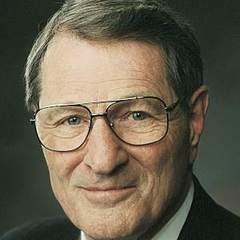
Neal A. Maxwell

Neal A. Maxwell Quotes

Author

Filter quotes by topic

Famous Neal A. Maxwell Quotes

“All of us must walk the same strait and narrow path, know the same kind of experiences as those we would seek to lead and to serve. There is not one strait and narrow path for the officers-the chosen-and another for the enlisted men. We are all to experience life "according to the flesh"; there is no other way, for it is the way to immortality and eternal life. Given the resplendent riches of the promised kingdom, why would anyone wish to walk another path than the one that leads us back to our gracious and merciful Father in Heaven?”

“Listen to these wounds of pain put in the form of questions to me by a young woman who had had two abortions: "I wonder about the spirits of those I had aborted, if they were there, if they were hurt? I was under three months each time, but a mother feels life before she feels movement." "I wonder if they are lost and alone?" "I wonder if they will ever have a body?" "I wonder if I will ever have a chance again to bring those spirits back as mine?" Alas, brothers and sisters, "wickedness never was happiness" (Alma 41:10).”

“There is also the very real possibility that, in the justice of God, one of the reasons He uses the weak and the foolish of the world is so that no argument could be made later that certain people were advantaged in some unfair way by that which was unearned-either in the premortal life or here. Hence it seems prudent for us to realize that just because one is set apart or ordained to a certain calling or assignment he or she must not expect to be set apart from the stresses of life. There appear to be no immunities.”

“It is understandable how some people could give way to this kind of pervasive pessimism, but we speak of a gospel which brings good tidings of great joy and this must be reflected in our lives, if we are to be believable especially as we suggest to others that there is, in fact, not only a better way, but also the way. Scriptures that speak of man as a being who "might have joy" have more impact when falling from the lips or pens of men and women whose lives give fresh evidence of the validity of that scripture.”

“. . . just as God cannot look upon sin with the least degree of allowance, as we become more like Him, neither can we. The best people have a heightened awareness of what little of the worst is still in them! Indeed, the divine discontent, the justifiable spiritual restlessness that we feel, is a natural follow-on feeling in the disciple who has taken the Lord's counsel to "make you a new heart and a new spirit." (Ezekiel 18:31.)”

“It is one of the great ironies of human history that some mortals with incorrect understanding of God and life's purposes sometimes scold God because of the abundance of human misery and suffering-which, indeed, lies all about us. Such individuals almost dare God to demonstrate His existence by straightening things out-and at once! But He is a much different kind of Father than that. Surely it is requisite to eternal life that we come to know God and Jesus Christ whom He has sent (see John 17:3).”

“It is one of the ironies of religious history that many mortals err in their understanding of the nature of God and end up rejecting not the real God but their own erroneous and stereotypical image of God. Frequently this is because they have thought of God solely in terms of thunderings at Sinai without pondering substance. . . .”

“Men's and nations' finest hour consist of those moments when extraordinary challenge is met by extraordinary response. Hence in those darkest hours, we must light our individual candles rather than vying with others to call attention to the enveloping darkness. Our indignation about injustice should lead to illumination, for if it does not, we are only adding to the despair-and the moment of gravest danger is when there is so little light that darkness seems normal!”

“A good friend, who knows whereof he speaks, has observed of trials, ‘If it’s fair, it is not a true trial!’ That is, without the added presence of some inexplicableness and some irony and injustice, the experience may not stretch us or lift us sufficiently. The crucifixion of Christ was clearly the greatest injustice in human history, but the Savior bore up under it with majesty and indescribable valor.”

“While most of our suffering is self- inflicted, some is caused by or permitted by God. This sobering reality calls for deep submissiveness, especially when God does not remove the cup from us. In such circumstances, when reminded about the premortal shouting for joy as this life's plan was unfolded (Job 38:7), we can perhaps be pardoned if, in some moments, we wonder what all the shouting was about.”

“How can you and I really expect to glide naively through life, as if to say, 'Lord, give me experience, but not grief, not sorrow, not pain, not opposition, not betrayal, and certainly not to be forsaken. Keep from me, Lord, all those experiences which made Thee what Thou art! Then, let me come and dwell with Thee and fully share Thy joy!'”

“Our goals should stretch us bit by bit. So often when we think we have encountered a ceiling, it is really a psychological or experimental barrier that we have built ourselves. We built it and we can remove it. Just as correct principles, when applied, carry their own witness that they are true, so do correct personal improvement programs. But we must not expect personal improvement without pain or some 'remodeling.' We can't expect to have the thrills of revealed religion without the theology. We cannot expect to have the soul stretching without Christian service.”

“In conclusion, the submission of one's will is really the only uniquely personal thing we have to place on God's altar. The many other things we 'give,' brothers and sisters, are actually the things He has already given or loaned to us. However, when you and I finally submit ourselves, by letting our individual wills be swallowed up in God's will, then we are really giving something to Him! It is the only possession which is truly ours to give!”

“To think of enduring to the end as ‘hanging in there,’ doing one’s duty relentlessly, is not inaccurate. Yet enduring to the end is more than outlasting and surviving, though it includes those qualities. We are called upon, as was the Prophet Joseph, to ‘endure it well,’ gracefully, not grudgingly. (D&C 121:8.) We are also told that we must ‘endure in faith.’ (D&C 101:35.) These dimensions of enduring are important to note. Likewise, we are asked to endure ‘valiantly.’ (D&C 121:29.)”

“The cumulative weight of all mortal sins--past, present, and future--pressed upon that perfect, sinless, and sensitive Soul! All our infirmities and sicknesses were somehow, too, a part of the awful arithmetic of the Atonement. (See Alma 7:11-12; Isa. 53:3-5; Matt. 8:17.) The anguished Jesus not only pled with the Father that the hour and cup might pass from Him, but with this relevant citation. 'And he said, Abba, Father, all things are possible unto thee; take away this cup from me.' (Mark 14:35-36.)”

“So it is that real, personal sacrifice never was placing an animal on the altar. Instead, it is a willingness to put the animal in us upon the altar and letting it be consumed! Such is the 'sacrifice unto the Lord... of a broken heart and a contrite spirit,' (D&C 59:8), a prerequisite to taking up the cross, while giving 'away all [our] sins' in order to 'know God' (Alma 22:18) for the denial of self precedes the full acceptance of Him.”

“We tend to think of consecration only as yielding up, when divinely directed, our material possessions. But ultimate consecration is the yielding up of oneself to God. Heart, soul, and mind were the encompassing words of Christ in describing the first commandment, which is constantly, not periodically, operative (see Matt. 22:37). If kept, then our performances will, in turn, be fully consecrated for the lasting welfare of our souls (see 2 Ne. 32:9).”

“In a 'wheat and tares' world, how unusually blessed faithful members are to have the precious and constant gift of the Holy Ghost with reminders of what is right and of the covenants we have made. 'For behold, ... the Holy Ghost ... will show unto you all things what ye should do.' (2 Ne. 32:5.) Whatever the decibels of decadence, these need not overwhelm the still, small voice! Some of the best sermons we will ever hear will be thus prompted from the pulpit of memory—to an audience of one!”

“Like Jesus, we can decide, daily or instantly, to give no heed to temptation (see D&C 20:22). We can respond to irritation with a smile instead of scowl, or by giving warm praise instead of icy indifference. By our being understanding instead of abrupt, others, in turn, may decide to hold on a little longer rather than to give way. Love, patience, and meekness can be just as contagious as rudeness and crudeness.”

“Naive optimism and pervasive pessimism are both to be avoided, therefore. It's not an easy balance to maintain, to be asked to work away in the Ninevehs of our lives without being so conscious of the coming cataclysm that we are not serious citizens of our communities and nations. By living and sharing the gospel of Jesus Christ, we are doing the most relevant thing we can do by way of helping. (There are civic and other chores to be done, of course.) Day in and day out, the gospel is the one thing that is most relevant, and we are to be of good cheer.”

“No "natural" resource is more precious and to be used more wisely than time. These mortal moments matter more than we know. There are no idle hours; there are only idle people. In true righteousness there is serenity, but there is an array of reminders that the "sacred present" is packed with possibilities which are slipping by us, which are going away from us each moment.”

“To one degree or another we all struggle with selfishness. Since it is so common, why worry about selfishness anyway? Because selfishness is really self-destruction in slow motion. No wonder the Prophet Joseph Smith urged, "Let every selfish feeling be not only buried, but annihilated" (Teachings of the Prophet Joseph Smith, p. 178). Hence annihilation - not moderation - is the destination! . . . Meekness is the real cure, for it does not merely mask selfishness but dissolves it!”