Quotessence
Home / Authors / Nhat Hanh
Nhat Hanh

Nhat Hanh Quotes

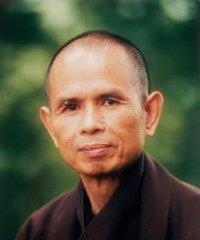
Monk

Filter quotes by topic

Famous Nhat Hanh Quotes

“Sometimes your joy is the source of your smile, but sometimes your smile can be the source of your joy.”

“People have a hard time letting go of their suffering. Out of a fear of the unknown, they prefer suffering that is familiar.”

“Hope is important because it can make the present moment less difficult to bear. If we believe that tomorrow will be better, we can bear a hardship today.”

“There is no way to happiness - happiness is the way.”

“One day I saw a picture of the Buddha on a Buddhist magazine and he was sitting on the grass, and he was sitting on the grass, very peaceful, smiling, and I was impressed. Around me people were not like that, so I had the desire to be someone like him. I nourished that kind of desire until the age of sixteen, when I had the permission from my parents to go and ordain as a Buddhist monk.”

“When you climb a ladder and arrive on the sixth step and you think that is the highest, then you cannot come to the seventh. So the technique is to abandon the sixth in order for the seventh step to be possible. And this is our practice, to release our views. The practice of nonattachment to views is at the heart of the Buddhist practice of meditation.”

“When another person makes you suffer, it is because he suffers deeply within himself, and his suffering is spilling over. He does not need punishment; he needs help. That's the message he is sending.”

“People usually consider walking on water or in thin air a miracle. But I think the real miracle is not to walk either on water or in thin air, but to walk on earth. Every day we are engaged in a miracle which we don't even recognize: a blue sky, white clouds, green leaves, the black, curious eyes of a child -- our own two eyes. All is a miracle.”

“Through my love for you, I want to express my love for the whole cosmos, the whole of humanity, and all beings. By living with you, I want to learn to love everyone and all species. If I succeed in loving you, I will be able to love everyone and all species on Earth... This is the real message of love.”

“Feelings, whether of compassion or irritation, should be welcomed, recognized, and treated on an absolutely equal basis; because both are ourselves. The tangerine I am eating is me. The mustard greens I am planting are me. I plant with all my heart and mind. I clean this teapot with the kind of attention I would have were I giving the baby Buddha or Jesus a bath. Nothing should be treated more carefully than anything else. In mindfulness, compassion, irritation, mustard green plant, and teapot are all sacred.”

“By eating meat we share responsibility for causing climate change, the destruction of our forests, and the poisoning of our air and water. The simple act of becoming a vegetarian can make a difference in the health of our planet.”

“To dwell in the here and now does not mean you never think about the past or responsibly plan for the future. The idea is simply not to allow yourself to get lost in regrets about the past or worries about the future. If you are firmly grounded in the present moment, the past can be an object of inquiry, the object of your mindfulness and concentration. You can attain many insights by looking into the past. But you are still grounded in the present moment.”

“To be beautiful means to be yourself. You don’t need to be accepted by others. You need to accept yourself.”

“Your breathing should flow gracefully, like a river, like a watersnake crossing the water, and not like a chain of rugged mountains or the gallop of a horse. To master our breath is to be in control of our bodies and minds. Each time we find ourselves dispersed and find it difficult to gain control of ourselves by different means, the method of watching the breath should always be used.”

“If we are not empty, we become a block of matter. We cannot breathe, we cannot think. To be empty means to be alive, to breathe in and to breathe out. We cannot be alive if we are not empty. Emptiness is impermanence, it is change. We should not complain about impermanence, because without impermanence, nothing is possible.”

“Through your love for each other, through learning the art of making one person happy, you learn to express your love for the whole of humanity and all beings. Please help us develop the curriculum for the Institute for the Happiness of One Person. Don't wait until we open the school. You can begin practicing right away.”

“If we are not fully ourselves, truly in the present moment, we miss everything. When a child presents himself to you with his smile, if you are not really there - thinking about the future or the past, or preoccupied with other problems - then the child is not really there for you. The technique of being alive is to go back to yourself in order for the child to appear like a marvellous reality. Then you can see him smile and you can embrace him in your arms.”

“Aware of the suffering caused by the destruction of life, I am committed to cultivating compassion and learning ways to protect the lives of people, animals, plants, and minerals. I am determined not to kill, not to let others kill, and not to support any act of killing in the world, in my thinking, and in my way of life.”

“The essence of love and compassion is understanding, the ability to recognize the physical, material, and psychological suffering of others, to put ourselves "inside the skin" of the other. We "go inside" their body, feelings, and mental formations, and witness for ourselves their suffering. Shallow observation as an outsider is not enough to see their suffering. We must become one with the subject of our observation. When we are in contact with another's suffering, a feeling of compassion is born in us. Compassion means, literally, "to suffer with."”

“Training is needed in order to love properly; and to be able to give happiness and joy, you must practice DEEP LOOKING directed toward the other person you love. Because if you do not understand this person, you cannot love properly. Understanding is the essence of love. If you cannot understand, you cannot love. That is the message of the Buddha.”

“When we come into contact with the other person, our thoughts and actions should express our mind of compassion, even if that person says and does things that are not easy to accept. We practice in this way until we see clearly that our love is not contingent upon the other person being lovable.”

“Love is the capacity to take care, to protect, to nourish. If you are not capable of generatng that kind of energy toward yourself - if you are not capable of taking care of yourself, of nourishing yourself, of protecting yourself - it is very difficult to take care of another person. In the Buddhist teaching, it's clear that to love oneself is the foundation of the love of other people. Love is a practice. Love is truly a practice.”

“You have two gardens: your own garden and that of your beloved. First, you have to take care of your own garden and master the art of gardening. In each one of us there are flowers and there is also garbage. The garbage is the anger, fear, discrimination, and jealousy within us. If you water the garbage, you will strengthen the negative seeds. If you water the flowers of compassion, understanding, and love, you will strengthen the positive seeds. What you grow is up to you.”

“Understanding and Love are not two separate things, but just one. To develop understanding, you have to practice looking at all living beings with the eyes of compassion. When you understand, you cannot help but love. And when you love, you naturally act in a way that can relieve the suffering of people.”

“During the last 2,500 years in Buddhist monasteries, a system of seven practices of reconciliation has evolved. Although these techniques were formulated to settle disputes within the circle of monks, i think they might also be of use in our households and in our society.The first practice is Face-to-Face-Sitting.”