Quotessence
Home / Authors / Nhat Hanh
Nhat Hanh

Nhat Hanh Quotes

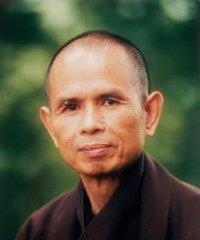
Monk

Filter quotes by topic

Famous Nhat Hanh Quotes

“Sometimes you have a flash of insight, but it's not strong enough to survive. Therefore in the practice of Buddhism, samadhi is the power to maintain insight alive in every moment, so that every speech, every word, every act will bear the nature of that insight. It is a question of cleaning. And you clean better if you are surrounded by those who are practicing exactly the same.”

“If I am incapable of washing dishes joyfully, if I want to finish them quickly so I can go and have dessert, I will be equally incapable of enjoying my dessert. With the fork in my hand, I will be thinking about what to do next, and the texture and flavor of the dessert, together with the pleasure of eating it, will be lost. I will always be dragged into the future, never able to live in the present moment.”

“We should be able to bring the practice of meditation hall into our daily lives. We need to discuss among ourselves how to do it. Do you practice breathing between phone calls? Do you practice smiling while cutting carrots? Do you practice relaxation after hard hours of work? These are practical questions. If you know how to apply meditation to dinner time, leisure time, sleeping time, it will penetrate your daily life, and it will also have a tremendous effect on social concerns.”

“We are often sad and suffer a lot when things change, but change and impermanence have a positive side. Thanks to impermanence, everything is possible. Life itself is possible... If your daughter is not impermanent, she cannot grow up to become a woman. Then your grandchildren would never manifest.”

“Inside every one of us is a garden, and every practitioner has to go back to their garden and take care of it. Maybe in the past, you left in untended for a long time. You should know exactly what is going on in your own garden, and try to put everything in order. Restore the beauty; restore the harmony in your garden. If it is well tended, many people will enjoy your garden.”

“Mindful consumption is the object of this precept. We are what we consume. If we look deeply into the items that we consume every day, we will come to know our own nature very well. We have to eat, drink, consume, but if we do it unmindfully, we may destroy our bodies and our consciousness, showing ingratitude toward our ancestors, our parents, and future generations.”

“No one can practice the precepts perfectly, including the Buddha... Boiled vegetables contain dead bacteria. We cannot practice the First Precept or any of the precepts perfectly. But because of the real danger in our society-alcoholism has destroyed so many families and has brought about much unhappiness-we have to do something. We have to live in a way that will eradicate that kind of damage. That is why even if you can be very healthy with one glass of wine every week, I still urge you with all my strength to abandon that glass of wine.”

“Recently, one friend asked me, "How can I force myself to smile when I am filled with sorrow? It isn't natural." I told her she must be able to smile to her sorrow, because we are more than our sorrow. A human being is like a television set with millions of channels. If we turn the Buddha on, we are the Buddha. If we turn sorrow on then we are sorrow. If we turn a smile on, we really are the smile. We can not let just one channel dominate us. We have the seed of everything in us, and we have to seize the situation in our hand, to recover our own sovereignty.”

“Leaves are usually looked upon as the children of the tree. Yes, they are children of the tree, born from the tree, but they are also mothers of the tree. The leaves combine raw sap, water, and minerals, with sunshine and gas, and convert it into a variegated sap that can nourish the tree. In this way, the leaves become the mother of the tree. We are all children of society, but we are also mothers. We have to nourish society. If we are uprooted from society, we can not trasform it into a more liveable place for us and our children.”

“I do many kinds of work, and if you forbid me from binding books, from gardening, from writing poetry, from practicing walking meditation, from teaching children, I will be very unhappy. To me, work is pleasant. Pleasant or unpleaseant depends on our way of looking.”

“It is often said that the Buddha's teaching is only a raft to help you cross the river, a finger pointing to the moon. Don't maistake the finger for the moon. The raft is not the shore. If we cling to the raft, if we cling to the finger, we miss everything. We cannot, in the name of the finger or the raft kill each other. Human life is more precious than any ideology, any doctrine.”

“A flower is not a flower. It is made only of non-flower elements - sunshine, clouds, time, space, earth, minerals, gardeners, and so on. A true flower contains the whole universe. If we return any one of these non-flower elements to its source, there will be no flower.”

“You need the practice of mindfulness to bring your mind back to the body and establish yourself in the moment. If you are fully present, you need only make a step or take a breath in order to enter the kingdom of God. And once you have the kingdom, you don't need to run after objects of your craving, like power, fame, sensual pleasure, and so on. Peace is possible. Happiness is possible.”

“Deep listening is the kind of listening that can help relieve the suffering of another person. You can call it compassionate listening. You listen with only one purpose: to help him or her to empty his heart. Even if he says things that are full of wrong perceptions, full of bitterness, you are still capable of continuing to listen with compassion. Because you know that listening like that, you give that person a chance to suffer less.”

“When we come to the table, we shouldn't negotiate right away. We should spend time walking together, eating together, making acquaintance, telling each other about our own suffering, without blame or condemnation. It takes maybe one, two, three weeks to do that. And if communication and understanding are possible, negotiation will be easier. So if I am to organize a peace negotiation, I will organize it in that way.”

“Through my love for you, I want to express my love for the whole cosmos, the whole of humanity, and all beings. By living with you, I want to learn to love everyone and all species. If I succeed in loving you, I will be able to love everyone and all species on Earth... This is the real message of love.”

“Around us, life bursts with miracles--a glass of water, a ray of sunshine, a leaf, a caterpillar, a flower, laughter, raindrops. If you live in awareness, it is easy to see miracles everywhere. Each human being is a multiplicity of miracles. Eyes that see thousands of colors, shapes, and forms; ears that hear a bee flying or a thunderclap; a brain that ponders a speck of dust as easily as the entire cosmos; a heart that beats in rhythm with the heartbeat of all beings. When we are tired and feel discouraged by life's daily struggles, we may not notice these miracles, but they are always there.”

“We who have touched war have a duty to bring the truth about war to those who have not had a direct experience of it. We are the light at the tip of the candle. It is really hot, but it has the power of shining and illuminating. If we practice mindfulness, we will know how to look deeply into the nature of war and, with our insight, wake people up so that together we can avoid repeating the same horrors again and again.”