Quotessence
Home / Authors / Ralph Waldo Emerson
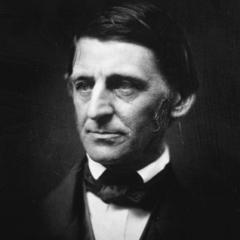
Ralph Waldo Emerson

Ralph Waldo Emerson Quotes

Essayist

Filter quotes by topic

Famous Ralph Waldo Emerson Quotes

“I am at a loss to understand why people hold Miss Austen's novels at so high a rate, which seem to me vulgar in tone, sterile in artistic invention, imprisoned in their wretched conventions of English society, without genius, wit, or knowledge of the world. Never was life so pinched and narrow. ... All that interests in any character [is this]: has he (or she) the money to marry with? ... Suicide is more respectable.”

“These are the voices which we hear in solitude, but they grow faint and inaudible as we enter into the world. Society everywhere is in conspiracy against the manhood of everyone of its members. Society is a joint-stock company, in which the members agree, for the better securing of his bread to each shareholder, to surrender the liberty and culture of the eater. The virtue in most request is conformity. Self-reliance is its aversion. It loves not realities and creators, but names and customs.”

“Wherever snow falls, or water flows, or birds fly, wherever day and night meet in twilight, wherever the blue heaven is hung by clouds, or sown with stars, wherever are forms with transparent boundaries, wherever are outlets into celestial space, wherever is danger, and awe, and love, there is Beauty, plenteous as rain, shed for thee, and though thou shouldest walk the world over, thou shalt not be able to find a condition inopportune or ignoble.”

“We dress our garden, eat our dinners, discuss the household with our wives, and these things make no impression, are forgotten next week; but in the solitude to which every man is always returning, he has a sanity and revelations, which in his passage into new worlds he will carry with him. Never mind the ridicule, never mind the defeat: up again, old heart! — it seems to say, — there is victory yet for all justice; and the true romance which the world exists to realize, will be the transformation of genius into practical power.”

“Every spirit builds itself a house; and beyond its house a world; and beyond its world, a heaven. Know then, that the world exists for you. For you is the phenomenon perfect. What we are, that only can we see. All that Adam had, all that Caesar could, you have and can do. Adam called his house, heaven and earth; Caesar called his house, Rome; you perhaps call yours, a cobler's trade; a hundred acres of ploughed land; or a scholar's garret. Yet line for line and point for point, your dominion is as great as theirs, though without fine names. Build, therefore, your own world.”

“We are all inventors, each sailing out on a voyage of discovery, guided each by a private chart, of which there is no duplicate. The world is all gates, all opportunities.”

“Courage charms us, because it indicates that a man loves an idea better than all things in the world, that he is thinking neither of his bed, nor his dinner, nor his money, but will venture all to put in act the invisible thought of his mind.”

“In like manner the effect of every action is measured by the depth of the sentiment from which it proceeds. The great man knew not that he was great. It took a century or two for that fact to appear. What he did, he did, he did because he must; it was the most natural thing in the world, and grew out of the circumstances of the moment.”

“We live in succession, in division, in parts, in particles. Meantime within man is the soul of the whole; the wise silence; the universal beauty, to which every part and particle is equally related, the eternal ONE. And this deep power in which we exist and whose beatitude is all accessible to us, is not only self-sufficing and perfect in every hour, but the act of seeing and the thing seen, the seer and the spectacle, the subject and the object, are one. We see the world piece by piece, as the sun, the moon, the animal, the tree; but the whole, of which these are shining parts, is the soul.”

“The soul comes from without into the human body, as into a temporary abode, and it goes out of it anew it passes into other habitations, for the soul is immortal." "It is the secret of the world that all things subsist and do not die, but only retire a little from sight and afterwards return again. Nothing is dead; men feign themselves dead, and endure mock funerals... and there they stand looking out of the window, sound and well, in some strange new disguise.”

“Each work of art excludes the world, concentrates attention on itself. For the time it is the only thing worth doing -to do just that; be it a sonnet, a statue, a landscape, an outline head of Caesar, or an oration. Presently we return to the sight of another that globes itself into a whole as did the first, for example, a beautiful garden; and nothing seems worth doing in life but laying out a garden.”

“Man is a shrewd inventor, and is ever taking the hint of a new machine from his own structure, adapting some secret of his own anatomy in iron, wood, and leather, to some required function in the work of the world.”

“The mark of the man of the world is absence of pretension. He does not make a speech; he takes a low business-tone, avoids all brag, is nobody, dresses plainly, promises not at all, performs much, speaks in monosyllables, hugs his fact.”

“We do not yet trust the unknown powers of thought. Whence came all these tools, inventions, book laws, parties, kingdoms? Out of the invisible world, through a few brains. The arts and institutions of men are created out of thought. The powers that make the capitalist are metaphysical, the force of method and force of will makes trade, and builds towns.”