Source: The Works of Samuel Johnson, LL. D.
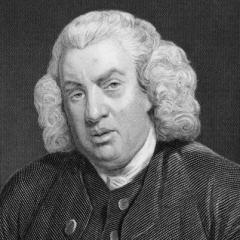
Filter quotes by topic
Famous Samuel Johnson Quotes
Source: The Life of Samuel Johnson
Source: Murphy's essay. The rambler. The adventurer. The idler. Rasselas. Tales of the imagination. Letters. Irene. Miscellaneous poems
Source: The works of Samuel Johnson, LL. D.: with an essay on his life and genius
Source: The life of Samuel Johnson, LL. D., comprehending an account of his studies, and numerous works, in chronological order: a series of his epistolary correspondence and conversations with many eminent persons; and various original pieces of his composition, never before published; the whole exhibiting a view of literature and literary men in Great Britain, for near half a century during which he flourished
“Man's chief merit consists in resisting the impulses of his nature.”
Source: Johnsonian miscellanies
Source: The Works of Samuel Johnson, LL.D.
“No man likes to live under the eye of perpetual disapprobation.”
Source: The life of Samuel Johnson, LL. D., comprehending an account of his studies, and numerous works, in chronological order: a series of his epistolary correspondence and conversations with many eminent persons; and various original pieces of his composition, never before published; the whole exhibiting a view of literature and literary men in Great Britain, for near half a century during which he flourished
“Perhaps man is the only being that can properly be called idle.”
Source: The Rambler (1750-'52) a. the Idler (1758-'60)
Source: The life of Samuel Johnson, LL. D., comprehending an account of his studies, and numerous works, in chronological order: a series of his epistolary correspondence and conversations with many eminent persons; and various original pieces of his composition, never before published; the whole exhibiting a view of literature and literary men in Great Britain, for near half a century during which he flourished
Source: Johnsoniana; or supplement to Boswell; being Anecdotes and sayings of Dr. Johnson, etc
Source: Johnsoniana: Or, Supplement to Boswell: Being Anecdotes and Sayings of Dr. Johnson
Source: The Rambler: A Periodical Paper, Published in 1750, 1751, 1752
“Every man's affairs, however little, are important to himself.”
Source: The life of Samuel Johnson, LL. D., comprehending an account of his studies, and numerous works, in chronological order: a series of his epistolary correspondence and conversations with many eminent persons; and various original pieces of his composition, never before published; the whole exhibiting a view of literature and literary men in Great Britain, for near half a century during which he flourished
“It very seldom happens to a man that his business is his pleasure.”
Source: The beauties of Johnson: choice selections from his works
“Every man wishes to be wise, and they who cannot be wise are almost always cunning.”
Source: Boswell's Life of Johnson: Including Boswell's Journal of a Tour of the Hebrides, and Johnson's Diary of A Journey Into North Wales
Source: The life of Samuel Johnson, LL. D., comprehending an account of his studies, and numerous works, in chronological order: a series of his epistolary correspondence and conversations with many eminent persons; and various original pieces of his composition, never before published; the whole exhibiting a view of literature and literary men in Great Britain, for near half a century during which he flourished
“Pity is not natural to man. Children always are cruel. Savages are always cruel.”
Source: The Idler: With Additional Essays
Source: The Wisdom of the Rambler, Adventurer, and Idler
“A man with a good coat upon his back meets with a better reception than he who has a bad one.”
“Every man has a lurking wish to appear considerable in his native place.”
“Such seems to be the disposition of man, that whatever makes a distinction produces rivalry.”
Source: Journey to the Hebrides: A Journey to the Western Islands of Scotland & The Journal of a Tour to the Hebrides
Source: The Life of Samuel Johnson, LL. D.: Including a Journal of a Tour to the Hebrides
“No man is obliged to do as much as he can do. A man is to have part of his life to himself.”
Source: The life of Samuel Johnson, LL. D., comprehending an account of his studies, and numerous works, in chronological order: a series of his epistolary correspondence and conversations with many eminent persons; and various original pieces of his composition, never before published; the whole exhibiting a view of literature and literary men in Great Britain, for near half a century during which he flourished
Source: The Life of Samuel Johnson
Source: Samuel Johnson: Selected Writings
Source: The life of Samuel Johnson, LL. D., comprehending an account of his studies, and numerous works, in chronological order: a series of his epistolary correspondence and conversations with many eminent persons; and various original pieces of his composition, never before published; the whole exhibiting a view of literature and literary men in Great Britain, for near half a century during which he flourished
Source: The works of Samuel Johnson
Source: Rasselas
“All censure of a man's self is oblique praise. It is in order to show how much he can spare.”
Source: Works: With an Essay on His Life and Genius
“You cannot, by all the lecturing in the world, enable a man to make a shoe.”
Source: The life of Samuel Johnson, LL. D., comprehending an account of his studies, and numerous works, in chronological order: a series of his epistolary correspondence and conversations with many eminent persons; and various original pieces of his composition, never before published; the whole exhibiting a view of literature and literary men in Great Britain, for near half a century during which he flourished
“Every man prefers virtue, when there is not some strong incitement to transgress its precepts.”
Source: The life of Samuel Johnson, LL. D., comprehending an account of his studies, and numerous works, in chronological order: a series of his epistolary correspondence and conversations with many eminent persons; and various original pieces of his composition, never before published; the whole exhibiting a view of literature and literary men in Great Britain, for near half a century during which he flourished
Source: Dr. Johnson's Table Talk: Containing Aphorisms on Literature, Life, and Manners; with Anecdotes of Distinguished Persons, Selected and Arranged from Dr. Boswell's Life of Johnson
Source: Dr. Johnson's Table-talk: Containing Aphorisms on Literature, Life, and Manners, with Anecdotes of Distinguished Persons, Selected and Arranged from Mr. Boswell's Life of Johnson
Source: The life of Samuel Johnson, LL. D., comprehending an account of his studies, and numerous works, in chronological order: a series of his epistolary correspondence and conversations with many eminent persons; and various original pieces of his composition, never before published; the whole exhibiting a view of literature and literary men in Great Britain, for near half a century during which he flourished
Source: The works of Samuel Johnson
Source: Johnson's Lives of the British Poets