Quotessence
Home / Authors / Stefan Zweig Books
Stefan Zweig

Stefan Zweig Books

Novelist

Schachnovelle

A source page for quotes linked to Stefan Zweig.
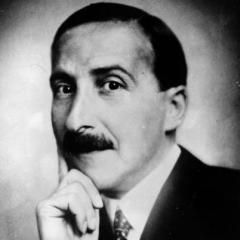
0 quotes

Related Quotes

“And the child—your child—was born there in the midst of misery. It was a deadly place: strange, everything was strange, we women lying there were strange to each other, lonely and hating one another out of misery, the same torment in that crowded ward full of chloroform and blood, screams and groans.”

“The instinct of self-deception in human beings makes them try to banish from their minds dangers of which at the bottom they are perfectly aware by declaring them nonexistent, and a warning such as mine against cheap optimism was bound to prove particularly unwelcome at a moment when a sumptuously laid supper was awaiting for us in the next room.”

“No, no puedo decirle lo espeluznante que me resultó mirar con él esos cien o doscientos pedazos de papel vacíos o reproducciones en mal estado, pero que, en la memoria de ese hombre en su trágica ignorancia, eran tan increíblemente reales que sin error celebraba y describía cada uno de ellos en una sucesión intachable. Aquella colección invisible que hacía tiempo debía de haber sido esparcida a los cuatro vientos, para ese ciego, para esa persona engañada de manera conmovedora, todavía estaba allí, inmutable, y la pasión que mostraba al verla era tan abrumadora que casi comencé a creer en ella.”

“Hábeis e frios calculadores podem vir demonstrar, ainda e sempre, que o sonho do erasmismo é impossível, e os factos poderão parecer dar-lhes razão; isso nao impede que sejam sempre necessários os seres que indicam aos povos aquilo que os aproxima e aquilo que os divide, e que renovam no coração dod homens a crença em mais alta humanidade. Há no legado de Erasmo uma promessa criadora. Aquele que mostra o espírito fora do seu quadro, nas dimensões da Humanidade, dá ao indivíduo uma forma sobre-humana; só as reivindicações ultrapessoais e que parecerem quase irrealizáveis, dão aos homens e aos povos a consciência da sua verdadeira medida.”

“Yalnızca kısa bir süre, bir an için bu acı dizlerimin bağını öyle çözdü ki, nefessiz, cansız ve sanki ölecekmiş gibi bir duyguyla o banka yığılıp kaldım. Ama dediğim gibi bütün acılar korkaktır, yaşama karşı duyulan aşırı arzu karşısında acı geriler; çünkü yaşama arzusu, düşüncelerimizde var olan ölüm arzusundan çok daha güçlü şekilde bedenimizin her zerresinde mevcuttur.”

“He was the kind of young man whose handsome face has brought him plenty of success in the past and is now ever-ready for a new encounter, a fresh-experience, always eager to set off into the unknown territory of a little adventure, never taken by surprise because he has worked out everything in advance and is waiting to see what happens, a man who will never overlook any erotic opportunity, whose first glance probes every woman's sensuality, and explores it, without discriminating between his friend's wife and the parlour-maid who opens the door to him. Such men are described with a certain facile contempt as lady-killers, but the term has a nugget of truthful observation in it, for in fact all the passionate instincts of the chase are present in their ceaseless vigilance: the stalking of the prey, the excitement and mental cruelty of the kill. They are constantly on the alert, always ready and willing to follow the trail of an adventure to the very edge of the abyss. They are full of passion all the time, but it is the passion of a gambler rather than a lover, cold, calculating and dangerous. Some are so persistent that their whole lives, long after their youth is spent, are made an eternal adventure by this expectation. Each of their days is resolved into hundreds of small sensual experiences - a look exchanged in passing, a fleeting smile, knees brushing together as a couple sit opposite each other - and the year, in its own turn, dissolves into hundreds of such days in which sensuous experience is the constantly flowing, nourishing, inspiring source of life.”

“Ai suoi occhi gli esseri umani erano sempre stati come l’aria, di cui non si avverte la presenza, ma adesso che la solitudine le serrava la gola, solo adesso sentiva per la prima volta quanto ne avesse bisogno, comprendeva come fossero importanti, persino quando mentivano, quando ingannavano, capiva che tutto in lei, la sua leggerezza, la sua sicurezza e allegria, dipendeva dalla loro presenza. Per decenni aveva nuotato nelle acque della società, senza sapere che esse la nutrivano e la sorreggevano, mentre ora, come un pesce gettato sulla riva della solitudine, sussultava per la disperazione e nel dolore della rivolta. Da " Storia di una caduta”

“Farklı hisseden, farklı hassasiyetlere sahip ve farkındalığı güçlenmiş başka bir insan haline geldiğimi biliyorum. Daha iyi bir insan olduğumu iddia edecek cesaretim yok elbette, ama daha mutlu bir insan olduğumu biliyorum, çünkü o buz gibi donuk hayatım için yeni bir anlam buldum, yaşamın kendisinden başka bir sözcükle açıklayamayacağım bir anlam. Ait olduğum kesimin normlarını ve kalıplarını boş bulduğum için artık ne kendimden ne de başkalarından utanıyorum. Onur, suç, günah gibi kavramlar bir anda soğuk, metalsi bir tını kazandı, bunları dehşete kapılmadan telaffuz edemiyorum artık.”

“Holding a precious book meant to Mendel what an assignment with a woman might to another man. These moments were his platonic nights of love. Books had power over him; money never did. Great collectors, including the founder of a collection in Princeton University Library, tried in vain to recruit him as an adviser and buyer for their libraries—Jakob Mendel declined; no one could imagine him anywhere but in the Café Gluck. Thirty-three years ago, when his beard was still soft and black and he had ringlets over his forehead, he had come from the east to Vienna, a crook-backed lad, to study for the rabbinate, but he had soon abandoned Jehovah the harsh One God to give himself up to idolatry in the form of the brilliant, thousand-fold polytheism of books. That was when he had first found his way to the Café Gluck, and gradually it became his workplace, his headquarters, his post office, his world. Like an astronomer alone in his observatory, studying myriads of stars every night through the tiny round lens of the telescope, observing their mysterious courses, their wandering multitude as they are extinguished and then appear again, so Jakob Mendel looked through his glasses out from that rectangular table into the other universe of books, also eternally circling and being reborn in that world above our own.”

“A lame creature, a cripple like myself, has no right to love. How should I, broken, shattered being that I am, be anything but a burden to you, when to myself I am an object of disgust, of loathing. A creature such as I, I know, has no right to love, and certainly no right to be loved. It is for such a creature to creep away into a corner and die and cease to make other people's lives a burden with her presence.”

“Después comprendí que esa mirada que atrae, que te envuelve y te desnuda a la vez, esa mirada de seductor consumado, era tu modo de mirar a todas las mujeres que se cruzaban en tu camino, a cualquier vendedora que te atendía, a cualquier criada que te abría la puerta. No eres consciente de la fuerza de esa mirada que tu ternura hacia las mujeres hace parecer más dulce y afectuosa en su insistencia.”

“Voldria poder ser tan útil com vostè; ajudar una sola persona és potser més segur que ajudar aquesta pàtria d'ara i això que en diem humanitat... i, dit sigui de passada, hauríem de retirar-li aquest bonic nom mentre duri la guerra, ja no li escau. —Se la mirà amb posat dubitatiu—. De fet no hauria de parlar així a la filla d'un general, sinó escriure opuscles i articles bèl·lics com els meus senyors col·legues. Però jo tinc una mania: la guerra és un crim i una bestiesa. No voldria influenciar-la, a vostè. D'altra banda, tinc la impressió que m'arrisco parlant així. Potser estic contaminat perquè acabo de venir de cals «enemics», d'Anglaterra. Potser ja no veig les coses clares. Potser n'hi ha d'altres que també tenen un fill. Un serbi, un rus. Però ara només es pot veure i s'ha de veure les coses com les veu ella, la guerra. Jo no ho puc canviar després de trenta anys; per a mi no hi ha ronyons francesos, russos o austríacs, i no es pot distingir els enemics a partir de les partícules sanguínies; només puc ser allà on hi ha un malalt i puc ajudar. No és pas la humanitat victoriosa la que necessita el metge, sinó la malalta. No puc ni vull acceptar una altra cosa. Mentre jo m'he escarrassat tota la vida a ajudar els individus, ells celebren, en els seus comunicats militars, haver anihilat totalment sis divisions. És pràctic, i recomanable, readaptar-se, però estic massa cansat per a ser pràctic d'aquesta manera.”

“the outcasts, the branded, the ugly, the withered, the deformed, the despised and rejected, desire with a more passionate, far more dangerous avidity than the happy; that they love with a fanatical, a baleful, a black love, and that no passion on earth rears its head so greedily, so desperately, as the forlorn and hopeless passion of these step-chlidren of God, who feel that they can only justify their earthly existence by loving and being loved.”