Quotessence
Home / Authors / Oscar Wilde
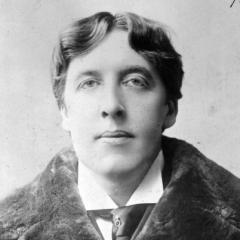
Oscar Wilde

Oscar Wilde Quotes

Writer

Filter quotes by topic

Famous Oscar Wilde Quotes

“Prosperity, pleasure and success, may be rough of grain and common in fibre, but sorrow is the most sensitive of all created things. There is nothing that stirs in the whole world of thought to which sorrow does not vibrate in terrible and exquisite pulsation. The thin beaten-out leaf of tremulous gold that chronicles the direction of forces the eye cannot see is in comparison coarse. It is a wound that bleeds when any hand but that of love touches it, and even then must bleed again, though not in pain.”

“A man can be happy with any woman, as long as he does not love her.”

“All women become like their mothers. That is their tragedy. No man does. That's his.”

“For a year after that was done to me I wept every day at the same hour and for the same space of time. That is not such a tragic thing as possibly it sounds to you. To those who are in prison tears are a part of every day's experience. A day in prison on which one does not weep is a day on which one's heart is hard, not a day on which one's heart is happy.”

“A map of the world that does not include Utopia is not worth even glancing at, for it leaves out the one country at which Humanity is always landing. And when Humanity lands there, it looks out, and, seeing a better country, sets sail. Progress is the realisation of Utopias.”

“Things are because we see them, and what we see, and how we see it, depends on the Arts that influenced us. To look at a thing is very different from seeing a thing. One does not see anything until one sees its beauty. Then, and then only, does it comes into existence.”

“Yet each man kills the thing he loves, By each let this be heard, Some do it with a bitter look, Some with a flattering word, The coward does it with a kiss, The brave man with a sword! Some kill their love when they are young, And some when they are old; Some strangle with the hands of Lust, Some with the hands of Gold: The kindest use a knife, because The dead so soon grow cold. Some love too little, some too long, Some sell, and others buy; Some do the deed with many tears, And some without a sigh: For each man kills the thing he loves, Yet each man does not die.”

“There is no such thing as a good influence. Because to influence a person is to give him one's own soul. He does not think his natural thoughts, or burn with his natural passions. His virtures are not real to him. His sins, if there are such thing as sins, are borrowed. He becomes an echo of someone else's music, an actor of a part that has not been written for him.”

“The world has become sad because a puppet was once melancholy. The nihilist, that strange martyr who has no faith, who goes to the stake without enthusiasm, and dies for what he does not believe in, is a purely literary product. He was invented by Turgenev, and completed by Dostoevsky. Robespierre came out of the pages of Rousseau as surely as the People's Palace rose out debris of a novel. Literature always anticipates life. It does not copy it, but moulds it to its purpose.”

“Jack? . . . No, there is very little music in the name Jack, if any at all, indeed. It does not thrill. It produces absolutely no vibrations . . . I have known several Jacks, and they all, without exception, were more than usually plain. Besides, Jack is a notorious domesticity for John! And I pity any woman who is married to a man called John. She would probably never be allowed to know the entrancing pleasure of a single moment’s solitude. The only really safe name is Ernest.”

“Love does not traffic in a marketplace, nor use a huckster's scales. Its joy, like the joy of the intellect, is to feel itself alive. The aim of Love is to love: no more, and no less. You were my enemy: such an enemy as no man ever had. I had given you all my life, and to gratify the lowest and most contemptible of all human passions, hatred and vanity and greed, you had thrown it away. In less than three years you had entirely ruined me in every point of view. For my own sake there was nothing for me to do but to love you.”

“I am jealous of everything whose beauty does not die. I am jealous of the portrait you have painted of me. Why should it keep what I must lose? Every moment that passes takes something from me and gives something to it. Oh, if it were only the other way! If the picture could change, and I could be always what I am now! Why did you paint it? It will mock me some day—mock me horribly!”

“What a silly thing love is!' said the student as he walked away. 'It is not half as useful as logic, for it does not prove anything, and it is always telling one of things that are not going to happen, and making one believe things that are not true. In fact, it is quite unpractical, and, as in this age to be practical is everything, I shall go back to philosophy and study metaphysics.' So he returned to his room and pulled out a great dusty book, and began to read.”

“God knows; I won't be an Oxford don anyhow. I'll be a poet, a writer, a dramatist. Somehow or other I'll be famous, and if not famous, I'll be notorious. Or perhaps I'll lead the life of pleasure for a time and then—who knows?—rest and do nothing. What does Plato say is the highest end that man can attain here below? To sit down and contemplate the good. Perhaps that will be the end of me too.”

“Alone, and without any reference to his neighbours, without any interference, the artist can fashion a beautiful thing; and if he does not do it solely for his own pleasure, he is not an artist at all.”

“Romance lives by repetition, and repetition converts an appetite into an art. Besides, each time that one loves is the only time one has ever loved. Difference of object does not alter singleness of passion. It merely intensifies it. We can have in life but one great experience at best, and the secret of life is to reproduce that experience as often as possible.”

“Ones real life is often the life that one does not lead.”

“They are always asking a writer why he does not write like somebody else, or a painter why he does not paint like somebody else, quite oblivious of the fact that if either of them did anything of the kind he would cease to be an artist.”