Quotessence
Home / Authors / Plato Books
Plato

Plato Books

Philosopher

Notes

A source page for quotes linked to Plato.
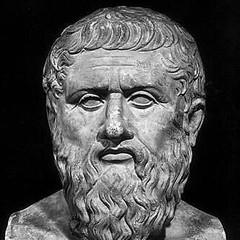
0 quotes

On Socrates

A source page for quotes linked to Plato.

0 quotes

Plato on Love

A source page for quotes linked to Plato.

0 quotes

Republic: ...

A source page for quotes linked to Plato.

0 quotes

The Dialogues

A source page for quotes linked to Plato.

0 quotes

Related Quotes

“...when he looks at Beauty in the only way that Beauty can be seen - only then will it become possible for him to give birth not to images of virtue (because he's in touch with no images), but to true virtue [arete] (because he is in touch with true Beauty). The love of the gods belongs to anyone who has given to true virtue and nourished it, and if any human being could become immortal, it would be he.”

“There is a third form of possession or madness, of which the Muses are the source. This seizes a tender, virgin soul and stimulates it to rapt passionate expression, especially in lyric poetry, glorifying the countless mighty deeds of ancient times for the instruction of posterity. But if any man comes to the gates of poetry without the madness of the Muses, persuaded that skill alone will make him a good poet, then shall he and his works of sanity with him be brought to nought by the poetry of madness, and behold, their place is nowhere to be found.”

“The accumulation of gold in the treasury of private individuals is the ruin of timocracy; they invent illegal modes of expenditure; for what do they or their wives care about the law? Yes, indeed. And then one, seeing another grow rich, seeks to rival him, and thus the great mass of the citizens become lovers of money. Likely enough. And so they grow richer and richer, and the more they think of making a fortune the less they think of virtue; for when riches and virtue are placed together in the scales of the balance, the one always rises as the other falls. True. And in proportion as riches and rich men are honoured in the State, virtue and the virtuous are dishonoured. Clearly. And what is honoured is cultivated, and that which has no honour is neglected.”

“[W]hen men have both done and suffered injustice and have had experience of both, not being able to avoid the one and obtain the other, they think that they had better agree among themselves to have neither; hence there arise laws and mutual covenants; and that which is ordained by law is termed by them lawful and just. This they affirm to be the origin and nature of justice;—it is a mean or compromise, between the best of all, which is to do injustice and not be punished, and the worst of all, which is to suffer injustice without the power of retaliation; and justice, being at a middle point between the two, is tolerated not as a good, but as the lesser evil…”

“Imagine that the keeper of a huge, strong beast notices what makes it angry, what it desires, how it has to be approached and handled, the circumstances and the conditions under which it becomes particularly fierce or calm, what provokes its typical cries, and what tones of voice make it gentle or wild. Once he's spent enough time in the creature's company to acquire all this information, he calls it knowledge, forms it into a systematic branch of expertise, and starts to teach it, despite total ignorance, in fact, about which of the creature's attitudes and desires is commendable or deplorable, good or bad, moral or immoral. His usage of all these terms simply conforms to the great beast's attitudes, and he describes things as good or bad according to its likes and dislikes, and can't justify his usage of the terms any further, but describes as right and good the things which are merely indispensable, since he hasn't realised and can't explain to anyone else how vast a gulf there is between necessity and goodness.”

“if someone got to see the Beautiful itself, absolute, pure, unmixed, not polluted by human flesh or colors or any other great nonsense of mortality, but if he could see the divine Beauty itself in its one form? Do you think it would be a poor life for a human being to look there and to behold it by that which he ought, and to be with it? Or haven't you remembered that in that life alone, when he looks at Beauty in the only way what Beauty can be seen - only then will it become possible for him to give birth no to images of virtue but to true virtue. The love of the gods belongs to anyone who has given birth to true virtue and nourished it, and if any human being could become immortal, it would be he.”

“And when the constitution of the State is completed, the conception of justice is not dismissed, but reappears under the same or different names throughout the work, both as the inner law of the individual soul, and finally as the principle of rewards and punishments of another life. The virtues are based on justice, of which common honesty in buying and selling is the shadow, and justice is based on the idea of good, which is the harmony of the world, and is reflected both in the institutions of states and in motions of the heavenly bodies.”

“And whenever any one informs us that he has found a man who knows all the arts, and all things else that anybody knows, and every single thing with a higher degree of accuracy than any other man –whoever tells us this, I think that we can only imagine him to be a simple creature who is likely to have been deceived by some wizard or actor whom he met, and whom he thought all-knowing, because he himself was unable to analyze the nature of knowledge and ignorance and imitation.”

“[Dialogue between Solon and an Egyptian Priest] In the Egyptian Delta, at the head of which the river Nile divides, there is a certain district which is called the district of Sais [...] To this city came Solon, and was received there with great honour; he asked the priests who were most skilful in such matters, about antiquity, and made the discovery that neither he nor any other Hellene knew anything worth mentioning about the times of old. On one occasion, wishing to draw them on to speak of antiquity, he began to tell about the most ancient things in our part of the world-about Phoroneus, who is called "the first man," and about Niobe; and after the Deluge, of the survival of Deucalion and Pyrrha; and he traced the genealogy of their descendants, and reckoning up the dates, tried to compute how many years ago the events of which he was speaking happened. Thereupon one of the priests, who was of a very great age, said: O Solon, Solon, you Hellenes are never anything but children, and there is not an old man among you. Solon in return asked him what he meant. I mean to say, he replied, that in mind you are all young; there is no old opinion handed down among you by ancient tradition, nor any science which is hoary with age.”

“What about someone who believes in beautiful things but doesn’t believe in the beautiful itself and isn’t able to follow anyone who could lead him to the knowledge of it? Don’t you think he is living in a dream rather than a wakened state? Isn’t this dreaming: whether asleep or awake, to think that a likeness is not a likeness but rather the thing itself that it is like?”