Quotessence
Home / Authors / Bertrand Russell
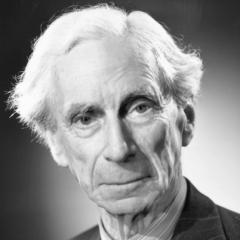
Bertrand Russell

Bertrand Russell Quotes

Philosopher

Filter quotes by topic

Famous Bertrand Russell Quotes

“The first man who said "fire burns" was employing scientific method, at any rate if he had allowed himself to be burnt several times. This man had already passed through the two stages of observation and generalization. He had not, however, what scientific technique demands - a careful choice of significant facts on the one hand, and, on the other hand, various means of arriving at laws otherwise than my mere generalization.”

“[Man] ... his origin, his growth, his hopes and fears, his loves and his beliefs are but the outcome of accidental collocations of atoms; that no fire, no heroism, no intensity of thought and feeling can preserve an individual life beyond the grave; that all the labour of the ages, all the devotion, all the inspiration, all the noonday brightness of human genius are destined to extinction in the vast death of the solar system, and that the whole temple of Man's achievement must inevitably be buried beneath the debris of a universe in ruins.”

“It is a curious and painful fact that almost all the completely futile treatments that have been believed in during the long history of medical folly have been such as caused acute suffering to the patient. When anesthetics were discovered, pious people considered them an attempt to evade the will of God. It was pointed out, however, that when God extracted Adam's rib He put him into a deep sleep. This proved that anesthetics are all right for men; women, however, ought to suffer, because of the curse of Eve.”

“In science the successors stand upon the shoulders of their predecessors; where one man of supreme genius has invented a method, a thousand lesser men can apply it. ... In art nothing worth doing can be done without genius; in science even a very moderate capacity can contribute to a supreme achievement.”

“Science, by itself, cannot supply us with an ethic. It can show us how to achieve a given end, and it may show us that some ends cannot be achieved. But among ends that can be achieved our choice must be decided by other than purely scientific considerations. If a man were to say, "I hate the human race, and I think it would be a good thing if it were exterminated," we could say, "Well, my dear sir, let us begin the process with you." But this is hardly argument, and no amount of science could prove such a man mistaken.”

“In attempting to understand the elements out of which mental phenomena are compounded, it is of the greatest importance to remember that from the protozoa to man there is nowhere a very wide gap either in structure or in behaviour. From this fact it is a highly probable inference that there is also nowhere a very wide mental gap.”

“Although this may seem a paradox, all exact science is dominated by the idea of approximation. When a man tells you that he knows the exact truth about anything, you are safe in inferring that he is an inexact man. Every careful measurement in science is always given with the probable error ... every observer admits that he is likely wrong, and knows about how much wrong he is likely to be.”

“My conclusion is that there is no reason to believe any of the dogmas of traditional theology and, further, that there is no reason to wish that they were true. Man, in so far as he is not subject to natural forces, is free to work out his own destiny. The responsibility is his, and so is the opportunity.”

“Passive acceptance of the teacher's wisdom is easy to most boys and girls. It involves no effort of independent thought, and seems rational because the teacher knows more than his pupils; it is moreover the way to win the favour of the teacher unless he is a very exceptional man. Yet the habit of passive acceptance is a disastrous one in later life. It causes man to seek and to accept a leader, and to accept as a leader whoever is established in that position.”

“To abandon the struggle for private happiness, to expel all eagerness of temporary desire, to burn with passion for eternal things-this is emancipation, and this is the free man's worship... United with his fellow men by the strongest of all ties, the tie of a common doom, the free man finds that a new vision is with him always, shedding over every daily task the light of love.”

“Aristotle, in spite of his reputation, is full of absurdities. He says that children should be conceived in the Winter, when the wind is in the North, and that if people marry too young the children will be female. He tells us that the blood of females is blacker than that of males; that the pig is the only animal liable to measles; that an elephant suffering from insomnia should have its shoulders rubbed with salt, olive-oil, and warm water; that women have fewer teeth than men, and so on. Nevertheless, he is considered by the great majority of philosophers a paragon of wisdom.”

“In regard to the past, where contemplation is not obscured by desire and the need for action, we see, more clearly than in the lives about us, the value for good and evil, of the aims men have pursued and the means they have adopted. It is good, from time to time, to view the present as already past, and to examine what elements it contains that will add to the world's store of permanent possessions, that will live and give life when we and all our generation have perished.”

“William James describes a man who got the experience from laughing-gas; whenever he was under its influence, he knew the secret of the universe, but when he came to, he had forgotten it. At last, with immense effort, he wrote down the secret before the vision had faded. When completely recovered, he rushed to see what he had written. It was 'A smell of petroleum prevails throughout'.”

“Men fear thought as they fear nothing else on earth - more than ruin, more even than death. Thought is subversive and revolutionary, destructive and terrible, thought is merciless to privilege, established institutions, and comfortable habits; thought is anarchic and lawless, indifferent to authority, careless of the well-tried wisdom of the ages. Thought looks into the pit of hell and is not afraid ... Thought is great and swift and free, the light of the world, and the chief glory of man.”

“Ever since men became capable of free speculation, their actions, in innumerable important respects, have depended upon their theories as to the world and human life, as to what is good and what is evil. This is true in the present day as at any former time. To understand an age or a nation, we must understand its philosophy, and to understand its philosophy we must ourselves be in some degree philosophers. There is here a reciprocal causation: the circumstances of men s lives do much to determine their philosophy, but, conversely, their philosophy does much to determine their circumstances.”

“The demand for certainty is one which is natural to man, but is nevertheless an intellectual vice. So long as men are not trained to withhold judgment in the absence of evidence, they will be led astray by cocksure prophets, and it is likely that their leaders will be either ignorant fanatics or dishonest charlatans. To endure uncertainty is difficult, but so are most of the other virtues.”

“He will see himself and life and the world as truly as our human limitations will permit; realizing the brevity and minuteness of human life, he will realize also that in individual minds is concentrated whatever of value the known universe contains. And he will see that the man whose mind mirrors the world becomes in a sense as great as the world. In emancipation from the fears that beset the slave of circumstance he will experience a profound joy, and through all the vicissitudes of his outward life he will remain in the depths of his being a happy man.”

“The whole conception of a God is a conception derived from the ancient oriental despotisms. It is a conception quite unworthy of free men. We ought to stand up and look the world frankly in the face. We ought to make the best we can of the world, and if it is not so good as we wish, after all it will still be better than what these others have made of it in all these ages.”

“Something of the hermit's temper is an essential element in many forms of excellence, since it enables men to resist the lure of popularity, to pursue important work in spite of general indifference or hostility, and arrive at opinions which are opposed to prevalent errors.”

“The first step in a fascist movement is the combination under an energetic leader of a number of men who possess more than the average share of leisure, brutality, and stupidity. The next step is to fascinate fools and muzzle the intelligent, by emotional excitement on the one hand and terrorism on the other.”

“A man who has once perceived, however temporarily and however briefly, what makes greatness of soul, can no longer be happy if he allows himself to be petty, self-seeking, troubled by trivial misfortunes, dreading what fate may have in store for him. The man capable of greatness of soul will open wide the windows of his mind, letting the winds blow freely upon it from every portion of the universe.”

“It will be said that the joy of mental adventure must be rare, that there are few who can appreciate it, and that ordinary education can take no account of so aristocratic a good. I do not believe this. The joy of mental adventure is far commoner in the young than in grown men and women. ...It is rare in later life because everything is done to kill it during education.”