Quotessence
Home / Authors / Carl Rogers Books
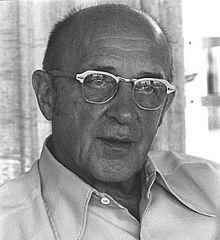
Carl Rogers

Carl Rogers Books

Psychologist

A Way of Being

A source page for quotes linked to Carl Rogers.
0 quotes

Related Quotes

“Hearing has consequences. When I truly hear a person and the meanings that are important to him at that moment, hearing not simply his words, but him, and when I let him know that I have heard his own private personal meanings, many things happen. There is first of all a grateful look. He feels released. He wants to tell me more about his world. He surges forth in a new sense of freedom. He becomes more open to the process of change. I have often noticed that the more deeply I hear the meanings of the person, the more there is that happens. Almost always, when a person realize he has been deeply heard, his eyes moisten. I think in some real sense he is weeping for joy. It is as though he were saying, "Thank God, somebody heard me. Someone knows what it's like to be me.”

“Facilitative attitudes (and skills) can help a therapist gain entry into the group Freedom from a desire to control the outcome, and respect for the capacity of the group, and skills in releasing individual expression Openness to all attitudes no matter how extreme or unrealistic they may seem Acceptance of the problems experienced by the group where they are clearly defined as issues Allowance of the freedom of choices in direction, either for the group or individuals particularly in the near future”

“I think my deepest criticism of the educational system . . . is that it's all based upon a distrust of the student. Don't trust him to follow his own leads; guide him; tell him what to do; tell him what he should think; tell him what he should learn. Consequently at the very age when he should be developing adult characteristics of choice and decision making, when he should be trusted on some of those things, trusted to make mistakes and to learn from those mistakes, he is, instead, regimented and shoved into a curriculum, whether it fits him or not.”

“The genuinely significant creation, whether an idea, or a work of art, or a scientific discovery, is most likely to be seen at first as erroneous, bad, or foolish. Later it may be seen as obvious, something self-evident to all. Only still later does it receive its final evaluation as a creative contribution. It seems clear no contemporary mortal can satisfactorily evaluate a creative product at the time it is formed, and this statement is increasingly true the greater the novelty of the creation.”

“One of the most revolutionary concepts to grow out of our clinical experience is the growing recognition that innermost core of man's nature - the deepest layers of his personality, the base of his 'animal nature' - is basically socialized, forward-moving, rational and realistic... He is realistically able to control himself, and he is incorrigibly socialized in his desires. There is no beast in man, there is only man in man.”

“The action of the child inventing a new game with his playmates; Einstein formulating a theory of relativity; the housewife devising a new sauce for the meat, a young author writing his first novel; all of these are in terms of definition, Creative, and there is no attempt to set them in some order of more or less Creative.”

“The only person who is educated is the one who has learned how to learn and change.”

“In my early professional years I was asking the question: How can I treat, or cure, or change this person? Now I would phrase the question in this way: How can I provide a relationship which this person may use for his own personal growth?”

“I believe that the testing of the student's achievements in order to see if he meets some criterion held by the teacher, is directly contrary to the implications of therapy for significant learning.”

“You know that I don't believe that anyone has ever taught anything to anyone. I question that efficacy of teaching. The only thing that I know is that anyone who wants to learn will learn. And maybe a teacher is a facilitator, a person who puts things down and shows people how exciting and wonderful it is and asks them to eat.”

“The kind of caring that the client-centered therapist desires to achieve is a gullible caring, in which clients are accepted as they say they are, not with a lurking suspicion in the therapist's mind that they may, in fact, be otherwise. This attitude is not stupidity on the therapist's part; it is the kind of attitude that is most likely to lead to trust.”

“If we value independence, if we are disturbed by the growing conformity of knowledge, of values, of attitudes, which our present system induces, then we may wish to set up conditions of learning which make for uniqueness, for self-direction, and for self-initiated learning.”