Quotessence
Home / Authors / George Orwell
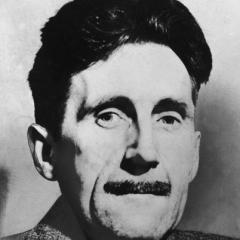
George Orwell

George Orwell Quotes

Novelist

Filter quotes by topic

Famous George Orwell Quotes

“There were times when the fact of impending death seemed as palpable as the bed they lay on, and they would cling together with a sort of despairing sensuality, like a damned soul grasping at his last morsel of pleasure when the clock is within five minutes of striking. But there were also times when they had the illusion not only of safety but of permanence.”

“I had the lonely child's habit of making up stories and holding conversations with imaginary persons, and I think from the very start my literary ambitions were mixed up with the feeling of being isolated and undervalued. I knew that I had a facility with words and a power of facing unpleasant facts, and I felt that this created a sort of private world in which I could get my own back for my failure in everyday life.”

“High sentiments always win in the end. The leaders who offer blood, toil, tears and sweat always get more out of their followers than those who offer safety and a good time. When it comes to the pinch, human beings are heroic.”

“The relative freedom which we enjoy depends of public opinion. The law is no protection. Governments make laws, but whether they are carried out, and how the police behave, depends on the general temper in the country. If large numbers of people are interested in freedom of speech, there will be freedom of speech, even if the law forbids it; if public opinion is sluggish, inconvenient minorities will be persecuted, even if laws exist to protect them.”

“But what is work and what is not work? Is it work to dig, to carpenter, to plant trees, to fell trees, to ride, to fish, to hunt, to feed chickens, to play the piano, to take photographs, to build a house, to cook, to sew, to trim hats, to mend motor bicycles? All of these things are work to somebody, and all of them are play to somebody. There are in fact very few activities which cannot be classed either as work or play according as you choose to regard them.”

“Actions are held to be good or bad, not on their own merits, but according to who does them. There is almost no kind of outrage-torture, imprisonment without trial, assassination, the bombing of civilians-which does not change its moral color when it is committed by 'our' side. The nationalist not only does not disapprove of atrocities committed by his own side, he has a remarkable capacity for not even hearing about them.”

“The process [of mass-media deception] has to be conscious, or it would not be carried out with sufficient precision, but it also has to be unconscious, or it would bring with it a feeling of falsity and hence of guilt.... To tell deliberate lies while genuinely believing in them, to forget any fact that has become inconvenient, and then, when it becomes necessary again, to draw it back from oblivion for just so long as it is needed, to deny the existence of objective reality and all the while to take account of the reality which one denies all this is indispensably necessary.”

“For the ordinary man is passive. Within a narrow circle (home life, and perhaps the trade unions or local politics) he feels himself master of his fate, but against major events he is as helpless as against the elements. So far from endeavoring to influence the future, he simply lies down and lets things happen to him.”

“The child thinks of growing old as an almost obscene calamity, which for some mysterious reason will never happen to itself. All who have passed the age of thirty are joyless grotesques, endlessly fussing about things of no importance and staying alive without, so far as the child can see, having anything to live for. Only child life is real life.”

“The Puritanical nonsense of excluding children and therefore to some extent women from pubs has turned these places into mere boozing shops instead of the family gathering places that they ought to be.”

“To know and not to know, to be conscious of complete truthfulne­ss while telling carefully constructe­d lies, to hold simultaneo­usly two opinions which cancelled out, knowing them to be contradict­ory and believing in both of them, to use logic against logic, to repudiate morality while laying claim to it, to believe that democracy was impossible and that the Party was the guardian of democracy.”

“All that was required of them (i.e. the brain-washed masses) was a primitive patriotism which could be appealed to whenever it was necessary to make them accept longer working hours or shorter rations. And even when they became discontented, as they sometimes did, their discontent led nowhere, because, being without general ideas, they could only focus it on petty specific grievances. The larger evils invariably escaped their notice.”

“The totalitarian states can do great things, but there is one thing they cannot do: they cannot give the factory-worker a rifle and tell him to take it home and keep it in his bedroom. That rifle, hanging on the wall of the working-class flat or laborer's cottage, is the symbol of democracy. It is our job to see that it stays there.”

“Do you begin to see, then, what kind of world we are creating? It is the exact opposite of the stupid hedonistic Utopias that the old reformers imagined. A world of fear and treachery and torment, a world of trampling and being trampled upon, a world which will grow not less but more merciless as it refines itself. Progress in our world will be progress toward more pain.”

“There was of course no way of knowing whether you were being watched at any given moment. How often, or on what system, the Thought Police plugged in on any individual wire was guesswork. It was even conceivable that they watched everybody all the time. But at any rate they could plug in your wire whenever they wanted to. You had to live-did live, from habit that became instinct-in the assumption that every sound you made was overheard, and, except in darkness, every movement scrutinized.”

“The ideal set up by the Party was something huge, terrible, and glittering-a world of steel and concrete, of monstrous machines and terrifying weapons-a nation of warriors and fanatics, marching forward in perfect unity, all thinking the same thoughts and shouting the same slogans, perpetually working, fighting, triumphing, persecuting-three hundred million people all with the same face.”

“A hideous ecstasy of fear and vindictiveness, a desire to kill, to torture, to smash faces in with a sledge hammer, seemed to flow through the whole group of people like an electric current, turning one even against one's will into a grimacing, screaming lunatic. And yet the rage that one felt was an abstract, undirected emotion which could be switched from one object to another like the flame of a blowlamp.”

“The Ministry of Truth, which concerned itself with news, entertainment, education and fine arts. The Ministry of Peace, which concerned itself with war. The Ministry of Love, which maintained law and order. And the Ministry of Plenty, which is responsible for economic affairs. their names, in Newspeak: Minitrue, Minipax, Miniluv and Miniplenty”