Quotessence
Home / Authors / James Madison
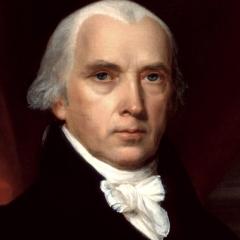
James Madison

James Madison Quotes

4th U.S. President

Filter quotes by topic

Famous James Madison Quotes

“When men exercise their reason coolly and freely, on a variety of distinct questions, they inevitably fall into different opinions, on some of them. When they are governed by a common passion, their opinions if they are so to be called, will be the same.”

“If we resort for a criterion to the different principles on which different forms of government are established, we may define a republic to be, or at least may bestow that name on, a government which derives all its powers directly or indirectly from the great body of the people, and is administered by persons holding their offices during pleasure for a limited period, or during good behavior.”

“A republic, by which I mean a government in which the scheme of representation takes place, opens a different prospect and promises the cure for which we are seeking.”

“The genius of Republican liberty, seems to demand on one side, not only that all power should be derived from the people; but, that those entrusted with it should be kept in dependence on the people, by a short duration of their appointments; and, that, even during this short period, the trust should be placed not in a few, but in a number of hands.”

“It is a misfortune incident to republican government, though in a less degree than to other governments, that those who administer it, may forget their obligations to their constituents, and prove unfaithful to their important trust.”

“The first question that offers itself is, whether the general form and aspect of the government be strictly republican? It is evident that no other form would be reconcileable with the genius of the people of America; with the fundamental principles of the revolution; or with that honourable determination which animates every votary of freedom, to rest all our political experiments on the capacity of mankind for self-government.”

“What is to be the consequence, in case the Congress shall misconstrue this part [the necessary and proper clause] of the Constitution and exercise powers not warranted by its true meaning, I answer the same as if they should misconstrue or enlarge any other power vested in them . . . the success of the usurpation will depend on the executive and judiciary departments, which are to expound and give effect to the legislative acts; and in a last resort a remedy must be obtained from the people, who can by the elections of more faithful representatives, annul the acts of the usurpers.”

“Nothing has yet been offered to invalidate the doctrine that the meaning of the Constitution may as well be ascertained by the Legislative as by the Judicial authority.”

“I acknowledge, in the ordinary course of government, that the exposition of the laws and Constitution devolves upon the judicial. But I beg to know upon what principle it can be contended that any one department draws from the Constitution greater powers than another in marking out the limits of the powers of the several departments.”

“[I]n the next place, to show that unless these departments be so far connected and blended as to give to each a constitutional control over the others, the degree of separation which the maxim requires, as essential to a free government, can never in practice be duly maintained.”

“To what expedient then shall we finally resort, for maintaining in practice the necessary partition of power among the several departments, as laid down in the constitution? The only answer that can be given is, that as all these exterior provisions are found to be inadequate, the defect must be supplied, by so contriving the interior structure of the government, as that its several constituent parts may, by their mutual relations, be the means of keeping each other in their proper places.”

“As the war was just in its origin and necessary and noble in its objects, we can reflect with a proud satisfaction that in carrying it on no principle of justice or honor, no usage of civilized nations, no precept of courtesy or humanity, have been infringed.”

“The danger of silent accumulations & encroachments by Ecclesiastical Bodies have not sufficiently engaged attention in the U.S. [...] Besides the danger of a direct mixture of Religion & civil Government, there is an evil which ought to be guarded against in the indefinite accumulation of property from the capacity of holding it in perpetuity by ecclesiastical Corporations. [...] The establishment of the chaplainship to Congs. is a palpable violation of equal rights, as well as of Constitutional principles.”

“The powers delegated by the proposed Constitution to the federal government are few and defined. Those which are to remain in the State governments are numerous and indefinite.”

“Besides the advantage of being armed, which the Americans possess over the people of almost every other nation.... Notwithstanding the military establishments in the several kingdoms of Europe, which are carried as far as the public resources will bear, the governments are afraid to trust the people with arms.”

“It is not certain that with this aid alone [possession of arms], they would not be able to shake off their yokes. But were the people to posses the additional advantages of local governments chosen by themselves, who could collect the national will, and direct the national force; and of officers appointed out of the militia, by these governments and attached both to them and to the militia, it may be affirmed with the greatest assurance, that the throne of every tyranny in Europe would be speedily overturned, in spite of the legions which surround it.”

“The government of the United States is a definite government, confined to specified objects. It is not like the state governments, whose powers are more general. Charity is no part of the legislative duty of the government.”

“Place three individuals in a situation wherein the interest of each depends on the voice of the others, and give to two of them an interest opposed to the rights of the third. Will the latter be secure? The prudence of every man would shun the danger. The rules & forms of justice suppose & guard against it. Will two thousand in a like situation be less likely to encroach on the rights of one thousand?”

“Because we hold it for 'a fundamental and undeniable truth', that religion or 'the duty which we owe to our Creator' and the manner of discharging it, can be directed only by reason and conviction, not by force or violence.”

“Before any man can be considered as a member of Civil Society, he must be considered as a subject of the Governour of the Universe: And if a member of Civil Society, do it with a saving of his allegiance to the Universal Sovereign. We maintain therefore that in matters of Religion, no man's right is abridged by the institution of Civil Society and that Religion is wholly exempt from its cognizance.”

“Enlightened statesmen will not always be at the helm.”

“Justice is the end of government. It is the end of civil society. It ever has been and ever will be pursued until it be obtained, or until liberty be lost in the pursuit.”

“The Constitution expressly and exclusively vests in the Legislature the power of declaring a state of war [and] the power of raising armies.... A delegation of such powers [to the President] would have struck, not only at the fabric of our Constitution, but at the foundation of all well organized and well checked governments. The separation of the power of declaring war from that of conducting it, is wisely contrived to exclude the danger of its being declared for the sake of its being conducted.”

“I consider it…as subverting the fundamental and characteristic principle of the Government…and as bidding defiance to the sense in which the Constitution is known to have been proposed, advocated, and adopted. If Congress can do whatever in their discretion can be done by money, and will promote the General Welfare, the Government is no longer a limited one.”

“I do not conceive that power is given to the President and Senate to dismember the empire, or to alienate any great, essential right. I do not think the whole legislative authority have this power. The exercise of the power must be consistent with the object of the delegation.”

“The great objects which presented themselves [to the Constitutional Convention] ... formed a task more difficult than can be well conceived by those who were not concerned in the execution of it. Adding to these considerations the natural diversity of human opinions on all new and complicated subjects, it is impossible to consider the degree of concord which ultimately prevailed as less than a miracle.”

“The management of foreign relations appears to be the most susceptible of abuse of all the trusts committed to a Government, because they can be concealed or disclosed, or disclosed in such parts and at such times as will best suit particular views; and because the body of the people are less capable of judging, and are more under the influence of prejudices, on that branch of their affairs, than of any other. Perhaps it is a universal truth that the loss of liberty at home is to be charged to provisions against danger, real or pretended, from abroad.”

“The real wonder is that so many difficulties should have been surmounted [in the federal convention], and surmounted with a unanimity almost as unprecedented as it must have been unexpected. It is impossible for any man of candor to reflect on this circumstance without partaking of the astonishment. It is impossible for the man of pious reflection not to perceive in it a finger of that Almighty hand which has been so frequently and signally extended to our relief in the critical stages of the revolution.”