Quotessence
Home / Authors / Jurgen Habermas Books
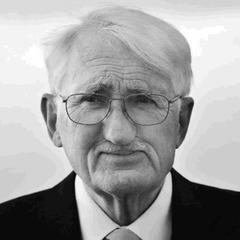
Jurgen Habermas

Jurgen Habermas Books

Philosopher

No books found for this author.

Related Quotes

“Subjects who reciprocally recognize each other as such, must consider each other as identical, insofar as they both take up the position of subject; they must at all times subsume themselves and the other under the same category. At the same time, the relation of reciprocity of recognition demands the non-identity of one and the other, both must also maintain their absolute difference, for to be a subject implies the claim of individuation.”

“Norms appearing in the form of law entitle actors to exercise their rights or liberties. However, one cannot determine which of these laws are legitimate simply by looking at the form of individual rights. Only by bringing in the discourse principle can one show that each person is owed a right to the greatest possible measure of equal liberties that are mutually compatible.”

“Technically speaking, since our complex societies are highly susceptible to interferences and accidents,they certainly offer ideal opportunities for a prompt disruption of normal activities. These disruptions can, with minimum expense, have considerably destructive consequences. Global terrorism is extreme both in its lack of realistic goals and in its cynical exploitation of the vulnerability of complex systems.”

“The usage of the words "public" and "public sphere" betrays a multiplicity of concurrent meanings. Their origins go back to various historical phases and, when applied synchronically to the conditions of a bourgeois society that is industrially advanced and constituted as a social-welfare state, they fuse into a clouded amalgam. Yet the very conditions that make the inherited language seem inappropriate appear to require these words, however confused their employment.”

“The bourgeois public sphere may be conceived above all as the sphere of private people come together as a public; they soon claimed the public sphere regulated from above against the public authorities themselves, to engage them in a debate over the general rules governing relations in the basically privatized but publicly relevant sphere of commodity exchange and social labor.”

“Although objectively greater demands are placed on this authority, it operates less as a public opinion giving a rational foundation to the exercise of political and social authority, the more it is generated for the purpose of an abstract vote that amounts to no more than an act of acclamation within a public sphere temporarily manufactured for show or manipulation.”

“As medium for reaching understanding, speech acts serve: a) to establish and renew interpersonal relations, whereby the speaker takes up a relation to something in the world of legitimate social orders; b) to represent states and events, whereby the speaker takes up a relation to something in the world of existing states of affairs; c) to manifest experiences that is, to represent oneself- whereby the speaker takes up a relation to something in the subjective world to which he has privileged access.”