Quotessence
Home / Authors / Ludwig von Mises
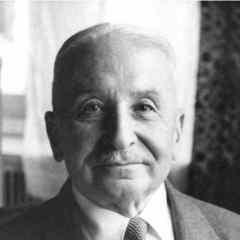
Ludwig von Mises

Ludwig von Mises Quotes

Philosopher

Filter quotes by topic

Famous Ludwig von Mises Quotes

“Granted, many of them replied, that socialism may not result in riches for all but rather in a smaller production of wealth; nevertheless the masses will be happier under socialism, because they will share their worries with all their fellow citizens, and there will not be wealthier classes to be envied by poorer ones. The starving and ragged workers of Soviet Russia, they tell us, are a thousand times more joyful than the workers of the West who live under conditions which are luxurious compared to Russian standards; equality in poverty is a more satisfactory state than well-being where there are people who can flaunt more luxuries than the average man.”

“The worship of the state is the worship of force. There is no more dangerous menace to civilization than a government of incompetent, corrupt, or vile men. The worst evils which mankind ever had to endure were inflicted by bad governments. The state can be and has often been in the course of history the main source of mischief and disaster.”

“A man who chooses between drinking a glass of milk and a glass of a solution of potassium cyanide does not choose between two beverages; he chooses between life and death. A society that chooses between capitalism and socialism does not choose between two social systems; it chooses between social cooperation and the disintegration of society. Socialism is not an alternative to capitalism; it is an alternative to any system under which men can live as human beings.”

“Rhetorical bombast, music and song resound, banners wave, flowers and colors serve as symbols, and the leaders seek to attach their followers to their own person. Liberalism has nothing to do with all this. It has no party flower and no party color, no party song and no party idols, no symbols and no slogans. It has the substance and the arguments. These must lead it to victory.”

“What ranks above all else for economic and political reconstruction is a radical change of ideologies. Economic prosperity is not so much a material problem; it is, first of all, an intellectual, spiritual, and moral problem.”

“All Nazi champions insist again and again that Marxism and Bolshevism are the quintessence of the Jewish mind, and that it is the great historic mission of Nazism to root out this pest. It is true that this attitude did not prevent the German nationalists either from coöperating with the German communists in undermining the Weimar Republic, or from training their black guards in Russian artillery and aviation camps in the years 1923–1933, or— in the period from August, 1939, until June, 1941—from entering into a close political and military complicity with Soviet Russia. Nevertheless, public opinion supports the view that Nazism and Bolshevism are philosophies—Weltanschauungen—implacably opposed to each other.”

“Perhaps the grumbler will object on the ground that he considers p a vital commodity, much more important than q, and that therefore the production of p should be expanded and that of q restricted. If this is really the meaning of his criticism, he is at variance with the valuations of the consumers. He throws off his mask and shows his dictatorial aspirations. Production should not be directed by the wishes of the public but by his own despotic discretion.”

“Spiritual movements are revolts of thought against inertia, of the few against the many; of those who because they are strong in spirit are strongest alone against those who can express themselves only in the mass and the mob, and who are significant only because they are numerous.”

“Socialism is not in the least what it pretends to be. It is not the pioneer of a better and finer world, but the spoiler of what thousands of years of civilization have created. It does not build, it destroys. For destruction is the essence of it. It produces nothing, it only consumes what the social order based on private ownership in the means of production has created.”

“Inflationism, however, is not an isolated phenomenon. It is only one piece in the total framework of politico-economic and socio-philosophical ideas of our time. Just as the sound money policy of gold standard advocates went hand in hand with liberalism, free trade, capitalism and peace, so is inflationism part and parcel of imperialism, militarism, protectionism, statism and socialism.”

“It is certain that many intellectuals envy the higher income of prosperous businessmen and that these feelings drive them toward socialism. They believe that the authorities of a socialist commonwealth would pay them higher salaries than those that they earn under capitalism.”

“The idea of Socialism is at once grandiose and simple. . .We may say, in fact, that it is one of the most ambitious creations of the human spirit, . . .so magnificent, so daring, that it has rightly aroused the greatest admiration. If we wish to save the world from barbarism we have to refute Socialism, but we cannot thrust it carelessly aside.”

“Capitalism and socialism are two distinct patterns of social organization. Private control of the means of production and public control are contradictory notions and not merely contrary notions. There is no such thing as a mixed economy, a system that would stand midway between capitalism and socialism.”

“Capitalism means free enterprise, sovereignty of the consumers in economic matters, and sovereignty of the voters in political matters. Socialism means full government control of every sphere of the individuals life and the unrestricted supremacy of the government in its capacity as central board of production management.”

“A society that chooses between capitalism and socialism does not choose between two social systems; it chooses between social cooperation and the disintegration of society. Socialism is not an alternative to capitalism; it is an alternative to any system under which men can live as human beings.”

“The desire for an increase of wealth can be satisfied through exchange, which is the only method possible in a capitalist economy, or by violence and petition as in a militarist society, where the strong acquire by force, the weak by petitioning.”

“Liberalism and capitalism address themselves to the cool, well-balanced mind. They proceed by strict logic, eliminating any appeal to the emotions. Socialism, on the contrary, works on the emotions, tries to violate logical considerations by rousing a sense of personal interest and to stifle the voice of reason by awakening primitive instincts.”

“The salesman thanks the customer for patronizing his shop and asks him to come again. But the socialists say: Be grateful to Hitler, render thanks to Stalin; be nice and submissive, then the great man will be kind to you later too.”

“There is simply no other choice than this: either to abstain from interference in the free play of the market, or to delegate the entire management of production and distribution to the government. Either capitalism or socialism: there exists no middle way.”

“The main characteristic of collectivism is that it does not take notice of the individual's will and moral self-determination. In the light of its philosophy the individual is born into a collective and it is "natural" and proper for him to behave as members of this collective are expected to behave. Expected by whom? Of course, by those individuals to whom, by the mysterious decrees of some mysterious agency, the task of determining the collective will and directing the actions of the collective has been entrusted.”

“The main propoganda trick of supporters of the allegedly "progressive" policy of government control is to blame capitalism for all that is unsatisfactory in present-day conditions and to extol the blessings of socialism. They have never attempted to prove their fallacious dogmas, all they did was to call their adversaries names and cast suspicion upon their motives. And, unfortunately, the average citizen cannot see through these stratagems. The liars must be afraid of the truth and are therefore driven to suppress its pronouncement.”