Quotessence
Home / Authors / Ludwig von Mises Books
Ludwig von Mises

Ludwig von Mises Books

Philosopher

Human Action

A source page for quotes linked to Ludwig von Mises.
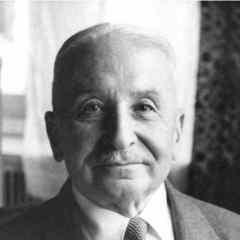
0 quotes

Bureaucracy

A source page for quotes linked to Ludwig von Mises.

0 quotes

Planned Chaos

A source page for quotes linked to Ludwig von Mises.

0 quotes

Profit and Loss

A source page for quotes linked to Ludwig von Mises.

0 quotes

Related Quotes

“Society has arisen out of the works of peace; the essence of society is peacemaking. Peace and not war is the father of all things. Only economic action has created the wealth around us; labor, not the profession of arms, brings happiness. Peace builds, war destroys.”

“Up to now in the West none of the apostles of stabilization and petrification has succeeded in wiping out the individuals' innate disposition to think and to apply to all problems the yardstick of reason. This alone, and no more, history and philosophy can assert in dealing with doctrines that claim to know exactly what the future has in store for mankind.”

“Granted, many of them replied, that socialism may not result in riches for all but rather in a smaller production of wealth; nevertheless the masses will be happier under socialism, because they will share their worries with all their fellow citizens, and there will not be wealthier classes to be envied by poorer ones. The starving and ragged workers of Soviet Russia, they tell us, are a thousand times more joyful than the workers of the West who live under conditions which are luxurious compared to Russian standards; equality in poverty is a more satisfactory state than well-being where there are people who can flaunt more luxuries than the average man.”

“The worship of the state is the worship of force. There is no more dangerous menace to civilization than a government of incompetent, corrupt, or vile men. The worst evils which mankind ever had to endure were inflicted by bad governments. The state can be and has often been in the course of history the main source of mischief and disaster.”

“A man who chooses between drinking a glass of milk and a glass of a solution of potassium cyanide does not choose between two beverages; he chooses between life and death. A society that chooses between capitalism and socialism does not choose between two social systems; it chooses between social cooperation and the disintegration of society. Socialism is not an alternative to capitalism; it is an alternative to any system under which men can live as human beings.”

“Rhetorical bombast, music and song resound, banners wave, flowers and colors serve as symbols, and the leaders seek to attach their followers to their own person. Liberalism has nothing to do with all this. It has no party flower and no party color, no party song and no party idols, no symbols and no slogans. It has the substance and the arguments. These must lead it to victory.”

“What ranks above all else for economic and political reconstruction is a radical change of ideologies. Economic prosperity is not so much a material problem; it is, first of all, an intellectual, spiritual, and moral problem.”

“It opens the mind toward an understanding of human nature and destiny. It increases wisdom. It is the very essence of that much misinterpreted concept, a liberal education. It is the foremost approach to humanism, the lore of the specifically human concerns that distinguish man from other living beings. . . . Personal culture is more than mere familiarity with the present state of science, technology, and civic affairs. It is more than acquaintance with books and paintings and the experience of travel and of visits to museums. It is the assimilation of the ideas that roused mankind from the inert routine of a merely animal existence to a life of reasoning and speculating. It is the individual’s effort to humanize himself by partaking in the tradition of all the best that earlier generations have bequeathed.”

“A government always finds itself obliged to resort to inflationary measures when it cannot negotiate loans and dare not levy taxes, because it has reason to fear that it will forfeit approval of the policy it is following if it reveals too soon the financial and general economic consequences of that policy. Thus inflation becomes the most important psychological resource of any economic policy whose consequences have to be concealed; and so in this sense it can be called an instrument of unpopular, i.e. of anti-democratic, policy, since by misleading public opinion it makes possible the continued existence of a system of government that would have no hope of the consent of the people if the circumstances were clearly laid before them. That is the political function of inflation. It explains why inflation has always been an important resource of policies of war and revolution and why we also find it in the service of socialism.”

“Since its appearance the view that prostitution is a product of capitalism has gained ground enormously. And as, in addition, preachers still complain that the good old morals have decayed, and accuse modern culture of having led to loose living, everyone is convinced that all sexual wrongs represent a symptom of decadence peculiar to our age.”

“The political antagonisms of today are not controversies over ultimate questions of philosophy, but opposing answers to the question how a goal that all acknowledge as legitimate can be achieved most quickly and with the least sacrifice. This goal, at which all men aim, is the best possible satisfaction of human wants; it is prosperity and abundance. Of course, this is not all that men aspire to, but it is all that they can expect to attain by resort to external means and by way of social cooperation. The inner blessings—happiness, peace of mind, exaltation—must be sought by each man within himself alone. Liberalism is no religion, no world view, no party of special interests. It is no religion because it demands neither faith nor devotion, because there is nothing mystical about it, and because it has no dogmas. It is no world view because it does not try to explain the cosmos and because it says nothing and does not seek to say anything about the meaning and purpose of human existence. It is no party of special interests because it does not provide or seek to provide any special advantage whatsoever to any individual or any group. It is something entirely different. It is an ideology, a doctrine of the mutual relationship among the members of society and, at the same time, the application of this doctrine to the conduct of men in actual society. It promises nothing that exceeds what can be accomplished in society and through society. It seeks to give men only one thing, the peaceful, undisturbed development of material well-being for all, in order thereby to shield them from the external causes of pain and suffering as far as it lies within the power of social institutions to do so at all. To diminish suffering, to increase happiness: that is its aim. No sect and no political party has believed that it could afford to forgo advancing its cause by appealing to men's senses. Rhetorical bombast, music and song resound, banners wave, flowers and colors serve as symbols, and the leaders seek to attach their followers to their own person. Liberalism has nothing to do with all this. It has no party flower and no party color, no party song and no party idols, no symbols and no slogans. It has the substance and the arguments. These must lead it to victory.”

“Used to the conditions of a capitalistic environment, the average American takes it for granted that every year business makes something new and better accessible to him. Looking backward upon the years of his own life, he realizes that many implements that were totally unknown in the days of his youth and many others which at that time could be enjoyed only by a small minority are now standard equipment of almost every household. He is fully confident that this trend will prevail also in the future. He simply calls it the American way of life and does not give serious thought to the question of what made this continuous improvement in the supply of material goods possible.”

“Common man does not speculate about the great problems. With regard to them he relies upon other people's authority, he behaves as "every decent fellow must behave,'' he is like a sheep in the herd. It is precisely this intellectual inertia that characterizes a man as a common man. Yet the common man does choose. He chooses to adopt traditional patterns or patterns adopted by other people because he is convinced that this procedure is best fitted to achieve his own welfare. And he is ready to change his ideology and consequently his mode of action whenever he becomes convinced that this would better serve his own interests.”

“The valuations which result in determination of definite prices are different. Each party attaches a higher value to the good he receives than to that he gives away. The exchange ratio, the price, is not the product of equality of valuation, but on the contrary, the product of a discrepancy in valuation.”

“It is customary to call the point of view of the advocates of the welfare state the “social” point of view as distinguished from the “individualistic” and “selfish” point of view of the champions of the rule of law. In fact, however, the supporters of the welfare state are utterly anti-social and intolerant zealots. For their ideology tacitly implies that the government will exactly execute what they themselves deem right and beneficial. They entirely disregard the possibility that there could arise disagreement with regard to the question of what is right and expedient and what is not. They advocate enlightened despotism, but they are convinced that the enlightened despot will in every detail comply with their own opinion concerning the measures to be adopted. They favour planning, but what they have in mind is exclusively their own plan, not those of other people.”

“All Nazi champions insist again and again that Marxism and Bolshevism are the quintessence of the Jewish mind, and that it is the great historic mission of Nazism to root out this pest. It is true that this attitude did not prevent the German nationalists either from coöperating with the German communists in undermining the Weimar Republic, or from training their black guards in Russian artillery and aviation camps in the years 1923–1933, or— in the period from August, 1939, until June, 1941—from entering into a close political and military complicity with Soviet Russia. Nevertheless, public opinion supports the view that Nazism and Bolshevism are philosophies—Weltanschauungen—implacably opposed to each other.”

“Except for Christianity, the Nazis reject as Jewish everything which stems from Jewish authors. This condemnation includes the writings of those Jews who, like Stahl, Lassalle, Gumplowicz, and Rathenau, have contributed many essential ideas to the system of Nazism. But the Jewish mind is, as the Nazis say, not limited to the Jews and their offspring only. Many “Aryans” have been imbued with Jewish mentality—for instance the poet, writer, and critic Gotthold Ephraim Lessing, the socialist Frederick Engels, the composer Johannes Brahms, the writer Thomas Mann, and the theologian Karl Barth. They too are damned. Then there are whole schools of thought, art, and literature rejected as Jewish. Internationalism and pacifism are Jewish, but so is warmongering. So are liberalism and capitalism, as well as the “spurious” socialism of the Marxians and of the Bolsheviks. The epithets Jewish and Western are applied to the philosophies of Descartes and Hume, to positivism, materialism and empiro-criticism, to the economic theories both of the classics and of modern subjectivism. Atonal music, the Italian opera style, the operetta and the paintings of impressionism are also Jewish. In short, Jewish is what any Nazi dislikes. If one put together everything that various Nazis have stigmatized as Jewish, one would get the impression that our whole civilization has been the achievement only of Jews.”

“There has been much talk about the alleged exploitation of the debtor nations by the creditor nations. But if the concept of exploitation is to be applied to these relations, it is rather an exploitation of the investing by the receiving nations. These loans and investments were not intended as gifts. The loans were made upon solemn stipulation of payment of principal and interest. The investments were made in the expectation that property rights would be respected. With the exception of the bulk of the investments made in the United States, in some of the British dominions, and in some smaller countries, these expectations have been disappointed. Bonds have been defaulted or will be in the next few years. Direct investments have been confiscated or soon will be. The capital-exporting countries can do nothing but wipe off their balances.”

“Perhaps the grumbler will object on the ground that he considers p a vital commodity, much more important than q, and that therefore the production of p should be expanded and that of q restricted. If this is really the meaning of his criticism, he is at variance with the valuations of the consumers. He throws off his mask and shows his dictatorial aspirations. Production should not be directed by the wishes of the public but by his own despotic discretion.”

“When, thirty-five years ago, I tried to give a summary of the ideas and principles of that social philosophy that was once known under the name of liberalism, I did not indulge in the vain hope that my account would prevent the impending catastrophes to which the policies adopted by the European nations were manifestly leading. All I wanted to achieve was to offer to the small minority of thoughtful people an opportunity to learn something about the aims of classical liberalism and its achievements and thus to pave the way for a resurrection of the spirit of freedom after the coming debacle.”

“It is solely bigness in business which makes it possible to supply the masses with all those products the present-day American common man does not want to do without. Luxury goods for the few can be produced in small shops. Luxury goods for the many require big business.”

“Economics is a theoretical science and as such abstains from any judgement of value. It is not its task to tell people what ends they should aim at. It is a science of the means to be applied for attainment of ends chosen, not, to be sure, a science of the choosing of ends. Ultimate decisions, the valuations and the choosing of ends, are beyond the scope of any science. Science never tells a man how he should act; it merely shows how a man must act if he wants to attain definite ends.”