Quotessence
Home / Authors / Milton Friedman
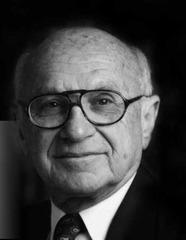
Milton Friedman

Milton Friedman Quotes

Economist

Filter quotes by topic

Famous Milton Friedman Quotes

“Now here's somebody who wants to smoke a marijuana cigarette. If he's caught, he goes to jail. Now is that moral? Is that proper? I think it's absolutely disgraceful that our government, supposed to be our government, should be in the position of converting people who are not harming others into criminals, of destroying their lives, putting them in jail. That's the issue to me. The economic issue comes in only for explaining why it has those effects. But the economic reasons are not the reasons.”

“The great virtue of a free market system is that it does not care what color people are; it does not care what their religion is; it only cares whether they can produce something you want to buy. It is the most effective system we have discovered to enable people who hate one another to deal with one another and help one another.”

“Keynes was a great economist. In every discipline, progress comes from people who make hypotheses, most of which turn out to be wrong, but all of which ultimately point to the right answer. Now Keynes, in 'The General Theory of Employment, Interest and Money,' set forth a hypothesis which was a beautiful one, and it really altered the shape of economics. But it turned out that it was a wrong hypothesis. That doesn't mean that he wasn't a great man!”

“Our minds tell us, and history confirms, that the great threat to freedom is the concentration of power. Government is necessary to preserve our freedom, it is an instrument through which we can exercise our freedom; yet by concentrating power in political hands, it is also a threat to freedom. Even though the men who wield this power initially be of good will and even though they be not corrupted by the power they exercise, the power will both attract and form men of a different stamp.”

“Political freedom means the absence of coercion of a man by his fellow men. The fundamental threat to freedom is power to coerce, be it in the hands of a monarch, a dictator, an oligarchy, or a momentary majority. The preservation of freedom requires the elimination of such concentration of power to the fullest possible extent and the dispersal and distribution of whatever power cannot be eliminated — a system of checks and balances.”

“The key insight of Adam Smith's Wealth of Nations is misleadingly simple: if an exchange between two parties is voluntary, it will not take place unless both believe they will benefit from it. Most economic fallacies derive from the neglect of this simple insight, from the tendency to assume that there is a fixed pie, that one party can gain only at the expense of another.”

“Government has three primary functions. It should provide for military defense of the nation. It should enforce contracts between individuals. It should protect citizens from crimes against themselves or their property. When government-- in pursuit of good intentions tries to rearrange the economy, legislate morality, or help special interests, the cost come in inefficiency, lack of motivation, and loss of freedom. Government should be a referee, not an active player.”

“I do not believe that the solution to our problem is simply to elect the right people. The important thing is to establish a political climate of opinion which will make it politically profitable for the wrong people to do the right thing. Unless it is politically profitable for the wrong people to do the right thing, the right people will not do the right thing either, or it they try, they will shortly be out of office.”

“There is one and only one responsibility of business: to use its resources and engage in activities designed to increase its profits so long as it stays within the rules of the game.”

“I start ... from a belief in individual freedom and that derives fundamentally from a belief in the limitations of our knowledge, from a belief ... that nobody can be sure that what he believes is right, is really right ... I'm an imperfect human being who cannot be certain of anything, so what position ... involved the least intolerance on my part? ... The most attractive position ... is putting individual freedom first.”

“I want people to take thought about their condition and to recognize that the maintainence of a free society is a very difficult and complicated thing and it requires a self-denying ordinance of the most extreme kind. It requires a willingness to put up with temporary evils on the basis of the subtle and sophisticated understanding that if you step in to do something about them you not only may make them worse, you will spread your tenticles and get bad results elsewhere.”

“There is no logical basis for the prohibition of marijuana. $7.7 billion is a lot of money, but that is one of the lesser evils. Our failure to successfully enforce these laws is responsible for the deaths of thousands of people in Colombia. I haven't even included the harm to young people. It's absolutely disgraceful to think of picking up a 22-year-old for smoking pot. More disgraceful is the denial of marijuana for medical purposes.”

“The power to determine the quantity of money... is too important, too pervasive, to be exercised by a few people, however public-spirited, if there is any feasible alternative. There is no need for such arbitrary power... Any system which gives so much power and so much discretion to a few men, [so] that mistakes - excusable or not - can have such far reaching effects, is a bad system. It is a bad system to believers in freedom just because it gives a few men such power without any effective check by the body politic - this is the key political argument against an independent central bank.”

“Fundamentally, there are only two ways of coordinating the economic activities of millions. One is central direction involving the use of coercion - the technique of the army and of the modern totalitarian state. The other is voluntary cooperation of individuals - the technique of the marketplace.”

“Self-interest is not myopic selfishness. It is whatever it is that interests the participants, whatever they value, whatever goals they pursue. The scientist seeking to advance the frontiers of his discipline, the missionary seeking to convert infidels to the true faith, the philanthropist seeking to bring comfort to the needy - all are pursuing their interests, as they see them, as they judge them by their own values.”

“The high rate of unemployment among teenagers, and especially black teenagers, is both a scandal and a serious source of social unrest. Yet it is largely a result of minimum wage laws. We regard the minimum wage law as one of the most, if not the most, anti-black laws on the statute books.”

“The economic miracle that has been the United States was not produced by socialized enterprises, by government-unon-industry cartels or by centralized economic planning. It was produced by private enterprises in a profit-and-loss system. And losses were at least as important in weeding out failures, as profits in fostering successes. Let government succor failures, and we shall be headed for stagnation and decline.”

“Consider Social Security. The young have always contributed to the support of the old. Earlier, the young helped their own parents out of a sense of love and duty. They now contribute to the support of someone else's parents out of compulsion and fear. The voluntary transfers strengthened the bonds of the family; the compulsory transfers weaken those bonds.”

“When a man spends his own money to buy something for himself, he is very careful about how much he spends and how he spends it. When a man spends his own money to buy something for someone else, he is still very careful about how much he spends, but somewhat less what he spends it on. When a man spends someone else's money to buy something for himself, he is very careful about what he buys, but doesn't care at all how much he spends. And when a man spends someone else's money on someone else, he does't care how much he spends or what he spends it on. And that's government for you.”

“When everybody owns something, nobody owns it, and nobody has a direct interest in maintaining or improving its condition. That is why buildings in the Soviet Union - like public housing in the United States - look decrepit within a year or two of their construction.”

“Nobody spends somebody else's money as carefully as he spends his own. Nobody uses somebody else's resources as carefully as he uses his own. So if you want efficiency and effectiveness, if you want knowledge to be properly utilized, you have to do it through the means of private property.”

“The great danger to the consumer is the monopoly -whether private or governmental. His most effective protection is free competition at home and free trade throughout the world. The consumer is protected from being exploited by one seller by the existence of another seller from whom he can buy and who is eager to sell to him. Alternative sources of supply protect the consumer far more effectively than all the Ralph Naders of the world.”