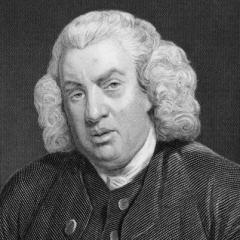
“Games are good or bad as to their nature; all may be perverted.”
“The duty of criticism is neither to depreciate nor dignify by partial representations, but to hold out the light of reason, whatever it may discover; and to promulgate the determinations of truth, whatever she shall dictate”
Source: The works of Samuel Johnson, LL. D.: with an essay on his life and genius
“Peevishness may be considered the canker of life, that destroys its vigor and checks its improvement; that creeps on with hourly depredations, and taints and vitiates what it cannot consume.”
Source: Selected poetry and prose
“Pendantry is the unseasonable ostentation of learning. It may be discovered either in the choice of a subject or in the manner d treating it.”
“Wisdom and virtue are by no means sufficient, without the supplemental laws of good-breeding, to secure freedom from degenerating into rudeness, or self esteem from swelling into insolence. A thousand incivilities may be committed, and a thousand offices neglected. without any remorse of conscience, or reproach from reason.”
Source: The Works of Samuel Johnson, LL.D.: With Murphy's Essay
“If a man begins to read in the middle of a book, and feels an inclination to go on, let him not quit it to go to the beginning. He may perhaps not feel again the inclination.”
Source: The Life of Samuel Johnson, LL. D.: Including a Journal of a Tour to the Hebrides
“The business of life is to go forward; he who sees evil in prospect meets it in his way, and he who catches it by retrospection turns back to find it. That which is feared may sometimes be avoided, but that which is regretted to-day may be regretted again to-morrow.”
Source: Life and Writings
“All truth is valuable, and satirical criticism may be considered as useful when it rectifies error and improves judgment; he that refines the public taste is a public benefactor.”
Source: The Beauties of Johnson: Consisting of Maxims and Observations, Moral, Critical, and Miscellaneous, Accurately Extracted from the Works of Dr. Samuel Johnson, and Arranged in Alphabetical Order, After the Manner of the Duke de la Roche-Foucault's Maxims
“Philosophy has often attempted to repress insolence by asserting that all conditions are leveled by death; a position which, however it may defect the happy, will seldom afford much comfort to the wretched.”
Source: The Wisdom of the Rambler, Adventurer, and Idler
“When a friend is carried to his grave, we at once find excuses for every weakness, and palliation of every fault. We recollect a thousand endearments, which before glided off our minds without impression, a thousand favors unrepaid, a thousand duties unperformed; and wish, vainly wish, for his return, not so much that we may receive as that we may bestow happiness, and recompense that kindness which before we never understood.”
Source: The Wisdom of the Rambler, Adventurer, and Idler
“The mere power of saving what is already in our hands must be of easy acquisition to every mind; and as the example of Lord Bacon may show that the highest intellect cannot safely neglect it, a thousand instances every day prove that the humblest may practise it with success.”
“We frequently fall into error and folly, not because the true principles of action are not known, but because for a time they are not remembered; he may, therefore, justly be numbered among the benefactors of mankind who contracts the great rules of life into short sentences that may early be impressed on the memory, and taught by frequent recollection to occur habitually to the mind.”
Source: The beauties of Johnson: choice selections from his works
“It is more reasonable to wish for reputation while it may be enjoyed, as Anacreon calls upon his companions to give him for present use the wine and garlands which they propose to bestow upon his tomb.”
“Friendship, like love, is destroyed by long absence, though it may be increased by short intermissions. What we have missed long enough to want it, we value more when it is regained; but that which has been lost till it is forgotten will be found at last with little gladness, and with still less if a substitute has supplied the place.”
Source: The Works of Samuel Johnson, LL.D.: With An Essay on His Life and Genius
“As the greatest liar tells more truths than falsehoods, so may it be said of the worst man, that he does more good than evil.”
Source: The Life of Samuel Johnson, LL. D.: Including a Journal of a Tour to the Hebrides
“I wish you would add an index rerum, that when the reader recollects any incident he may easily find it.”
Source: The Life of Samuel Johnson, LL. D.: Including His Tour to the Hebrides, Correspondence with Mrs. Thrale, &c. With Numerous Additions
“The seeds of knowledge may be planted in solitude, but must be cultivated in public.”
Source: The Works of Samuel Johnson, LL. D.: With an Essay on His Life and Genius /c by Arthur Murphy, Esq
“A minute analysis of life at once destroys that splendor which dazzles the imagination. Whatsoever grandeur can display, or luxury enjoy, is procured by offices of which the mind shrinks from the contemplation. All the delicacies of the table may be traced back to the shambles and the dunghill; all magnificence of building was hewn from the quarry, and all the pomp of ornament dug from among the damps and darkness of the mine.”
Source: The beauties of Samuel Johnson, LL. D.: consisting of maxims and observations, moral, critical, and miscellaneous: to which are now added biographical anecdotes of the doctor, selected from the works of Mrs. Piozzi;--his Life, recently published by Mr. Boswell, and other authentic testimonies; also his will, and the sermon he wrote for the late Doctor Dodd
“Let us be quick to repent of injuries while repentance may not be a barren anguish.”
Source: The Rambler: In Four Volumes..
“It may be no less dangerous to claim, on certain occasions, too little than too much. There is something captivating in spirit and intrepidity, to which we often yield as to a resistless power; nor can we often yield as to a resistless power; nor can he reasonably expect the confidence of others who too apparently distrusts himself.”
Source: The Rambler: A Periodical Paper, Published in 1750, 1751, 1752
“It was said of Euripides, that every verse was a precept; and it may be said of Shakespeare, that from his works may be collected a system of civil and economical prudence.”
Source: The Dramatic Works of William Shakespeare
“Truth has no gradations; nothing which admits of increase can be so much what it is, as truth is truth. There may be a strange thing, and a thing more strange. But if a proposition be true, there can be none more true.”
Source: The Life of Johnson: with Maxims and Observations: Moral, Critical, and Miscellaneous, Accurately Selected from the Works of Dr. Samuel Johnson, and Arranged in Alphabetical Order
“A country gentleman should bring his lady to visit London as soon as he can, that they may have agreeable topicks for conversation when they are by themselves.”
Source: The life of Samuel Johnson, LL. D., comprehending an account of his studies, and numerous works, in chronological order: a series of his epistolary correspondence and conversations with many eminent persons; and various original pieces of his composition, never before published; the whole exhibiting a view of literature and literary men in Great Britain, for near half a century during which he flourished
“You never find people laboring to convince you that you may live very happily upon a plentiful income.”
Source: The Portable Johnson & Boswell
“To those who have lived long together, everything heard and everything seen recalls some pleasure communicated, some benefit conferred, some petty quarrel or some slight endearment. Esteem of great powers, or amiable qualities newly discovered may embroider a day or a week, but a friendship of twenty years is interwoven with the texture of life.”
Source: The Life of Samuel Johnson, LL. D.: Together with A Journal of a Tour to the Hebrides
“I will take no more physick, not even my opiates; for I have prayed that I may render up my soul to God unclouded.”
Source: The life of Samuel Johnson, LL. D., comprehending an account of his studies, and numerous works, in chronological order: a series of his epistolary correspondence and conversations with many eminent persons; and various original pieces of his composition, never before published; the whole exhibiting a view of literature and literary men in Great Britain, for near half a century during which he flourished
“There may be other reasons for a man's not speaking in publick than want of resolution: he may have nothing to say.”
Source: The life of Samuel Johnson, LL. D., comprehending an account of his studies, and numerous works, in chronological order: a series of his epistolary correspondence and conversations with many eminent persons; and various original pieces of his composition, never before published; the whole exhibiting a view of literature and literary men in Great Britain, for near half a century during which he flourished
“Criticism is a study by which men grow important and formidable at very small expense. The power of invention has been conferred by nature upon few, and the labour of learning those sciences which may, by mere labour, be obtained, is too great to be willingly endured; but every man can exert some judgment as he has upon the works of others; and he whom nature has made weak, and idleness keeps ignorant, may yet support his vanity by the name of critic.”
Source: The Works of Samuel Johnson, LL.: D., with an Essay on His Life and Genius
“Among the innumerable mortifications which waylay human arrogance on every side may well be reckoned our ignorance of the most common objects and effects, a defect of which we become more sensible by every attempt to supply it. Vulgar and inactive minds confound familiarity with knowledge and conceive themselves informed of the whole nature of things when they are shown their form or told their use; but the speculatist, who is not content with superficial views, harasses himself with fruitless curiosity, and still, as he inquires more, perceives only that he knows less.”
“Among the calamities of war may be justly numbered the diminution of the love of truth by falsehoods which interest dictates and credulity encourages. A peace will equally leave the warrior and the relater of wars destitute of employment; and I know not whether more is to be dreaded from streets filled with soldiers accustomed to plunder, or from garrets filled with scribblers accustomed to lie.”
“A student may easily exhaust his life in comparing divines and moralists without any practical regard to morals and religion; he may be learning not to live but to reason... while the chief use of his volumes is unthought of, his mind is unaffected, and his life is unreformed.”
Source: The Works of Samuel Johnson: LL.D. A New Edition in Twelve Volumes. With an Essay on His Life and Genius, by Arthur Murphy, Esq
“Every man is prompted by the love of himself to imagine that he possesses some qualities, superior, either in kind or degree, to those which he sees allotted to the rest of the world; and, whatever apparent disadvantages he may suffer in the comparison with others, he has some invisible distinctions, some latent reserve of excellence, which he throws into the balance, and by which he generally fancies that it is turned in his favour.”
Source: Samuel Johnson: Selected Writings
“Friendship may well deserve the sacrifice of pleasure, though not of conscience.”
Source: The Rambler: In Four Volumes
“It may be observed in general that the future is purchased by the present. It is not possible to secure distant or permanent happiness but by the forbearance of some immediate gratification. This is so evidently true with regard to the whole of our existence that all precepts of theology have no other tendency than to enforce a life of faith; a life regulated not by our senses but by our belief; a life in which pleasures are to be refused for fear of invisible punishments, and calamities sometimes to be sought, and always endured, in hope of rewards that shall be obtained in another state.”
Source: Works: ¬The Rambler
“Pointed axioms and acute replies fly loose about the world, and are assigned successively to those whom it may be the fashion to celebrate.”
Source: The Beauties of Samuel Johnson, LL.D.: Consisting of Maxims and Observations, Moral, Critical, and Miscellaneous, to which are Now Added, Biographical Anecdotes of the Doctor, Selected from the Late Productions of Mrs. Piozzi, Mr. Boswell, ...
“It is certain that success naturally confirms in us a favourable opinion of our own abilities. Scarce any man is willing to allot to accident, friendship, and a thousand causes, which concur in every event without human contrivance or interposition, the part which they may justly claim in his advancement. We rate ourselves by our fortune rather than our virtues, and exorbitant claims are quickly produced by imaginary merit.”
Source: The Rambler: In Four Volumes..
“A voyage to the moon, however romantick and absurd the scheme may now appear, since the properties of air have been better understood, seemed highly probable to many of the aspiring wits in the last century”
Source: The Works of Samuel Johnson, LL.D.: With Murphy's Essay
“It is our first duty to serve society, and after we have done that, we may attend wholly to the salvation of our own souls.”
“A simile, to be perfect, must both illustrate and ennoble the subject; must show it to the understanding in a clearer view, and display it to the fancy with greater dignity; but either of these qualities may be sufficient to recommend it.... That it may be complete, it is required to exhibit, independently of its references, a pleasing image; for a simile is said to be a short episode.”
Source: Johnson's Lives of the British poets completed by W. Hazlitt
“The use of travelling is to regulate imagination by reality, and instead of thinking how things may be, to see them as they are.”
Source: The Works of Samuel Johnson, L. L. D.: In Twelve Volumes
“Courage is the greatest of all virtues, because if you haven't courage, you may not have an opportunity to use any of the others.”
“Friendship, like love, is destroyed by long absence, though it may be increased by short intermissions.”
Source: The Works of Samuel Johnson: The Adventurer and Idler
“It is however, reasonable, to have perfection in our eye; that we may always advance towards it, though we know it never can be reached.”
“A fly, Sir, may sting a stately horse and make him wince; but, one is but an insect, and the other is a horse still.”
“A man may be so much of everything that he is nothing of anything.”
Source: The Life of Samuel Johnson
“So many objections may be made to everything, that nothing can overcome them but the necessity of doing something.”
“There are goods so opposed that we cannot seize both, but, by too much prudence, may pass between them at too great a distance to reach either.”
Source: Selected poetry and prose
“All travel has its advantages. If the passenger visits better countries, he may learn to improve his own. And if fortune carries him to worse, he may learn to enjoy it.”
Source: The beauties of Samuel Johnson, LL. D.: consisting of maxims and observations, moral, critical, and miscellaneous: to which are now added biographical anecdotes of the doctor, selected from the works of Mrs. Piozzi;--his Life, recently published by Mr. Boswell, and other authentic testimonies; also his will, and the sermon he wrote for the late Doctor Dodd
“The Church does not superstitiously observe days, merely as days, but as memorials of important facts. Christmas might be kept as well upon one day of the year as another; but there should be a stated day for commemorating the birth of our Saviour, because there is danger that what may be done on any day, will be neglected.”
Source: The Table Talk of Dr. Johnson: Comprising Opinions and Anecdotes of Life and Literature, Men, Manners, and Morals
“A man who uses a great many words to express his meaning is like a bad marksman who, instead of aiming a single stone at an object, takes up a handful and throws at it in hopes he may hit.”