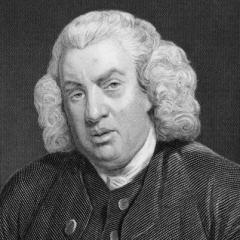
“A man may write at any time, if he will set himself doggedly to it.”
“You may translate books of science exactly. ... The beauties of poetry cannot be preserved in any language except that in which it was originally written.”
Source: The Table Talk of Dr. Johnson: Comprising Opinions and Anecdotes of Life and Literature, Men, Manners, and Morals
“Idleness is often covered by turbulence and hurry. He that neglects his known duty and real employment naturally endeavours to crowd his mind with something that may bar out the remembrance of his own folly, and does any thing but what he ought to do with eager diligence, that he may keep himself in his own favour.”
Source: The Rambler: A Periodical Paper, Published in 1750, 1751, 1752
“To have the management of the mind is a great art, and it may be attained in a considerable degree by experience and habitual exercise... Let him take a course of chemistry, or a course of rope-dance, or a course of any thing to which he is inclined at the time. Let him contrive to have as many retreats for his mind as he can, as many things to which it can fly from itself.”
“To have the management of the mind is a great art, and it may be attained in a considerable degree by experience and habitual exercise.”
Source: The life of Samuel Johnson, LL. D., comprehending an account of his studies, and numerous works, in chronological order: a series of his epistolary correspondence and conversations with many eminent persons; and various original pieces of his composition, never before published; the whole exhibiting a view of literature and literary men in Great Britain, for near half a century during which he flourished
“Youth enters the world with very happy prejudices in her own favor. She imagines herself not only certain of accomplishing every adventure, but of obtaining those rewards which the accomplishment may deserve. She is not easily persuaded to believe that the force of merit can be resisted by obstinacy and avarice, or its luster darkened by envy and malignity.”
Source: The Rambler: A Periodical Paper, Published in 1750, 1751, 1752
“When once a man has made celebrity necessary to his happiness, he has put it in the power of the weakest and most timorous malignity, if not to take away his satisfaction, at least to withhold it. His enemies may indulge their pride by airy negligence and gratify their malice by quiet neutrality.”
Source: The Rambler
“Much may be made of a Scotchman, if he be caught young.”
“The certainty that life cannot be long, and the probability that it will be much shorter than nature allows, ought to awaken every man to the active prosecution of whatever he is desirous to perform. It is true, that no diligence can ascertain success; death may intercept the swiftest career; but he who is cut off in the execution of an honest undertaking has at least the honour of falling in his rank, and has fought the battle, though he missed the victory.”
Source: The Life and Writings of Samuel Johnson...
“That all who are happy are equally happy is not true. A peasant and a philosopher may be equally satisfied, but not equally happy. A small drinking glass and a large one may be equally full, but the large one holds more than the small.”
Source: The Life of Samuel Johnson, LL. D.: Including a Journal of a Tour to the Hebrides
“More knowledge may be gained of a man's real character by a short conversation with one of his servants than from a formal and studied narrative, begun with his pedigree and ended with his funeral.”
“Flattery pleases very generally. In the first place, the flatterer may think what he says to be true; but, in the second place, whether he thinks so or not, he certainly thinks those whom he flatters of consequence enough to be flattered.”
Source: The life of Samuel Johnson, LL. D., comprehending an account of his studies, and numerous works, in chronological order: a series of his epistolary correspondence and conversations with many eminent persons; and various original pieces of his composition, never before published; the whole exhibiting a view of literature and literary men in Great Britain, for near half a century during which he flourished
“A man may be very sincere in good principles, without having good practice.”
Source: Boswell's Life of Johnson: Including Boswell's Journal of a Tour of the Hebrides, and Johnson's Diary of A Journey Into North Wales
“That friendship may be at once fond and lasting, there must not only be equal virtue on each part, but virtue of the same kind; not only the same end must be proposed, but the same means must be approved by both.”
Source: The Works of Samuel Johnson, LL.D.: With Murphy's Essay
“In bed we laugh, in bed we cry, and born in bed, in bed we die; the near approach a bed may show of human bliss to human woe.”
Source: The Works of the English Poets, from Chaucer to Cowper: Including the Series Edited with Prefaces, Biographical and Critical
“Man is a transitory being, and his designs must partake of the imperfections of their author. To confer duration is not always in our power. We must snatch the present moment, and employ it well, without too much solicitude for the future, and content ourselves with reflecting that our part is performed. He that waits for an opportunity to do much at once, may breathe out his life in idle wishes, and regret, in the last hour, his useless intentions and barren zeal.”
Source: The Rambler: A Periodical Paper, Published in 1750, 1751, 1752
“No degree of knowledge attainable by man is able to set him above the want of hourly assistance, or to extinguish the desire of fond endearments and tender officiousness; and, therefore, no one should think it unnecessary to learn those arts by which friendship may be gained.”
Source: Johnsoniana: Or, Supplement to Boswell: Being Anecdotes and Sayings of Dr. Johnson
“He that would travel for the entertainment of others, should remember that the great object of remark is human life. Every Nation has something peculiar in its Manufactures, its Works of Genius, its Medicines, its Agriculture, its Customs, and its Policy. He only is a useful Traveller, who brings home something by which his country may be benefited; who procures some supply of Want, or some mitigation of Evil, which may enable his readers to compare their condition with that of others, to improve it whenever it is worse, and whenever it is better to enjoy it.”
“Those who are in the power of evil habits must conquer them as they can; and conquered they must be, or neither wisdom nor happiness can be attained: but those who are not yet subject to their influence may, by timely caution, preserve their freedom.”
Source: The Wisdom of the Rambler, Adventurer, and Idler
“We have now learned that rashness and imprudence will not be deterred from taking credit; let us try whether fraud and avarice may be more easily restrained from giving it.”
Source: The Works of Samuel Johnson, LL. D.: With an Essay on His Life and Genius /c by Arthur Murphy, Esq
“Criticism is a study by which men grow important and formidable at very small expense. He whom nature has made weak, and idleness keeps ignorant, may yet support his vanity by the name of a critic.”
Source: Selected poetry and prose
“Ignorance, when it is voluntary, is criminal; and he may be properly charged with evil who refused to learn how he might prevent it.”
Source: The works of Samuel Johnson
“False taste is always busy to mislead those that are entering upon the regions of learning; and the traveller, uncertain of his way, and forsaken by the sun, will be pleased to see a fainter orb arise on the horizon, that may rescue him from total darkness, though with weak and borrowed lustre.”
Source: The Rambler: A Periodical Paper, Published in 1750, 1751, 1752
“Of many, imagined blessings it may be doubted whether he that wants or possesses them had more reason to be satisfied with his lot.”
Source: Murphy's essay. The rambler. The adventurer. The idler. Rasselas. Tales of the imagination. Letters. Irene. Miscellaneous poems
“It seems not more reasonable to leave the right of printing unrestrained, because writers may be afterwards censured, than it would be to sleep with doors unbolted, because by our laws we can hang a thief.”
Source: Lives of the Poets
“To use two languages familiarly and without contaminating one by the other, is very difficult; and to use more than two is hardly to be hoped. The prizes which some have received for their multiplicity of languages may be sufficient to excite industry, but can hardly generate confidence.”
“Never, my dear Sir, do you take it into your head that I do not love you; you may settle yourself in full confidence both of my love and my esteem; I love you as a kind man, I value you as a worthy man, and hope in time to reverence you as a man of exemplary piety.”
Source: The Letters of Samuel Johnson, Volume II: 1773-1776
“Every other enjoyment malice may destroy; every other panegyric envy may withhold; but no human power can deprive the boaster of his own encomiums.”
Source: Samuel Johnson: Selected Writings
“Pride is seldom delicate, it will please itself with very mean advantages; and envy feels not its own happiness, but when it may be compared with the misery of others”
Source: The Beauties of Samuel Johnson, LL.D.: Consisting of Maxims and Observations, Moral, Critical, and Miscellaneous, to which are Now Added, Biographical Anecdotes of the Doctor, Selected from the Late Productions of Mrs. Piozzi, Mr. Boswell, ...
“We may have many acquaintances, but we can have but few friends; this made Aristotle say that he that hath many friends hath none.”
“A contempt of the monuments and the wisdom of the past, may be justly reckoned one of the reigning follies of these days, to which pride and idleness have equally contributed.”
Source: The Works of Samuel Johnson, LL.D.: Journey to the Hebrides. Tales of the imagination. Prayers and sermons. Index
“Such is the constitution of man that labour may be styled its own reward; nor will any external incitements be requisite, if it be considered how much happiness is gained, and how much misery escaped, by frequent and violent agitation of the body.”
Source: The Rambler: A Periodical Paper, Published in 1750, 1751, 1752
“He that accepts protection, stipulates obedience. We have always protected the Americans; we may therefore subject them to government.”
Source: Sir Robert Chambers: Law, Literature, and Empire in the Age of Johnson
“Without good humour, learning and bravery can only confer that superiority which swells the heart of the lion in the desert, where he roars without reply, and ravages without resistance. Without good humour virtue may awe by its dignity and amaze by its brightness, but must always be viewed at a distance, and will scarcely gain a friend or attract an imitator.”
Source: The Rambler: In Four Volumes..
“No cause more frequently produces bashfulness than too high an opinion of our own importance. He that imagines an assembly filled with his merit, panting with expectation, and hushed with attention, easily terrifies himself with the dread of disappointing them, and strains his imagination in pursuit of something that may vindicate the veracity of fame, and show that his reputation was not gained by chance.”
Source: The Rambler: A Periodical Paper, Published in 1750, 1751, 1752
“The gratification of curiosity rather frees us from uneasiness than confers pleasure; we are more pained by ignorance than delighted by instruction. Curiosity is the thirst of the soul; it inflames and torments us, and makes us taste every thing with joy, however otherwise insipid, by which it may be quenched.”
Source: The works of Samuel Johnson, LL. D.: with an essay on his life and genius
“Among the lower classes of mankind there will be found very little desire of any other knowledge than what may contribute immediately to the relief of some pressing uneasiness, or the attainment of some near advantage.”
Source: The Rambler: A Periodical Paper, Published in 1750, 1751, 1752
“Pity is not natural to man. Children are always cruel. Savages are always cruel. Pity is acquired and improved by the cultivation of reason. We may have uneasy sensations from seeing a creature in distress, without pity; for we have not pity unless we wish to relieve them.”
“He is a benefactor of mankind who contracts the great rules of life into the short sentences, that may be easily impressed on the memory, and so recur habitually to the mind.”
“Among the calamities of war may be numbered the diminution of the love of truth, by the falsehoods which interest dictates, and credulity encourages.”
“A merchant may, perhaps, be a man of an enlarged mind, but there is nothing in trade connected with an enlarged mind.”
Source: Journey to the Hebrides: A Journey to the Western Islands of Scotland & The Journal of a Tour to the Hebrides
“Attainment is followed by neglect, possession by disgust, and the malicious remark of the Greek epigrammatist on marriage may be applied to many another course of life, that its two days of happiness are the first and the last”
Source: The Works of Alexander Pope, Esq. in Verse and Prose: Containing the Principal Notes of Drs. Warburton and Warton: Illustrations, and Critical and Explanatory Remarks, by Johnson, Wakefield, A. Chalmers ... and Others; to which are Added, Now First Published, Some Original Letters, with Additional Observations, and Memoirs of the Life of the Author
“In most ages many countries have had part of their inhabitants in a state of slavery; yet it may be doubted whether slavery can ever be supposed the natural condition of man. It is impossible not to conceive that men in their original state were equal; and very difficult to imagine how one would be subjected to another but by violent compulsion. An individual may, indeed, forfeit his liberty by a crime; but he cannot by that crime forfeit the liberty of his children.”
Source: The life of Samuel Johnson, LL. D., comprehending an account of his studies, and numerous works, in chronological order: a series of his epistolary correspondence and conversations with many eminent persons; and various original pieces of his composition, never before published; the whole exhibiting a view of literature and literary men in Great Britain, for near half a century during which he flourished
“Every other author may aspire to praise; the lexicographer can only hope to escape reproach.”
“As not every instance of similitude can be considered as a proof of imitation, so not every imitation ought to be stigmatised as plagiarism. The adoption of a noble sentiment, or the insertion of a borrowed ornament, may sometimes display so much judgment as will almost compensate for invention; and an inferior genius may, without any imputation of servility, pursue the paths of the ancients, provided he declines to tread in their footsteps.”
Source: The Beauties of Johnson: Consisting of Maxims and Observations, Moral, Critical, and Miscellaneous
“The complaint, therefore, that all topicks are preoccupied, is nothing more than the murmur of ignorance or idleness, by which some discourage others, and some themselves; the mutability of mankind will always furnish writers with new images, and the luxuriance of fancy may always embellish them with new decorations.”
Source: Selected essays
“The blaze of reputation cannot be blown out, but it often dies in the socket; a very few names may be considered as perpetual lamps that shine unconsumed.”
Source: Essay on the life and genius of Dr. Johnson [by Arthur Murphy] Poems. Rasselas, prince of Abissinia. Letters
“From all our observations we may collect with certainty, that misery is the lot of man, but cannot discover in what particular condition it will find most alleviations.”
Source: The Rambler
“I do not wonder that, where the monastick life is permitted, every order finds votaries, and every monastery inhabitants. Men will submit to any rule, by which they may be exempted from the tyranny of caprice and of chance. They are glad to supply by external authority their own want of constancy and resolution, and court the government of others, when long experience has convinced them of their own inability to govern themselves.”
Source: Life of Johnson: Including Boswell's Journal of a Tour to the Hebrides and Johnson's Diary of a Journey Into North Wales
“In order that all men may be taught to speak truth, it is necessary that all likewise should learn to hear it; for no species of falsehood is more frequent than flattery, to which the coward is betrayed by fear, the dependent by interest, and the friend by tenderness: those who are neither servile nor timorous are yet desirous to bestow pleasure; and, while unjust demands of praise continue to be made, there will always be some whom hope, fear, or kindness will dispose to pay them.”
Source: The Beauties of Samuel Johnson, Etc. (A New Edition, Being the Ninth.).