Quotessence
Home / Authors / Howard Zinn
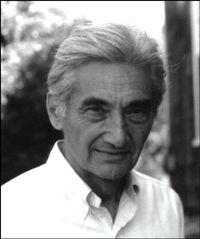
Howard Zinn

Howard Zinn Quotes

Historian

Filter quotes by topic

Famous Howard Zinn Quotes

“If we have learned anything in the past ten years, it is that these lovely things about America were never lovely. We have been expansionist and aggressive and mean to other people from the beginning. And we've been aggressive and mean to people in this country, and we've allocated the wealth of this country in a very unjust way. We've never had justice in our courts for the poor people, for black people, for radicals. Now how can we boast that America is a very special place? It's not that special. It really isn't.”

“What is called “apathy” is, I believe, a feeling of helplessness on the part of the ordinary citizen, a feeling of impotence in the face of enormous power. It’s not that people are apathetic; they do care about what is going on, but don’t know what to do about it, so they do nothing, and appear to be indifferent.”

“I am convinced that imprisonment is a way of pretending to solve the problem of crime. It does nothing for the victims of crime, but perpetuates the idea of retribution, thus maintaining the endless cycle of violence in our culture. It is a cruel and useless substitute for the elimination of those conditions--poverty, unemployment, homelessness, desperation, racism, greed--which are at the root of most punished crime. The crimes of the rich and powerful go mostly unpunished.”

“When the Democrats are attacked for [inciting class warfare] they shrink back. They don't say what obviously should be said, "Yes, there is class warfare. There has always been class warfare in this country." The reason the Democrats shrink back is because the Democrats and the Republicans are on the same side of the class war. They have slightly different takes. The Democrats are part of the upper class that is more willing to make concessions to the lower class in order to maintain their power.”

“Indeed, it is impossible to be neutral. In a world already moving in certain directions, where wealth and power are already distributed in certain ways, neutrality means accepting the way things are now. It is a world of clashing interests – war against peace, nationalism against internationalism, equality against greed, and democracy against elitism – and it seems to me both impossible and undesirable to be neutral in those conflicts.”

“It had long been true, and prisoners knew this better than anyone, that the poorer you were the more likely you were to end up in jail. This was not just because the poor committed more crimes. In fact, they did. The rich did not have to commit crimes to get what they wanted; the laws were on their side. But when the rich did commit crimes, they often were not prosecuted, and if they were they could get out on bail, hire clever lawyers, get better treatment from judges. Somehow, the jails ended up full of poor black people.”

“Scholars, who pride themselves on speaking their minds, often engage in a form of self-censorship which is called "realism." To be "realistic" in dealing with a problem is to work only among the alternatives which the most powerful in society put forth. It is as if we are all confined to a, b, c, or d in the multiple choice test, when we know there is another possible answer. American society, although it has more freedom of expression than most societies in the world, thus sets limits beyond which respectable people are not supposed to think or speak.”

“It's not right to respond to terrorism by terrorizing other people. And furthermore, it's not going to help. Then you might say, "Yes, it's terrorizing people, but it's worth doing because it will end terrorism." But how much common sense does it take to know that you cannot end terrorism by indiscriminately dropping bombs?”

“I came to the conclusion that war was an unacceptable way of solving whatever problems there were in the world--that there would be problems of tyranny, of injustice, of nations crossing frontiers and that injustice and tyranny should not be tolerated and should be fought and resisted, but the one thing that must not be used to solve that problem is war. Because war is inevitably the indiscriminate killing of large numbers of people. And that fact overwhelms whatever moral cause is somewhere buried in the history of that war.”

“What happened in World War II was what happened in war generally, and that was whatever the initiating cause, and however clear the moral reason is for the war in which one side looks better than the other, by the time the war ends both sides have been engaged in evil.”

“Behind the deceptive words designed to entice people into supporting violence -- words like democracy, freedom, self-defense, national security -- there is the reality of enormous wealth in the hands of a few, while billions of people in the world are hungry, sick, homeless.”

“While some multimillionaires started in poverty, most did not. A study of the origins of 303 textile, railroad and steel executives of the 1870s showed that 90 percent came from middle- or upper-class families. The Horatio Alger stories of "rags to riches" were true for a few men, but mostly a myth, and a useful myth for control.”

“I believe there are huge numbers of people in this country who would be willing to have radical changes in our economic and social system in order to make it a more egalitarian society and do away with homelessness and hunger and clean up the environment. But these people have no voice. They have no way of expressing themselves. Elections give them no way of expressing themselves.”

“I start from the supposition that the world is topsyturvy, that things are all wrong, that the wrong people are in jail and the wrong people are out of jail, that the wrong people are in power and the wrong people are out of power, that the wealth is distributed in this country and the world in such a way as not simply to require small reform but to require a drastic reallocation of wealth. I start from the supposition that we don't have to say too much about this because all we have to do is think about the state of the world today and realize that things are all upside down.”

“Protest beyond the law is not a departure from democracy; it is absolutely essential to it. It is a corrective to the sluggishness of "the proper channels," a way of breaking through passages blocked by tradition and prejudice. It is disruptive and troublesome, but it is a necessary disruption, a healthy troublesome.”

“Now I have been studying very closely what happens every day in the courts in Boston, Massachusetts. You would be astounded--maybe you wouldn't, maybe you have been around, maybe you have lived, maybe you have thought, maybe you have been hit--at how the daily rounds of injustice make their way through this marvelous thing that we call "due process.”

“There is the past and its continuing horrors: violence, war, prejudices against those who are different, outrageous monopolization of the good earth's wealth by a few, political power in the hands of liars and murderers, the building of prisons instead of schools, the poisoning of the press and the entire culture by money. It is easy to become discouraged observing this, especially since this is what the press and television insist that we look at, and nothing more.”

“The First Amendment and Fourteenth Amendment rights in the United States Constitution were being violated in Albany again and again - freedom of speech, freedom of assembly, the equal protection of the laws - I could count at least 30 such violations. Yet the president, sworn to uphold the Constitution, and all the agencies of the United States government at his disposal, were nowhere to be seen.”

“The white population could not possibly be unaffected by those events - some whites more stubborn in their defense of segregation, but others beginning to think in different ways. And the black population was transformed, having risen up in mass action for the first time, feeling its power, knowing now that if the old order could be shaken it could be toppled.”

“Not only did waging war against Hitler fail to save the Jews, it may be that the war itself brought on the Final Solution of genocide. This is not to remove the responsibility from Hitler and the Nazis, but there is much evidence that Germany's anti-Semitic actions, cruel as they were, would not have turned to mass murder were it not for the psychic distortions of war, acting on already distorted minds. Hitler's early aim was forced emigration, not extermination, but the frenzy of it created an atmosphere in which the policy turned to genocide.”

“One percent of the nation owns a third of the wealth. The rest of the wealth is distributed in such a way as to turn those in the 99 percent against one another: small property owners against the propertyless, black against white, native-born against foreign-born, intellectuals and professionals against the uneducated and the unskilled. These groups have resented one another and warred against one another with such vehemence and violence as to obscure their common position as sharers of leftovers in a very wealthy country.”

“[Nationalism is] a set of beliefs taught to each generation in which the Motherland or the Fatherland is an object of veneration and becomes a burning cause for which one becomes willing to kill the children of other Motherlands or Fatherlands.”

“We are not hated because we practice democracy, value freedom, or uphold human rights. We are hated because our government denies these things to people in Third World countries whose resources are coveted by multinational corporations. That hatred we have sown has come back to haunt us in the form of terrorism....”

“I did not feel proud of our country, seeing that we were bombing peasant villages, that we were not just hitting military targets, that children were being killed. We were terrorizing the North Vietnamese with our enormous Air Force. They had no Air Force at all. They were a little pitiful country and we were terrorizing them with our bombs. And no, I did not feel proud at all.”

“For most Black people there is still poverty and desperation. The Ghettos still exist, and the proportion of Blacks in prison is still much greater than Whites. Today, there is less overt racism, but the economic injustices create an "institutional racism" which exists even while more Blacks are in high places, such as Condoleeza Rice in Bush's Administration and Obama running for President.”

“Unfortunately, the greater consciousness among Whites about Black equality has not carried over to the new victims of racism - Muslims and Immigrants. There is no racial enlightenment for these groups, which are huge. Millions of Muslims and an equal number of immigrants, who whether legal or illegal, face discrimination both legally from the government and extra-legally from White Americans - and sometimes Black and Hispanic Americans. The Democratic Presidential candidates are avoiding these issues in order to cultivate support among White Americans.”

“Because of the control of the media by corporate wealth, the discovery of truth depends on an alternative media, such as small radio stations, networks, programs. Also, alternative newspapers, which exist all over the country. Also, cable TV programs, which are not dependent on commercial advertising. Also, the internet, which can reach millions of people by-passing the conventional media.”

“I did not know much history when I became a bombardier in the U.S. Air Force in World War II. Only after the War did I see that we, like the Nazis, had committed atrocities... Hiroshima, Nagasaki, Dresden, my own bombing missions. And when I studied history after the War, I learned from reading on my own, not from my university classes, about the history of U.S. expansion and imperialism.”