Quotessence
Home / Authors / Samuel Johnson Books
Samuel Johnson

Samuel Johnson Books

Writer

Idler

A source page for quotes linked to Samuel Johnson.
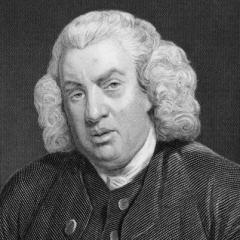
0 quotes

Life of Savage;

A source page for quotes linked to Samuel Johnson.

0 quotes

Lives

A source page for quotes linked to Samuel Johnson.

0 quotes

Paradise lost

A source page for quotes linked to Samuel Johnson.

0 quotes

Preface

A source page for quotes linked to Samuel Johnson.

0 quotes

Select Essays

A source page for quotes linked to Samuel Johnson.

0 quotes

Sermons

A source page for quotes linked to Samuel Johnson.

0 quotes

THE

A source page for quotes linked to Samuel Johnson.

0 quotes

Related Quotes

“Pleasure, in itself harmless, may become mischievous, by endearing to us a state which we know to be transient and probatory, and withdrawing our thoughts from that of which every hour brings us nearer to the beginning, and of which no length of time will bring us to the end. Mortification is not virtuous in itself, nor has any other use, but that it disengages us from the allurements of sense. In the state of future perfection, to which we all aspire, there will be pleasure without danger, and security without restraint.”

“Perhaps the excellence of aphorisms consists not so much in the expression of some rare or abstruse sentiment, as in the comprehension of some obvious and useful truth in a few words. We frequently fall into error and folly, not because the true principles of action are not known, but because, for a time, they are not remembered; and he may therefore be justly numbered among the benefactors of mankind who contracts the great rules of life into short sentences, that may be easily impressed on the memory, and taught by frequent recollection to recur habitually to the mind.”

“He who has nothing external that can divert him must find pleasure in his own thoughts, and must conceive himself what he is not; for who is pleased with what he is? He then expiates in boundless futurity, and culls from all imaginable conditions that which for the present moment he should most desire, amuses his desires with impossible enjoyments, and confers upon his pride unattainable dominion. The mind dances from scene to scene, unites all pleasures in all combination, and riots in delights which nature and fortune, with all their bounty, cannot bestow. In time some particular train of ideas fixes the attention; all other intellectual gratifications are rejected; the mind, in weariness or leisure, recurs constantly to the favorite conception, and feasts on the luscious falsehood whenever she is offended with the bitterness of truth. By degrees the reign of fancy is confirmed; she grows first imperious, and in time despotic. Then fictions begin to operate as realities, false opinions fasten upon the mind, and life passes in dreams of rapture or of anguish.”

“Rasselas listened to him with the veneration due to the instructions of a superior being, and waiting for him at the door, humbly implored the liberty of visiting so great a master of true wisdom. The lecturer hesitated a moment, when Rasselas put a purse of gold into his hand, which he received with a mixture of joy and wonder. “I have found,” said the Prince at his return to Imlac, “a man who can teach all that is necessary to be known; who, from the unshaken throne of rational fortitude, looks down on the scenes of life changing beneath him. He speaks, and attention watches his lips. He reasons, and conviction closes his periods. This man shall be my future guide: I will learn his doctrines and imitate his life.” “Be not too hasty,” said Imlac, “to trust or to admire the teachers of morality: they discourse like angels, but they live like men.” Rasselas, who could not conceive how any man could reason so forcibly without feeling the cogency of his own arguments, paid his visit in a few days, and was denied admission. He had now learned the power of money, and made his way by a piece of gold to the inner apartment, where he found the philosopher in a room half darkened, with his eyes misty and his face pale. “Sir,” said he, “you are come at a time when all human friendship is useless; what I suffer cannot be remedied: what I have lost cannot be supplied. My daughter, my only daughter, from whose tenderness I expected all the comforts of my age, died last night of a fever. My views, my purposes, my hopes, are at an end: I am now a lonely being, disunited from society.” “Sir,” said the Prince, “mortality is an event by which a wise man can never be surprised: we know that death is always near, and it should therefore always be expected.” “Young man,” answered the philosopher, “you speak like one that has never felt the pangs of separation.” “Have you then forgot the precepts,” said Rasselas, “which you so powerfully enforced? Has wisdom no strength to arm the heart against calamity? Consider that external things are naturally variable, but truth and reason are always the same.” “What comfort,” said the mourner, “can truth and reason afford me? Of what effect are they now, but to tell me that my daughter will not be restored?” The Prince, whose humanity would not suffer him to insult misery with reproof, went away, convinced of the emptiness of rhetorical sounds, and the inefficacy of polished periods and studied sentences.”

“What', said he, ' makes the difference between man and all the rest of the animal creation? Every beast that strays beside me has the same corporeal necessities with myself; he is hungry and crops the grass, he is thirsty and drinks the stream, his thirst and hunger are appeased, he is satisfied and sleeps; he rises again and is hungry, he is again fed and is at rest. I am hungry and thirsty like him, but when thirst and hunger cease I am not at rest; I am, like him, pained with want, but am not, like him, satisfied with fullness. The intermediate hours are tedious and gloomy; I long again to be hungry that I may again quicken my attention. The birds peck the berries or the corn, and fly away to the groves where they sit in seeming happiness on the branches, and waste their lives in tuning one unvaried series of sounds. I likewise can call the lutanist and the singer, but the sounds that pleased me yesterday weary me today, and will grow yet more wearisome tomorrow. I can discover within me no power of perception which is not glutted with its proper pleasure, yet I do not feel myself delighted. Man has surely some latent sense for which this place affords no gratification, or he has some desires distinct from sense which must be satisfied before he can be happy.”

“People have now a-days, (said he,) got a strange opinion that every thing should be taught by lectures. Now, I cannot see that lectures can do so much good as reading the books from which the lectures are taken. I know nothing that can be best taught by lectures, except where experiments are to be shewn. You may teach chymistry by lectures.—You might teach making of shoes by lectures!”

“Solitude is dangerous to reason, without being favourable to virtue: pleasures of some sort are necessary to the intellectual as to the corporeal health; and those who resist gaiety, will be likely for the most part to fall a sacrifice to appetite; for the solicitations of sense are always at hand, and a dram to a vacant and solitary person is a speedy and seducing relief. Remember that the solitary mind is certainly luxurious, probably superstitious, and possibly mad: the mind stagnates for want of employment, grows morbid, and is extinguished like a candle in foul air.”

“My dear friend, clear your mind of cant [excessive thought]. You may talk as other people do: you may say to a man, "Sir, I am your most humble servant." You are not his most humble servant. You may say, "These are bad times; it is a melancholy thing to be reserved to such times." You don't mind the times ... You may talk in this manner; it is a mode of talking in Society; but don't think foolishly.”

“It has been observed in all ages that the advantages of nature or of fortune have contributed very little to the promotion of happiness; and that those whom the splendour of their rank, or the extent of their capacity, have placed upon the summits of human life, have not often given any just occasion to envy in those who look up to them from a lower station; whether it be that apparent superiority incites great designs, and great designs are naturally liable to fatal miscarriages; or that the general lot of mankind is misery, and the misfortunes of those whose eminence drew upon them an universal attention, have been more carefully recorded, because they were more generally observed, and have in reality only been more conspicuous than others, not more frequent, or more severe.”

“Here I first mounted a little Highland steed; and if there had been many spectators, should have been somewhat ashamed of my figure in the march. The horses of the Islands, as of other barren countries, are very low: they are indeed musculous and strong, beyond what their size gives reason for expecting; but a bulky man upon one of their backs makes a very disproportionate appearance.”

“Wenn wir sehen, wie die Menschen altern und nach gewisser Zeit einer nach dem anderen sterben, Jahrhundert für Jahrhundert, dann können wir nur lachen über das Elixier, das die Verlängerung des Lebens auf über tausend Jahre verspricht; mit gleichem Recht ist der Lexikograph zu verspotten, der ohne das Beispiel einer Nation anführen zu können, die ihre Wörter und Ausdrücke vor Veränderlichkeit bewahrte, sich einbildet, sein Wörterbuch könne seine Sprache einbalsamieren, vor Verfälschung schützen und Verfall, und der meint, es stehe in seiner Macht, irdische Natur zu ändern oder die Welt mit einem Schlag von Verrücktheit, Eitelkeit und Affektiertheit zu befreien.”

“It is true that of far the greater part of things, we must content ourselves with such knowledge as description may exhibit, or analogy supply; but it is true likewise, that these ideas are always incomplete, and that at least, till we have compared them with realities, we do not know them to be just. As we see more, we become possessed of more certainties, and consequently gain more principles of reasoning, and found a wider base of analogy.”

“Other things may be seized by might, or purchased with money, but knowledge is to be gained only by study, and study to be prosecuted only in retirement.”

“Knowledge is praised and desired by multitudes whom her charms could never rouse from the couch of sloth; whom the faintest invitation of pleasure draws away from their studies; to whom any other method of wearing the day is more eligible than the use of books, and who are more easily engaged by any conversation than such as may rectify their notions or enlarge their comprehension.”

“To understand the works of celebrated authors, to comprehend their systems, and retain their reasonings, is a task more than equal to common intellects; and he is by no means to be accounted useless or idle, who has stored his mind with acquired knowledge, and can detail it occasionally to others who have less leisure or weaker abilities.”