Quotessence
Home / Authors / Ian Mcewan
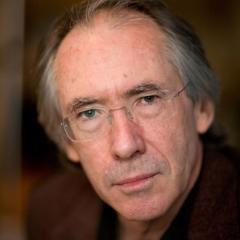
Ian Mcewan

Ian Mcewan Quotes

Novelist

Filter quotes by topic

Famous Ian Mcewan Quotes

“Half aware of him, Rosalind shifts position, fidgiting with a feeble turn of her shoulders so that her back is snug against his chest. She slides her foot along his shin and rests the arch of he foot on his toes. Aroused furthe, he feels his erection trapped against the small of her back and reaches down to free himself. Her breathing resumes its steady rhythm. Henry lies still, waiting for sleep. By contemporary standards, by any standards, it's perverse that he's never tired of making love to Rosalind, never been seriously tempted by the opportunities that has drifted his way through the generous logic of medical hierarchy. When he thinks of sex, he thinks of her. These eyes, these breasts, this tongue, this welcome. Who else could love him so knowingly, with such warmth and teasing humour, or accumulate so rich a past with him? In one lifetime it wouldn't be possible to find another woman with whom he can learn to be so free, whom he can please with such abandon and expertise. By some accident of character, it's familiarity that excites him more than sexual novelty. He suspects that there's something numbed or deficient or timid in himself. Plenty of male friends sidle into adventures with younger women; now and then a solid marriage explodes in a firefight of recrimination. Perowne watches on with unease, fearing he lacks an element of the musculine life force, and a bold and healthy appetite for experience. Where's his curiosity? What's wrong with him? But there is nothing he can do about himself. He meets the occasional questioning glance of an attractive woman with a bland and level smile. This fidelity might look like virtue of doggedness, but it's neither of these because he exercise no real choice. This is what he was to have: possession, belonging, repetition.”

“But this first clumsy attempt showed her that the imagination itself was a source of secrets: once she had begun a story, no one could be told. Pretending in words was too tentative, too vulnerable, too embarrassing to let anyone know. Even writing out the she saids, the and thens, made her wince, and she felt foolish, appearing to know about the emotions of an imaginary being. Self-exposure was inevitable the moment she described a character's weakness; the reader was bound to speculate that she was describing herself. What other authority could she have?”

“He closed his eyes. This bed was a wedding gift from friends he had not seen in years. He tried to remember their names, but they were gone. In it, or on it, his marriage had begun and, six years later, ended. He recognized a musical creak when he moved his legs, he smelled Julie on the sheets and banked-up pillows, her perfume and the close, soapy essence that characterized her newly washed linen. Here he had taken part in the longest, most revealing, and, later, most desolate conversations of his life. He had had the best sex ever here, and the worst wakeful nights. He had done more reading here than in any other single place - he remembered Anna Karenina and Daniel Deronda in one week of illness. He had never lost his temper so thoroughly anywhere else, nor had been so tender, protective, comforting, nor, since early childhood, been so cared for himself. Here his daughter had been conceived and born. On this side of the bed. Deep in the mattress were the traces of pee from her early-morning visits. She used to climb between then, sleep a little, then wake them with her chatter, her insistence on the day beginning. As they clung to their last fragments of dreams, she demanded the impossible: stories, poems, songs, invented catechisms, physical combat, tickling. Nearly all evidence of her existence, apart from photographs, they had destroyed or given away. All the worst and the best things that had ever happened to him had happened here. This was where he belonged. Beyond all immediate considerations, like the fact that his marriage was more or less finished, there was his right to lie here now in the marriage bed.”

“Este era o ataque. A apologia tomava emprestado e distorcia o velho estratagema do Eclesiastes: era tempo de resgatar a música das mão dos “donos daa verdade”, e era tempo de reafirmar a comunicabilidade essencial da música, que havia sido forjada, na Europa, numa tradição humanista que sempre reconhecera o enigma da natureza humana; era tempo de aceitar que uma execução para o público constituía uma “comunhão laica”, e era tempo de reconhecer a primazia do ritmo e do tom, bem como a natureza básica da melodia. Para que isso acontecesse sem apenas repetir a música do passado, cumpria formular uma definição contemporânea de beleza, o que, por sua vez, era impossível sem que se compreendesse uma “verdade fundamental”. Nesse ponto, Clive se valeu ousadamente de alguns ensaios inéditos e altamente especulativos de um colega de Noam Chomsky, que ele tinha lido quando passara férias na casa do autor, em Cape Cod: nossa capacidade de “ler” ritmos, melodias e harmonias agradáveis, assim como a faculdade exclusivamente humana da linguagem, era geneticamente determinada. Segundo os antropólogos, esses três elementos deviam existir em todas as culturas musicais. Nosso ouvido para harmonia era inato. (Além disso, sem um contexto envolvente de harmonia, a dissonância não fazia sentido e se tornava desinteressante.) Compreender uma linha melódica era um ato mental complexo, mas passível de ser executado até por uma criança bem pequena; já nascíamos com uma herança, éramos o Homo musicas; portanto, definir a beleza na música implicava uma definição da natureza humana, o que nos trazia de volta às humanidades e à capacidade de comunicação…”

“Los comentaristas que sugerían que la victoria del ordenador acabaría con el go se equivocaban. Tras su quinta derrota, el viejo maestro de go, auxiliado por un asistente, se puso de pie despacio, hizo una reverencia de cabeza hacia el ordenador portátil y lo felicitó con voz temblorosa. Dijo: "El jinete en su montura no acabó con el atletismo. Corremos por placer.”

“There are some moments when musicians together touch something sweeter than they've ever found before in rehearsals or performances, beyond the merely collaborative or technically proficient, when their expression becomes as easy and graceful as friendship or love. This is when they give us a glimpse of what we might be, of our best selves, and of an impossible world in which you give everything you have to others, but lose nothing of yourself.”

“Voleva fuggire, buttarsi da sola sul letto a faccia in giù e assaporare il dolore cocente di quel momento, e poi seguire con il pensiero il diramarsi di ogni possibile conseguenza fino al punto esatto che precedeva la devastazione. Aveva bisogno di contemplare a occhi chiusi la ricchezza di quello che aveva perso, di quello che aveva ceduto, e di prefigurarsi il nuovo stato delle cose.”

“Les après-midi d'hiver, en rentrant de l'école, Peter n'aimait rien tant que d'envoyer valser ses chaussures et de s'allonger à côté de Guillaume, devant le feu de cheminée du salon. Il aimait se mettre exactement à la hauteur de Guillaume, son visage à deux doigts de la tête féline, et observer à quel point celle-ci était réellement extraordinaire, si merveilleusement non humaine, tout ébouriffée de poils noirs. Ils encadraient un minuscule visage enfoui sous la fourrure, paré de moustaches blanches légèrement incurvées vers le bas. Les poils des sourcils jaillissaient droit comme des antennes de radio et les yeux verts malachite fendus en amande étaient comme des fenêtres entrouvertes sur un monde dans lequel Peter ne pourrait jamais pénétrer. Son approche déclenchait un tonnerre de ronronnements intenses d'une sonorité si grave et si forte que le sol en vibrait. Peter savait qu'il était indiscutablement le bienvenu.”

“At best he read popular science magazines like the Scientific American he had now, to keep himself up-to-date, in layman's terms, with physics generally. But even then his concentration was marred, for a lifetime's habit made him inconveniently watchful for his own name. He saw it as if in bold. It could leap out at him from an unread double page of small print, and sometimes he could sense it coming before the page turn.”

“We lived in a mist of half-shared, unreliable perception, and our sense data came warped by a prism of desire and belief, which tilted our memories too. We saw and remembered in our own favour and we persuaded ourselves along the way. Pitiless objectivity, especially about ourselves, was always a doomed societal strategy. We're descended from the indignant, passionate tellers of half truths who in order to convince others, simultaneously convinced themselves. Over generations success had winnowed us out, and with success came our defect, carved deep in the genes like ruts in a cart track – when it didn't suit us we couldn't agree on what was in front of us. Believing is seeing. That's why there are divorces, border disputes and wars, and why the statue of the Virgin Mary weeps blood and the one of Ganesh drinks milk. And that was why metaphysics and science were such courageous enterprises, such startling inventions, bigger than the wheel, bigger than agriculture, human artifacts set right against the grain of human nature. Disinterested truth. But it couldn't save us from ourselves, the ruts were too deep. There could be no private redemption in objectivity.”

“For children, childhood is timeless. It is always the present. Everything is in the present tense. Of course, they have memories. Of course, time shifts a little for them and Christmas comes round in the end. But they don't feel it. Today is what they feel, and when they say 'When I grow up,' there is always an edge of disbelief - how could they ever be other than what they are?”

“I'm not against religion in the sense that I feel I can't tolerate it, but I think written into the rubric of religion is the certainty of its own truth. And since there are 6,000 religions currently on the face of the earth, they can't all be right. And only the secular spirit can guarantee those freedoms and it's the secular spirit that they contest.”