Quotessence
Home / Authors / Noam Chomsky
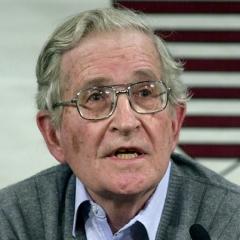
Noam Chomsky

Noam Chomsky Quotes

Linguist

Filter quotes by topic

Famous Noam Chomsky Quotes

“Most of us who were opposed to the war, especially in the early '60's - the war we were opposed to was the war on South Vietnam which destroyed South Vietnam's rural society. The South was devastated. But now anyone who opposed this atrocity is regarded as having defended North Vietnam. And that's part of the effort to present the war as if it were a war between South Vietnam and North Vietnam with the United States helping the South. Of course it's fabrication. But it's "official truth" now.”

“From 1962 to 1965 the US was dedicated to try to prevent the independence of South Vietnam, the reason was of course that Kennedy and Johnson knew that if any political solution was permitted in the south, the National Liberation Front would effectively come to power, so strong was its political support in comparison with the political support of the so-called South Vietnamese government.”

“Younger people who are being indoctrinated into the contemporary system of falsification - they really have to do some research to find out what is the truth. In the general population, people forget or don't care that much. And gradually what you hear drilled into your head everyday comes to be believed. People don't understand what you're talking about any more if you discuss the American war on South Vietnam.”

“There's kind of a hidden point which isn't being brought out, and that is that it is inconceivable that the U.S. would permit democracy in the Middle East, and for a very simple reason. Just take a look at polls of Arab public opinion. They exist. You can't find them in the press, but they exist from prestigious polling agencies. Released by major institutions. And what they show is that if there was democracy in the Middle East, the entire U.S. program for domination of the Middle East would be down the tube.”

“Looking at polls of Arab public opinion, you look at popular figures, the most popular figure is the prime minister of Turkey, Erdogan, and then it goes down the list. You get Osama Bin Laden, Saddam Hussein, you don't get Obama, or in fact any western leader. The public doesn't want the whole imperial project. So if you had democracy, it would be all over.”

“Barack Obama is an opportunist, mostly supported by the financial institutions. He had no positions on anything. He's very intelligent. If you look at his program, almost no substance. Change, hope, what's that? I mean, he had some policies, but it was almost certain that he would give them up instantly, which he did.”

“If you go back a century in Europe, all over the place people were speaking different languages. There were dozens of languages in France and Italy, and they're all called French [and Italian], but they were not mutually comprehensible. They were different languages. And they have mostly disappeared in the last century or so. Some are being preserved, like Welsh, some are being revived, like Basque or Catelan to some extent. There are plenty of people in Europe who can't talk to their grandmother because they talk a different language.”

“The local grocery store was a gathering, a community place. You knew the owner, if you didn't have any money they'd let you go for a couple days. You talked. It was a friendly place. Supermarkets are totally impersonal. I mean, you may say hello to the checkout girl or something, but the personal connections are all gone.”

“There are by now declassified documents from the 1950s that tells you a lot about what's going on in Egypt and we should have known it then. It's about exactly what's happening, how we can disregard public opinion as long as the dictators we support are capable of suppressing their populations. So to hell with public opinion. That's all right there in the 1950's. That's not security. That's not security of the government. That's, if anything, security from its own population. And there's a lot of that.”

“By accident of geography, the world's major oil resources are in Shi'ite-dominated areas. Iran's oil is concentrated right near the gulf, which happens to be an Arab area, not Persian. Khuzestan is Arab, has been loyal to Iran, fought with Iran not Iraq during the Iran-Iraq war. This is a potential source of dissension. I would be amazed if there isn't an attempt going on to stir up secessionist elements in Khuzestan.”

“We're supposed to believe that oil had nothing to do with it, that if Iraq were exporting pickles or jelly and the center of world oil production were in the South Pacific that the United States would've liberated them anyway. It has nothing to do with the oil, what a crass idea. Anyone with their head screwed on knows that that can't be true.”

“Allowing an independent and sovereign Iraq could be a nightmare for the United States. It would mean that it would be Shi'ite-dominated, at least if it's minimally democratic. It would continue to improve relations with Iran, just what the United States doesn't want to see. And beyond that, right across the border in Saudi Arabia where most of Saudi oil is, there happens to be a large Shi'ite population, probably a majority.”

“China is the center of the Asian energy security grid, which includes the Central Asian states and Russia. India is also hovering around the edge, South Korea is involved, and Iran is an associate member of some kind. If the Middle East oil resources around the Gulf, which are the main ones in the world, if they link up to the Asian grid, the United States is really a second-rate power. A lot is at stake in not withdrawing from Iraq.”

“There was a free election in Palestine, but it came out the wrong way. So instantly, the United States and Israel with Europe tagging along, moved to punish the Palestinian people, and punish them harshly, because they voted the wrong way in a free election. That's accepted here in the West as perfectly normal. That illustrates the deep hatred and contempt for democracy among western elites, so deep-seated they can't even perceive it when it's in front of their eyes. You punish people severely if they vote the wrong way in a free election.”

“I remember talking to, 40 years ago, one of the leading people in the government who was involved in arms control, pressing for arms control measures, détente, and so on. He's very high up, and we were talking about whether arms control could succeed. And only partially as a joke he said, "Well it might succeed if the high tech industry makes more profit from arms control than it can make from weapons-related research and production. If we get to that tipping point maybe arms control will work." He was partially joking but there's a truth that lies behind it.”

“The manufacturing industry is starting to press for some kind of national healthcare. Now it's beginning to put it on the agenda. It doesn't matter if the population wants it. What 90% of the population wants would be kind of irrelevant. But if part of the concentration of corporate capital that basically runs the country - another thing we're not allowed to say but it's obvious - if part of that sector becomes in favor then the issue moves onto the political agenda.”

“Human needs are served by a sustainable lifestyle, almost by definition, if humans include coming generations. And a shift to such technologies as high-speed rail instead of maximizing fossil fuel use, and solar energy, is not "relentless resource extraction."”

“What has to be done today is (1) large-scale conversion (weatherizing , etc.), (2) sharp change in transportation to greater efficiency, like high-speed rail, (3) serious efforts to move to sustainable energy, probably solar in the somewhat longer term, (4) other adjustments that are feasible. If done effectively, that might be enough to stave off disaster. If not, then we can give up the ghost, because there are no alternatives in this world, at least none that I've seen suggested.”

“In a capitalist system, there's a principle that if you invest, especially in a long-term risky investment, if something comes out of it, you're supposed to get the profit. It doesn't happen in our system. The taxpayer paid for it and gets nothing - assumes all of the risk, gets zero. The money goes into the pockets of Bill Gates and Steve Jobs, who are ripping off decades of work in the public sector.”

“If [Respulicans] can't get rid of [Obamacare], they're going to have to tell their base, we've been lying to you for the last five years. So they're willing to go to almost any extent to do that. That's unusual, in fact I think it's unique in the history of modern parliamentary systems. And it's very dangerous for the country and for the world.”

“The shutdown itself is bad but not devastating. The real danger will come up in a couple of weeks. There's legislation which is in fact routine - it's passed every year - which allows the government to borrow money, otherwise it can't function. If Congress does not approve this budget request, the government may have to default.”

“Maybe [the Republicans] 'll find ways around it, but the financial system of the world depends very heavily on the credibility of the US Treasury Department. US Treasury securities are what's called "good as gold"; they're the basis of international finance, and if the government can't uphold them, if they become valueless, the effect on the international financial system could be quite severe. But in order to destroy a limited health-care law, the right-wing Republicans, the reactionary Republicans, are willing to do that.”

“Credible reports came through that Syria had used chemical weapons. Whether it's true actually is still open to question, but it's very probably true. At that point, what was at stake was what is called credibility. So if you read the political actors, political leadership, foreign policy commentary, they constantly point out accurately that US credibility was at stake, and we have to maintain US credibility. So therefore something had to be done to show you can't violate our orders.”

“If some small storekeeper somewhere decides he's not going to pay the money, the Godfather doesn't let him get away with it. The money doesn't mean anything to him, but he sends in his goons to beat him to a pulp. You have to establish credibility, otherwise conformity to your orders will tend to erode. International affairs runs in much the same way.”

“Luckily for [Barack] Obama, the Russians came along and rescued him with this proposal [to confiscate Assad's chemical weapons] which he quickly accepted - it was a way out of the embarrassment of facing likely defeat. They still have the option of bombing if they want to. And incidentally, to add one comment about this, you'll notice that this would be a very good moment to institute a call for imposing the Chemical Weapons Convention on the Middle East.”

“If [climate change ] became a serious proposal in the United States, there would be a huge propaganda onslaught by the business community, the energy corporations and many others, to try to frighten the population into opposing it - claiming that if they have it, all sorts of terrible things will happen, like you won't be able to heat your home, or whatever the story is.”

“Capitalism is based on the principle that everything has to be privately owned; it can't be held in common. There is even a dogma, which is today called, the "tragedy of the commons" which holds that if things are held in common they are going to be destroyed. If they're privatized, like you give them to Bechtel or Monsanto or ExxonMobil, then they'll be preserved because that's the capitalist's religion.”

“It's been a real success - one of the great business successes in the United States - to break down organization, to separate people too: it's part of consumerism. If you can drive people toward individual consumption, that's the highest goal in life. And furthermore, drive them into debt so they're trapped. You don't have to worry about a democracy function because people are trapped and they're alone.”

“If there had been a charismatic figure in the United States who could mobilize fears, anger, racism, a sense of loss of the future that belongs to us, this country could be in real danger. We're lucky that there never has been an honest, charismatic figure. McCarthy was too much of a thug, you know? Nixon was too crooked. Trump, I think, is too much of a clown. So, we've been lucky.”

“If in fact, the US story is correct, if it is true that Syria used chemical weapons, then it wouldn't be a major crime to send a kind of shot across the bow saying you can't do this anymore. Not the best thing in the world, but not a major crime, either. So, I think at the very least there should have been an inquiry into what happened. But just joining the bandwagon about how we're finally standing up to crimes in Syria, that's ridiculous.”

“If you assume that there is no hope, you guarantee that there will be no hope. If you assume that there is an instinct for freedom, that there are opportunities to change things, then there is a possibility that you can contribute to making a better world.”

“If you look at history, even recent history, you see that there is indeed progress. . . . Over time, the cycle is clearly, generally upwards. And it doesn't happen by laws of nature. And it doesn't happen by social laws. . . . It happens as a result of hard work by dedicated people who are willing to look at problems honestly, to look at them without illusions, and to go to work chipping away at them, with no guarantee of success — in fact, with a need for a rather high tolerance for failure along the way, and plenty of disappointments.”

“Optimism is a strategy for making a better future. Because unless you believe that the future can be better, it’s unlikely you will step up and take responsibility for making it so. If you assume that there’s no hope, you guarantee that there will be no hope. If you assume that there is an instinct for freedom, there are opportunities to change things, there’s a chance you may contribute to making a better world. The choice is yours.”