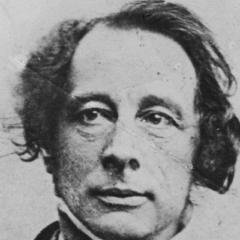
“A mob is usually a creature of very mysterious existence, particularly in a large city. Where it comes from, or whither it goes, few men can tell. Assembling and dispersing with equal suddenness, it is as difficult to follow to its various sources as the sea itself; nor does the parallel stop here, for the ocean is not more fickle and uncertain, more terrible when roused, more unreasonable or more cruel.”
Source: Charles Dickens's works. Charles Dickens ed. [18 vols. of a 21 vol. set. Wanting A child's history of England; Christmas stories; The mystery of Edwin Drood].
“The wine-shops breed, in physical atmosphere of malaria and a moral pestilence of envy and vengeance, the men of crime and revolution.”
Source: Household Words
“For who can wonder that man should feel a vague belief in tales of disembodied spirits wandering through those places which they once dearly affected, when he himself, scarcely less separated from his old world than they, is for ever lingering upon past emotions and bygone times, and hovering, the ghost of his former self, about the places and people that warmed his heart of old?”
Source: The Mystery of Edwin Drood and Other Stories
“There are many pleasant fictions of the law in constant operation, but there is not one so pleasant or practically humorous as that which supposes every man to be of equal value in its impartial eye, and the benefits of all laws to be equally attainable by all men, without the smallest reference to the furniture of their pockets.”
Source: The Life And Adventures Of Nicholas Nickleby
“The worst of all listeners is the man who does nothing but listen.”
Source: all the year round
“The receptive attitude enables one mind to fix itself to another as by spiritual grappling-irons. When you see that every word you utter us taken in, and weighed, and measured by your listener, you cannot free yourself from the influence of his presence. You are compelled to have in your thoughts not only the words you utter, but the man to whom they are spoken. You must not only talk, and talk well, but you must talk to him.”
“Of all bad listeners, the worst and most terrible to encounter is the man who is so fond of listening that he wishes to hear, not only your conversation, but that of every other person in the room.”
Source: all the year round
“The habit of paying compliments kept a man's tongue oiled without any expense.”
Source: The Old Curiosity Shop--and Reprinted Pieces
“It's over, and can't be helped, and that's one consolation, as they always say in Turkey, when they cut the wrong man's head off.”
“Although I am an old man, night is generally my time for walking.”
Source: The Old Curiosity Shop--and Reprinted Pieces
“I can see others in the sunlight; I can see our boats' crews and our athletic young men on the glistening water, or speckled with the moving lights of sunlit leaves; but I myself am always in the shadow looking on. Not unsympathetically, - God forbid! - but looking on alone, much as I looked at Sylvia from the shadows of the ruined house, or looked at the red gleam shining through the farmer's windows, and listened to the fall of dancing feet, when all the ruin was dark that night in the quadrangle.”
Source: Hard Times (And Other Stories)
“"But even if he has been wicked," pursued Rose, "think how young he is; think that he may never have known a mother's love, or the comfort of a home; that ill-usage and blows, or the want of bread, may have driven him to herd with men who have forced him to guilt. Aunt, dear aunt, for mercy's sake, think of this, before you let them drag this sick child to a prison, which in any case must be the grave of all his chances of amendment."”
Source: The Charles Dickens Collection Volume One: Oliver Twist, Great Expectations, and Bleak House
“If Natur has gifted a man with powers of argeyment, a man has a right to make the best of 'em, and has not a right to stand on false delicacy, and deny that he is so gifted; for that is a turning of his back on Natur, a flouting of her, a slighting of her precious caskets, and a proving of one's self to be a swine that isn't worth her scattering pearls before.”
Source: Barnaby Rudge ... With a frontispiece drawn by Hablot Knight Browne, etc
“"I saw her, in the fire, but now. I hear her in music, in the wind, in the dead stillness of the night," returned the haunted man.”
Source: Dickens' Christmas Spirits: A Christmas Carol and Other Tales
“It was a very aged, ghostly place; the church had been built many hundreds of years ago, and had once had a convent or monastery attached; for arches in ruins, remains of oriel windows, and fragments of blackened walls, were yet standing-, while other portions of the old building, which had crumbled away and fallen down, were mingled with the churchyard earth and overgrown with grass, as if they too claimed a burying-place and sought to mix their ashes with the dust of men.”
Source: The Old Curiosity Shop: And Reprinted Pieces
“"Ghost of the Future," he exclaimed, "I fear you more than any spectre I have seen. But as I know your purpose is to do me good, and as I hope to live to be another man from what I was, I am prepared to bear you company, and do it with a thankful heart. Will you not speak to me?"”
Source: A Christmas Carol
“"It is a sensation not experienced by many mortals," said he, "to be looking into a churchyard on a wild windy night, and to feel that I no more hold a place among the living than these dead do, and even to know that I lie buried somewhere else, as they lie buried here. Nothing uses me to it. A spirit that was once a man could hardly feel stranger or lonelier, going unrecognized among mankind, than I feel."”
Source: Charles Dickens's works. Charles Dickens ed. [18 vols. of a 21 vol. set. Wanting A child's history of England; Christmas stories; The mystery of Edwin Drood].
“As he glided stealthily along, creeping beneath the shelter of the walls and doorways, the hideous old man seemed like some loathsome reptile, engendered in the slime and darkness through which he moved: crawling forth, by night, in search of some rich offal for a meal.”
Source: Oliver Twist
“What lawsuits grow out of the graves of rich men, every day; sowing perjury, hatred, and lies among near kindred, where there should be nothing but love!”
Source: The Life and Adventures of Martin Chuzzlewit
“"A child!" said Edith, looking at her. "When was I a child? What childhood did you ever leave to me? I was a woman - artful, designing, mercenary, laying snares for men - before I knew myself, or you, or even understood the base and wretched aim of every new display I learnt. You gave birth to a woman. Look upon her. She is in her pride tonight."”
Source: Charles Dickens's works. Charles Dickens ed. [18 vols. of a 21 vol. set. Wanting A child's history of England; Christmas stories; The mystery of Edwin Drood].
“The expression of a man's face is commonly a help to his thoughts, or glossary on his speech; but the countenance of Newman Noggs, in his ordinary moods, was a problem which no stretch of ingenuity could solve.”
Source: Novels
“Mr. Pickwick took a seat and the paper, but instead of reading the latter, peeped over the top of it, and took a survey of the man of business, who was an elderly, pimply-faced, vegetable-diet sort of man, in a black coat, dark mixture trousers, and small black gaiters; a kind of being who seemed to be an essential part of the desk at which he was writing, and to have as much thought or sentiment.”
Source: The posthumous papers of the Pickwick Club
“As I said just now, the world has gone past me. I don't blame it; but I no longer understand it. Tradesmen are not the same as they used to be, apprentices are not the same, business is not the same, business commodities are not the same. Seven-eighths of my stock is old-fashioned. I am an old-fashioned man in an old-fashioned shop, in a street that is not the same as I remember it. I have fallen behind the time, and am too old to catch it again.”
Source: Charles Dickens's works. Charles Dickens ed. [18 vols. of a 21 vol. set. Wanting A child's history of England; Christmas stories; The mystery of Edwin Drood].
“Old Mr. Rarx was not a pleasant man to look at, nor yet to talk to, or to be with, for no one could help seeing that he was a sordid and selfish character, and that he had warped further and further out of the straight with time.”
Source: Dickens Ultimate Christmas Collection: The Greatest Stories & Novels for Christmas Time: A Christmas Carol, Doctor Marigold, Oliver Twist, Tom Tiddler's Ground, The Holly-Tree and more (Illustrated): The Best Loved Christmas Classics in One Volume
“He was the meekest of his sex, the mildest of little men. He sidled in and out of a room, to take up the less space. He walked as softly as the Ghost in Hamlet, and more slowly. He carried his head on one side, partly in modest depreciation of himself, partly in modest propitiation of everybody else.”
Source: The Personal History of David Copperfield ... With Frontispiece by H. K. Browne
“What is natural in me, is natural in many other men, I infer, and so I am not afraid to write that I never had loved Steerforth better than when the ties that bound me to him were broken. In the keen distress of the discovery of his unworthiness, I thought more of all that was brilliant in him, I softened more towards all that was good in him, I did more justice to the qualities that might have made him a man of a noble nature and a great name, than ever I had done in the height of my devotion to him.”
Source: Four Novels: Great Expectations, David Copperfield, A Tale of Two Cities, and Hard Times
“The man who now confronted Gashford, was a squat, thickset personage, with a low, retreating forehead, a coarse shock head of hair, and eyes so small and near together, that his broken nose alone seemed to prevent their meeting and fusing into one of the usual size.”
Source: A Cyclopedia of the Best Thoughts of Charles Dickens
“He had a certain air of being a handsome man-which he was not; and a certain air of being a well-bred man-which he was not. It was mere swagger and challenge; but in this particular, as in many others, blustering assertion goes for proof, half over the world.”
Source: LITTLE DORRIT
“Rattle me out of bed early, set me going, give me as short a time as you like to bolt my meals in, and keep me at it. Keep me always at it, and I'll keep you always at it, you keep somebody else always at it. There you are with the Whole Duty of Man in a commercial country.”
Source: Charles Dickens's works. Charles Dickens ed. [18 vols. of a 21 vol. set. Wanting A child's history of England; Christmas stories; The mystery of Edwin Drood].
“In truth, no men on earth can cheer like Englishmen, who do so rally one another's blood and spirit when they cheer in earnest, that the stir is like the rush of their whole history, with all its standards waving at once, from Saxon Alfred's downwards.”
Source: Delphi Complete Works of Charles Dickens (Illustrated)
“The haggard aspect of the little old man was wonderfully suited to the place; he might have groped among old churches and tombs and deserted houses and gathered all the spoils with his own hands. There was nothing in the whole collection but was in keeping with himself nothing that looked older or more worn than he.”
Source: The Old Curiosity Shop
“Recollections of the past and visions of the present come to bear me company; the meanest man to whom I have ever given alms appears, to add his mite of peace and comfort to my stock; and whenever the fire within me shall grow cold, to light my path upon this earth no more, I pray that it may be at such an hour as this, and when I love the world as well as I do now.”
Source: CHARLES DICKENS – The Complete Short Stories: 190+ Christmas Tales, Social Sketches, Tales for Children & Other Stories (Illustrated): A Christmas Carol, The Chimes, The Battle of Life, The Haunted Man, Sketches by Boz, Mudfog Papers, Reprinted Pieces, Pearl-Fishing, Christmas Stories, Child's Dream of a Star, Holiday Romance…
“'I believe, Mr. Snitchey,' said Alfred, 'there are quiet victories and struggles, great sacrifices of self, and noble acts of heroism, in it - even in many of its apparent lightnesses and contradictions - not the less difficult to achieve, because they have no earthly chronicle or audience - done every day in nooks and corners, and in little households, and in men's and women's hearts - any one of which might reconcile the sternest man to such a world, and fill him with belief and hope in it.”
Source: The Complete Works of Charles Dickens: A Christmas Carol and Other Christmas Books
“I admire machinery as much is any man, and am as thankful to it as any man can be for what it does for us. But it will never be a substitute for the face of a man, with his soul in it, encouraging another man to be brave and true.”
Source: Christmas Stories from
“Some happy talent, and some fortunate opportunity, may form the two sides of the ladder on which some men mount, but the rounds of that ladder must be made of stuff to stand wear and tear; and there is no substitute for thorough-going, ardent, and sincere earnestness.”
Source: Delphi Complete Works of Charles Dickens (Illustrated)
“A man can well afford to be as bold as brass, my good fellow, when he gets gold in exchange!”
Source: The Life and Adventures of Martin Chuzzlewit
“Man is but mortal: and there is a point beyond which human courage cannot extend. Mr. Pickwick gazed through his spectacles for an instant on the advancing mass, and then fairly turned his back and-we will not say fled; firstly, because it is an ignoble term, and, secondly, because Mr. Pickwick's figure was by no means adapted for that mode of retreat-he trotted away, at as quick a rate as his legs would convey him;.”
Source: The posthumous papers of the Pickwick Club
“... I had a latent impression that there was something decidedly fine in Mr. Wopsle's elocution - not for old associations' sake, I am afraid, but because it was very slow, very dreary, very up-hill and down-hill, and very unlike any way in which any man in any natural circumstances of life or death ever expressed himself about anything.”
Source: THE GREATEST DICKENS CLASSICS (Illustrated Edition): Oliver Twist, The Pickwick Papers, Great Expectations, A Tale of Two Cities, Hard Times, David Copperfield, A Christmas Carol, Bleak House, Little Dorrit, Our Mutual Friend, The Life of Dickens
“Poetry's unnat'ral; no man ever talked poetry 'cept a beadle on boxin' day, or Warren's blackin' or Rowland's oil, or some o' them low fellows; never you let yourself down to talk poetry, my boy.”
“I don't quite recollect how many tumblers of whiskey toddy each man drank after supper; but this I know, that about one o'clock in the morning, the baillie's grown-up son became insensible while attempting the first verse of 'Willie brewed a peck o' maut'; and he having been, for half an hour before, the only other man visible above the mahogany, it occurred to my uncle that it was almost time to think about going.”
Source: The Pickwick Papers: The Posthumous Papers of the Pickwick Club
“The water of the fountain ran, the swift river ran, the day ran into evening, so much life in the city ran into death according to rule, time and tide waited for no man, the rats were sleeping close together in their dark holes again, the Fancy Ball was lighted up at supper, all things ran their course.”
Source: a tale of two cities
“"Lord bless you!" said Mr. Omer, resuming his pipe, "a man must take the fat with the lean; that's what he must make up his mind to, in this life. "”
Source: Delphi Complete Works of Charles Dickens (Illustrated)
“This fine young man had all the inclination to be a profligate of the first water, and only lacked the one good trait in the common catalogue of debauched vices - open-handedness - to be a notable vagabond. But there his griping and penurious habits stepped in; and as one poison will sometimes neutralise another, when wholesome remedies would not avail, so he was restrained by a bad passion from quaffing his full measure of evil, when virtue might have sought to hold him back in vain.”
Source: Children's Tales from Dickens – The Great Classics & The Wonderful Stories for Children (Illustrated Edition): Oliver Twist, David Copperfield, Great Expectations, A Christmas Carol, Holiday Romance, The Old Curiosity Shop, Nicholas Nickleby, Martin Chuzzlewit, Christmas Stories, A Child’s Dream of a Star…
“Although a man may lose a sense of his own importance when he is a mere unit among a busy throng, all utterly regardless of him, it by no means follows that he can dispossess himself, with equal facility, of a very strong sense of the importance and magnitude of his cares.”
Source: The Life And Adventures Of Nicholas Nickleby
“An observer of men who finds himself steadily repelled by some apparently trifling thing in a stranger is right to give it great weight. It may be the clue to the whole mystery. A hair or two will show where a lion is hidden. A very little key will open a very heavy door.”
Source: The Mystery of Edwin Drood and Other Stories
“... I feel certain that his tale is true. Feeling that certainty, I befriend him. As long as that certainty shall last, I will befriend him. And if any consideration could shake me in this resolve, I should be so ashamed of myself for my meanness, that no man's good opinion - no, nor no woman's - so gained, could compensate me for the loss of my own.”
Source: The Complete Works of Charles Dickens: Edwin Drood and Miscellaneous
“He was bolder in the daylight-most men are.”
Source: The Pickwick Papers
“There is not a manufacturer or tradesman in existence, who would not employ a man who takes a reasonable degree of pride in the appearance of himself and those about him, in preference to a sullen, slovenly fellow, who works doggedly on, regardless of his own clothing and that of his wife and children, and seeming to take pleasure or pride in nothing.”
Source: Sunday Under Three Heads: Easyread Super Large 24pt Edition
“It has always been my opinion since I first possessed such a thing as an opinion, that the man who knows only one subject is next tiresome to the man who knows no subject. Therefore, in the course of my life I have taught myself whatever I could, and although I am not an educated man, I am able, I am thankful to say, to have an intelligent interest in most things.”
Source: Dickens Ultimate Christmas Collection: The Greatest Stories & Novels for Christmas Time: A Christmas Carol, Doctor Marigold, Oliver Twist, Tom Tiddler's Ground, The Holly-Tree and more (Illustrated): The Best Loved Christmas Classics in One Volume
“No one has the least regard for the man; with them all, he has been an object of avoidance, suspicion, and aversion; but the spark of life within him is curiously separable from himself now, and they have a deep interest in it, probably because it IS life, and they are living and must die.”
Source: Our Mutual Friend: Easyread Edition