Quotessence
Home / Authors / Douglas Hofstadter Books
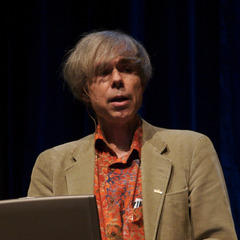
Douglas Hofstadter

Douglas Hofstadter Books

Professor

Related Quotes

“Historically, people have been naive about what qualities, if mechanized, would undeniably constitute intelligence. Is intelligence an ability to integrate functions symbolically? If so, then AI already exists, since symbolic integration routines outdo the best people in most cases. If intelligence involves learning, creativity, emotional responses, a sense of beauty, a sense of self, then there is a long road ahead, and it may be that these will only be realized when we have totally duplicated a living brain.”

“And, carrying this thought just a little further, in some ways, Carol was me and I no less was her. And I still am her, in some sense. Sometimes I describe how I feel these days by saying, "Well, now I'm Doug-&-Carol." Carol's hopes and dreams now reside in my brain; they grew there over the years, just as they grew inside her brain. They still flourish in mine, and in a small, diluted way, far less than before, some of Carol's soul, some of Carol's consciousness just a tiny fraction, to be sure, but still, not nothing at all - survives inside me, because of all the merging and blurring over years of intimacy. And I'm not the only one in whom Carol's way of looking at the world, her way of being, lives on to different degrees, she lives on inside those people who knew her intimately and loved her deeply: her family and her close friends.”

“Do you remember your first sip of beer? Terrible! How could anyone like that stuff? But beer, you reflect, is an acquired taste; one gradually trains oneself—or just comes—to enjoy that flavor. What flavor? The flavor of that first sip? No one could like that flavor! Beer tastes different to the experienced beer drinker. Then beer isn't an acquired tast; one doesn't learn to like that first taste; one gradually comes to experience a different, and likable, taste. Had the first sip tasted that way, you would have liked beer wholeheartedly from the beginning!”

“INTROSPECTION AND INSANITY: A GODELIAN PROBLEM I think it can have suggestive value to translate Godel's Theorem into other domains, provided one specifies in advance that the translations are metaphorical and are not intended to be taken literally. That having been said, I see two major ways of using analogies to connect Godel's Theorem and human thoughts. One involves the problem of wondering about one's sanity. How can you figure out if you are sane? This is a Strange Loop indeed. Once you begin to question your own sanity, you can get trapped in an ever-tighter vortex of self-fulfilling prophecies, though the process is by no means inevitable. Everyone knows that the insane interpret the world via their own peculiarly consistent logic; how can you tell if your own logic is 'peculiar' or not, given that you have only your own logic to judge itself? I don't see any answer. I am just reminded of Godel's second Theorem, which implies that the only versions of formal number theory which assert their own consistency are inconsistent...”

“What is an "I", and why are such things found (at least so far) only in association with, as poet Russell Edson once wonderfully phrased it, "teetering bulbs of dread and dream" - that is, only in association with certain kinds of gooey lumps encased in hard protective shells mounted atop mobile pedestals that roam the world on pairs of slightly fuzzy, jointed stilts?”

“Perhaps the problem is the seeming need that people have of making black-and-white cutoffs when it comes to certain mysterious phenomena, such as life and consciousness. People seem to want there to be an absolute threshold between the living and the nonliving, and between the thinking and the "merely mechanical," ... But the onward march of science seems to force us ever more clearly into accepting intermediate levels of such properties.”

“I would proclaim that the vast majority of what [say, Scientific American] is true-yet my ability to defend such a claim is weaker than I would like. And most likely the readers, authors, and editors of that magazine would be equally hard pressed to come up with cogent, non-technical arguments convincing a skeptic of this point, especially if pitted against a clever lawyer arguing the contrary. How come Truth is such a slippery beast?”

“The proverbial German phenomenon of the verb-at-the-end about which droll tales of absentminded professors who would begin a sentence, ramble on for an entire lecture, and then finish up by rattling off a string of verbs by which their audience, for whom the stack had long since lost its coherence, would be totally nonplussed, are told, is an excellent example of linguistic recursion.”

“The key question is, no matter how much you absorb of another person, can you have absorbed so much of them that when that primary brain perishes, you can feel that that person did not totally perish from the earth... because they live on in a 'second neural home'?... In the wake of a human being's death, what survives is a set of afterglows, some brighter and some dimmer, in the collective brains of those who were dearest to them... Though the primary brain has been eclipsed, there is, in those who remain... a collective corona that still glows.”

“We create an image of who we are inside our self. The image then becomes very deeply entrenched, and it becomes the thing that we attribute responsibility to - we say "I", "I" did this because "I" wanted to, because "I" am a good person or because "I" am a bad person. The loop is the fact that we represent our selves, our desires, hopes, dreads and dreams: it is the way in which we conceive of ourselves, rather than the way we conceive of Mount Everest or of a tree. And I say it exists entirely in the loop: the self is an hallucination hallucinated by an hallucination.”