Quotessence
Home / Authors / Hermann Hesse
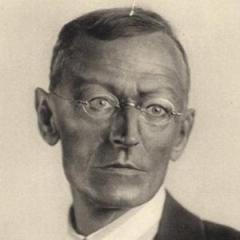
Hermann Hesse

Hermann Hesse Quotes

Poet

Filter quotes by topic

Famous Hermann Hesse Quotes

“On making music, Herr Haller, on making music as well and as much as possible and with all the intensity of which one is capable. That is the point, Monsieur. Though I carried the complete works of Bach and Haydn in my head and could say the cleverest things about them, not a soul would be the bet- ter for it. But when I take hold of my mouthpiece and play a lively shimmy, whether the shimmy be good or bad, it will give people pleasure. It gets into their legs and into their blood. That's the point and that alone. Look at the faces in a dance hall at the moment when the music strikes up after a longish pause, how eyes sparkle, legs twitch and faces begin to laugh. That is why one makes music.”

“In every piece of music he played, I heard more than the piece itself - it seemed as though everything he played was related, mysteriously connected...all of them said the same thing, said what the musician had in his soul too: yearning, a sincere grasping at the world combined with desperately cutting oneself off from it, a fervent hearkening to one's own dark soul, the frenzy of devotion and a profound curiosity about the miraculous.”

“The world, Govinda, my friend, is not imperfect, not to be seen as on a slow path towards perfection: No, it is perfect in every moment, all transgression already bears grace within itself, all little children already have the aged in themselves, all sucklings death, all the dying eternal life.... For that reason to me it seems what is appears good, death as life, transgression as holiness, cleverness as foolishness; everything must be so, requiring only my acceptance, only my willingness, my loving accord, for it to be good for me, to work for my benefit, never able to harm me.”

“For it cannot be denied that all over the world and in all ages there are beings who are perceived to be extraordinary, charming, and appealing, and whom many honor as benevolent spirits, because they make one think of a more beautiful, a freer, a more winged life than the one we lead.”

“Welcher Vater, welcher Lehrer hat ihn davor schützen können, selbst das Leben zu leben, selbst sich mit dem Leben zu beschmutzen, selbst Schuld auf sich zu laden, selbst den bitteren Trank zu trinken, selber seinen Weg zu finden? Glaubst du denn, Lieber, dieser Weg bleibe irgend jemandem vielleicht erspart? Vielleicht deinem Söhnchen, weil du es liebst, weil du ihm gern Leid und Schmerz und Enttäuschung ersparen möchtest? Aaber auch wenn du zehnmal für ihn stürbest, würdest du ihm nicht den kleinsten Teil seines Schicksals damit abnehmen können.”

“Among the many worlds which man did not receive as a gift of nature, but which he created with his own mind, the world of books is the greatest. Every child, scrawling his first letters on his slate and attempting to read for the first time, in so doing, enters an artificial and complicated world; to know the laws and rules of this world completely and to practice them perfectly, no single human life is long enough. Without words, without writing, and without books there would be no history, there could be no concept of humanity. And if anyone wants to try to enclose in a small space in a single house or single room, the history of the human spirit and to make it his own, he can only do this in the form of a collection of books.”

“But when we have offered love and reverence of our own accord, and not out of habit, when we have been disciples and friends with our innermost feelings, then it is a bitter and terrible moment when the realization is suddenly brought home to us that the guiding current of our life is bearing us away from those we love. Then the terrified heart flees anxiously back to the valleys of childhood virtues, and cannot believe that the rupture must take place, that another bond must be severed.”

“Lorsque enfin il se sentit absolument libre, Harry s'aperçut soudain que sa liberté était une mort, qu'il était resté seul, que le monde le laissait lugubrement tranquille, qu'il ne se souciait plus des hommes ni de lui-même, qu'il étouffait lentement dans une atmosphère toujours plus rare de vide et d'isolement. La solitude et l'indépendance avaient cessé d'être son désir pour devenir son sort et sa condamnation; le vœu magique était formulé et ne pouvait être repris; cela ne servait plus à rien de tendre les mains, d'être plein de désir et de bonne volonté, prêt à l'attachement et à la communauté : maintenant, on le laissait seul.”

“Would you actually believe that you had committed your foolish acts in order to spare your son from committing them too? And could you in any way protect your son from Sansara? How could you? By means of teachings, prayer, admonition? My dear, have you entirely forgotten that story, that story containing so many lessons, that story about Siddhartha, a Brahman's son, which you once told me here on this very spot? Who has kept the Samana Siddhartha safe from Sansara, from sin, from greed, from foolishness? Were his father's religious devotion, his teachers warnings, his own knowledge, his own search able to keep him safe? Which father, which teacher had been able to protect him from living his life for himself, from soiling himself with life, from burdening himself with guilt, from drinking the bitter drink for himself, from finding his path for himself? Would you think, my dear, anybody might perhaps be spared from taking this path? That perhaps your little son would be spared, because you love him, because you would like to keep him from suffering and pain and disappointment? But even if you would die ten times for him, you would not be able to take the slightest part of his destiny upon yourself.”

“After having been standing by the gate of the garden for a long time, Siddhartha realised that his desire was foolish, which had made him go up to this place, that he could not help his son, that he was not allowed to cling him. Deeply, he felt the love for the run-away in his heart, like a wound, and he felt at the same time that this wound had not been given to him in order to turn the knife in it, that it had to become a blossom and had to shine.”

“Be that as it may, one opinion that has often been expressed in the course of the war is absolutely mistaken: the opinion that, through its sheer magnitude and the gigantic mechanism of horror it set in motion, this war would frighten future generations out of ever making war again. Fear teaches men nothing. If men enjoy killing, no memory of war will deter them. Nor will the knowledge of the material damage wrought by war. Only in infinitesimal degree do men's actions spring from rational considerations. One can be thoroughly convinced that an action is absurd and still delight in it. Every passionate man does just that.”

“Obedient to no man, dependent only on weather and season, without a goal before them or a roof above them, owning nothing, open to every whim of fate, the homeless wanderers lead their childlike, brave, shabby existence. They are the sons of Adam, who was driven out of Paradise; the brothers of the animals, of innocence. Out of heaven's hand they accept what is given them from moment to moment: sun, rain, fog, snow, warmth, cold, comfort, and hardship; time does not exist for them and neither does history, or ambition, or that bizarre idol called progress and evolution, in which houseowners believe so desperately. A wayfarer may be delicate or crude, artful or awkward, brave or cowardly—he is always a child at heart, living in the first day of creation, before the beginning of the history of the world, his life always guided by a few simple instincts and needs. He may be intelligent or stupid; he may be deeply aware of the fleeting fragility of all living things, of how pettily and fearfully each living creature carries its bit of warm blood through the glaciers of cosmic space, or he may merely follow the commands of his poor stomach with childlike greed—he is always the opponent, the deadly enemy of the established proprietor, who hates him, despises him, or fears him, because he does not wish to be reminded that all existence is transitory, that life is constantly wilting, that merciless icy death fills the cosmos all around.”

“In respect to mankind we all of us have but one task. To help mankind as a whole make some small advance, to better a particular institution, to do away with one particular mode of killing - all these are commendable, but they are not my task and yours. Our task as men is this: in our own unique personal lives, to take a short step on the road from animal to man.”

“I feel life trembling within me, in my tongue, on the soles of my feet, in my desire or my suffering, I want my soul to be a wandering thing, able to move back into a hundred forms, I want to dream myself into priests and wanderers, female cooks and murderers, children and animals, and, more than anything else, birds and trees; that is necessary, I want it, I need it so I can go on living, and if sometime I were to lose these possibilities and be caught in so-called reality, then I would rather die.”

“...the Master and the boy followed each other as if drawn along the wires of some mechanism, until soon it could no longer be discerned which was coming and which going, which following and which leading, the old or the young man. Now it seemed to be the young man who showed honour and obedience to the old man, to authority and dignity; now again it was apparently the old man who was required to follow, serve, worship the figure of youth, of beginning, of mirth. And as he watched this at once senseless and significant dream circle, the dreamer felt alternately identical with the old man and the boy, now revering and now revered, now leading, now obeying; and in the course of these pendulum shifts there came a moment in which he was both, was simultaneously Master and small pupil; or rather he stood above both, was the instigator, conceiver, operator, and onlooker of the cycle, this futile spinning race between age and youth.”

“Of all the conceptions of pure bliss that people and poets have dreamed of, listening to the harmony of the spheres always seemed to me the highest and most intense. That is where my dearest and brightest dreams have ranged - to hear for the duration of a heartbeat the universe and the totality of life in its mysterious innate harmony. Alas, how is it that life can be so confusing and out of tune and false, how can there be lies, evil, envy and hate among people, when the shortest song and most simple piece of music preach that heaven is revealed in the purity, harmony and interplay of clearly sounded notes. And how can I upbraid people and grow angry when I myself, with all the good will in the world have been unable to make song and sweet music out of my life?”

“Tanışıklığımızın bu akşamında, bütün bir yaşamı bu güzel ve içtenlikli gözlerin bakışı altında gecirmenin insana mutluluk bağışlayan güzel bir şey sayılacağını, o zaman insanın kötü bir eyleme kalkışamayacağını, kötü bir şey düşünemeyeceğini içimden geçirdim. Ve yine o akşamdan sonra birlik ve bütünlüğe, alabildiğine ince bir ahenge yönelik özlemimi dindirebileceğim bir yerin bulunduğunu, bakışlarına ve sesine varlığımdaki her nabız vuruşunun, her nefesin tüm saflık ve içtenliğiyle yanıt vereceği birinin yeryüzünde yaşadığını biliyordum artık.”

“Cependant, avec un peu de zèle et quelque effort, je pouvais lire Platon, résoudre des calculs trigonométriques ou suivre une analyse chimique. Mais j’étais incapable d’une chose seulement : tirer de mon être le but obscur et me le représenter, comme le faisaient les autres qui savaient avec certitude vouloir être professeur ou juge, médecin ou artiste, et pendant combien de temps, et quels avantages ils retireraient de ces professions.”

“Pjesnik čiji nas stihovi ushićuju možda je bio tužan usamljenik a glazbenik neki sjetan sanjar, ali i tada njegovo djelo dijeli vedrinu bogova i zvijezda. Ono što nam umjetnik daje, to više nije njegov mrak, njegova patnja ili tjeskoba, to je kaplja čišste svjetlosti, vječite vedrine. Kad i cijeli narodi i jezici pokušavaju doprijeti do dubine svijeta, u mitovima, kozmologiji i raznim religijama, ono posljednje i najviše što mogu dostići, to je ta vedrina. Sjećas li se starih Indijaca, naš je stari waldzellski učitelj jednom o njima pričao: svijt patnje, razmišljanja, pokore, askeze; ali posljednja velika otkrića njegova duha bila su svijetla i vedra, vedar je smješak onih koji su preboljeli svijet i smješak Buddhe, vedri su likovi njegove dubokoumne mitologije.”

“Diese Grausamkeiten sind in Wirklichkeit keine. Ein Mensch des Mittelalters würde den ganzen Stil unseres heutigen Lebens noch ganz anders als grausam, entsetzlich und barbarisch verabscheuen! Jede Zeit, jede Kultur, jede Sitte und Tradition hat ihren Stil hat ihre ihr zukommenden Zartheiten und Härten, Schönheiten und Grausamkeiten, hält gewisse Leiden für selbstverständlich, nimmt gewisse Übel geduldig hin. Zum wirklichen Leiden, zur Hölle wir das menschliche Leben nur da, wo zwei Kulturen und Religionen einander überschneiden. […] Es gibt nun Zeiten, wo eine ganze Generation so zwischen zwei Zeiten, zwischen zwei Lebensstile hineingerät, dass ihre jede Selbstverständlichkeit, jede Sitte, jede Geborgenheit und Unschuld verloren geht.”

“Todos los hombres pasan por estas dificultades. Para el hombre medio es éste el punto en que las exigencias de su propia vida entran en colisión dramática con las circunstancias, el punto en que tiene que luchar más duramente por alcanzar el camino que conduce hacia adelante. Muchos viven tal morir y renacer, que es nuestro destino, sólo en ese momento de su vida en que el mundo infantil se resquebraja y se derrumba lentamente, cuando todo lo que amamos nos abandona y, de pronto, sentimos la soledad y la frialdad mortal del universo que nos rodea. Muchos se estrellan para siempre en este escollo y permanecen toda su vida apegados dolorosamente a un pasado irrecuperable, al sueño del paraíso perdido, que es el peor y más nefasto de todos los sueños.”

“When someone is seeking,” said Siddartha, “It happens quite easily that he only sees the thing that he is seeking; that he is unable to find anything, unable to absorb anything, because he is only thinking of the thing he is seeking, because he has a goal, because he is obsessed with his goal. Seeking means: to have a goal; but finding means: to be free, to be receptive, to have no goal. You, O worthy one, are perhaps indeed a seeker, for in striving towards your goal, you do not see many things that are under your nose.”

“When I have neither pleasure nor pain and have been breathing for a while the lukewarm insipid air of these so called good and tolerable days, I feel so bad in my childish soul that I smash my moldering lyre of thanksgiving in the face of the slumbering god of contentment and would rather feel tle very devil burn in me than this warmth of a well-heated room. A wild longing for strong emotions and sensations seethes in me, a rage against this toneless, flat, normal and sterile life. I have a mad impulse to smash something, a warehouse, perhaps, or a cathedral, or myself, to commit outrages, to pull off the wigs of a few revered idols, to provide a few rebellious schoolboys with the longed-for ticket to Hamburg, or to stand one or two representatives of the established order on their heads. For what I always hated and detested and cursed above all things was this contentment, this healthiness and comfort, this carefully preserved optimism of the middle classes, this fat and prosperous brood of mediocrity.”