Quotessence
Home / Authors / Stephen Covey
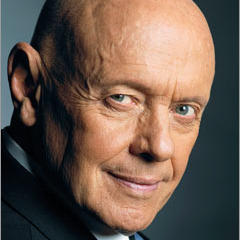
Stephen Covey

Stephen Covey Quotes

Author

Filter quotes by topic

Famous Stephen Covey Quotes

“How does humility manifest itself in leadership and in life? A humble person is more concerned about what is right than about being right, about acting on good ideas than having the ideas, about embracing new truth than defending outdated position, about building the team than exalting self, about recognizing contribution than being recognized for making it.”

“Always treat your employees exactly as you want them to treat your best customers. You can buy a person's hand, but you can't buy his heart; his heart is where his enthusiasm is. You can buy his back, but you can't buy his brain. That's where his creativity is. Treat employees as volunteers just as you treat customers as volunteers, because that's what they are. They volunteer the best parts - their hearts and minds.”

“I believe that God is the source of all the universal, timeless principles. And to Him, I give all the credit and the glory. However, to a person who is not religious, I believe they can live to the highest level of their conscience and develop spiritual intelligence that surpasses most people, including many religious people, who profess but do not practice.”

“But until a person can say deeply and honestly, "I am what I am today because of the choices I made yesterday," that person cannot say, "I choose otherwise.”

“It takes a great deal of character strength to apologize quickly out of one's heart rather than out of pity. A person must possess himself and have a deep sense of security in fundamental principles and values in order to genuinely apologize.”

“In effective personal leadership, visualization and affirmation techniques emerge naturally out of a foundation of well thought through purposes and principles that become the center of a person's life.”

“The person who is truly effective has the humility and reverence to recognize his own perceptual limitations and to appreciate the rich resources available through interaction with the hearts and minds of other human beings.”

“The only person over whom you have direct and immediate control is yourself. The most important assets to develop, preserve and enhance, therefore, are your own capabilities. And no one can do it for you. You must cultivate the habit of leadership effectiveness for yourself - and doing so will be the single best investment you will ever make.”

“I am personally convinced that one person can be a change catalyst, a 'transformer' in any situation, any organization. Such an individual is yeast that can leaven an entire loaf. It requires vision, initiative, patience, respect, persistence, courage, and faith to be a transforming leader.”

“The more authentic you become, the more genuine in your expression, particularly regarding personal experiences and even self-doubts, the more people can relate to your expression and the safer it makes them feel to express themselves. That expression, in turn, feeds on the other person's spirit, and genuine creative empathy takes place, producing new insights and learnings and a sense of excitement and adventure that keeps the process going.”

“Empathic listening is so powerful because it gives you accurate data to work with. Instead of projecting your own autobiography and assuming thoughts, feelings, motives and interpretation, you're dealing with the reality inside another person's head and heart. You're listening to understand. You're focused on receiving the deep communication of another human soul.”

“Too many vacations that last too long, too many movies, too much TV, too much video game playing - too much undisciplined leisure time in which a person continually takes the course of least resistance gradually wastes a life. It ensures that a person's capacities stay dormant, that talents remain undeveloped, that the mind and spirit become lethargic and that the heart remains unfulfilled.”

“The ability to subordinate an impulse to a value is the essence of the proactive person. Reactive people are driven by feelings, by circumstances, by conditions, by their environment. Proactive people are driven by values - carefully thought about, selected and internalized values.”

“As a principle-centered person you try to stand apart from the emotion of the situation and from other factors that would act on you, and evaluate the options. Looking at the balanced whole-the work needs, the family needs, the other needs that may be involved, and the possible implications of the various alternatives - you'll try to come up with the best solution taking all factors into consideration. We are limited but we can push back the borders of our limitations.”

“You will never be able to truly step inside another person, to see the world as he sees it, until you develop the pure desire, the strength of personal character, and the positive Emotional Bank Account, as well as the empathetic listening skills to do it.”

“Innocent pleasures in moderation can provide relaxation for the body and mind and can foster family and other relationships. But pleasure, per se, offers no deep, lasting satisfaction or sense of fulfillment. The pleasure-centered person, too soon bored with each succeeding level of "fun," constantly cries for more and more. So the next new pleasure has to be bigger and better, more exciting, with a bigger "high." A person in this state becomes almost entirely narcissistic, interpreting all of life in terms of the pleasure it provides to the self here and now.”

“Just as the education of nerve and sinew is vital to the excellent athlete and education of the mind is vital to the scholar, education of the conscience is vital to the truly proactive, highly effective person. Training and educating the conscience, however, requires even greater concentration, more balanced discipline, more consistently honest living. It requires regular feasting on inspiring literature, thinking noble thoughts and, above all, living in harmony with its still small voice.”

“When two people in a marriage are more concerned about getting the golden eggs, the benefits, than they are in preserving the relationship that makes them possible, they often become insensitive and inconsiderate, neglecting the little kindnesses and courtesies so important to a deep relationship. They begin to use control levers to manipulate each other, to focus on their own needs, to justify their own position and look for evidence to show the wrongness of the other person. The love, the richness, the softness and spontaneity begin to deteriorate.”