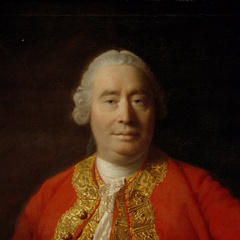
“No one can doubt, that the convention for the distinction of property, and for the stability of possession, is of all circumstances the most necessary to the establishment of human society, and that after the agreement for the fixing and observing of this rule, there remains little or nothing to be done towards settling a perfect harmony and concord.”
Source: A Treatise of Human Nature
“Nothing is demonstrable, unless the contrary implies a contradiction. Nothing, that is distinctly conceivable, implies a contradiction. Whatever we conceive as existent, we can also conceive as non-existent. There is no being, therefore, whose non-existence implies a contradiction. Consequently there is no being, whose existence is demonstrable.”
Source: Dialogues sur la religion naturelle
“We learn the influence of our will from experience alone. And experience only teaches us, how one event constantly follows another; without instructing us in the secret connexion, which binds them together, and renders them inseparable.”
Source: An Enquiry Concerning Human Understanding: Revision of Great Book
“One would appear ridiculous who would say, that it is only probable the sun will rise to-morrow, or that all men must die; thoughit is plain we have no further assurance of these facts than what experience affords us.”
Source: The Philosophy of David Hume
“Custom, then, is the great guide of human life. It is that principle alone, which renders our experience useful to us, and makes us expect, for the future, a similar train of events with those which have appeared in the past.”
Source: An Enquiry Concerning Human Understanding ; [with] A Letter from a Gentleman to His Friend in Edinburgh ; [and] An Abstract of a Treatise of Human Nature
“I know with certainty, that [an honest man] is not to put his hand into the fire, and hold it there, till it be consumed: And thisevent, I think I can foretell with the same assurance, as that, if he throw himself out at the window, and meet with no obstruction, he will not remain a moment suspended in the air.”
Source: An Enquiry Concerning the Human Understanding: And An Enquiry Concerning the Principles of Morals
“Nothing more powerfully excites any affection than to conceal some part of its object, by throwing it into a kind of shade, whichat the same time that it shows enough to prepossess us in favour of the object, leaves still some work for the imagination.”
Source: A Dissertation on the Passions: The Natural History of Religion : a Critical Edition
“The imagination of man is naturally sublime, delighted with whatever is remote and extraordinary, and running, without control, into the most distant parts of space and time in order to avoid the objects, which custom has rendered too familiar to it.”
Source: Essays and Treatises on Several Subjects
“Of all the animals with which this globe is peopled, there is none towards whom nature seems, at first sight, to have exercised more cruelty than towards man, in the numberless wants and necessities with which she has loaded him, and in the slender means which she affords to the relieving these necessities.”
“Enthusiasm, being the infirmity of bold and ambitious tempers, is naturally accompanied with a spirit of liberty; as superstition,on the contrary, renders men tame and abject, and fits them for slavery.”
Source: Essays Moral, Political, and Literary
“Upon the whole, necessity is something, that exists in the mind, not in objects; nor is it possible for us ever to form the most distant idea of it, consider'd as a quality in bodies. Either we have no idea of necessity, or necessity is nothing but that determination of thought to pass from cause to effects and effects to causes, according to their experienc'd union.”
Source: A Treatise of Human Nature
“Reasoning from the common course of nature, and without supposing any new interposition of the Supreme Cause, which ought always to be excluded from philosophy; what is incorruptible must also be ingenerable. The soul, therefore, if immortal, existed before our birth: And if the former existence noways concerned us, neither will the latter.”
Source: The Philosophical Works of David Hume ... Containing Dialogues Concerning Natural Religion, Essays on the Immortality of the Soul, Suicide ... &c. A New Edition
“Heroism, or military glory, is much admired by the generality of mankind. They consider it as the most sublime kind of merit. Menof cool reflection are not so sanguine in their praises of it.”
Source: Delphi Complete Works of David Hume (Illustrated)
“When I turn my eye inward, I find nothing but doubt and ignorance. All the world conspires to oppose and contradict me; though such is my weakness, that I feel all my opinions loosen and fall of themselves, when unsupported by the approbation of others.”
Source: A Treatise of Human Nature: Top Philosophy Collections
“If morality had naturally no influence on human passions and actions, it were in vain to take such pains to inculcate it; and nothing would be more fruitless than that multitude of rules and precepts with which all moralists abound.”
Source: A Treatise of Human Nature: Revision of Great Book
“When I think of God, when I think of him as existent, and when I believe him to be existent, my idea of him neither increases nordiminishes. But as it is certain there is a great difference betwixt the simple conception of the existence of an object, and the belief of it, and as this difference lies not in the parts or composition of the idea which we conceive; it follows, that it must lie in the manner in which we conceive it.”
Source: A Treatise of Human Nature
“There surely is a being who presides over the universe; and who, with infinite wisdom and power, has reduced the jarring elementsinto just order and proportion. Let speculative reasoners dispute, how far this beneficent being extends his care, and whether he prolongs our existence beyond the grave, in order to bestow on virtue its just reward, and render it fully triumphant.”
Source: Selected essays
“Learning has been as great a Loser by being shut up in Colleges and Cells, and secluded from the World and good Company. By that Means, every Thing of what we call Belles Lettres became totally barbarous, being cultivated by Men without any Taste of Life or Manners, and without that Liberty and Facility of Thought and Expression, which can only be acquir'd by Conversation.”
Source: Essays Moral, Political, and Literary
“The end of all moral speculations is to teach us our duty; and, by proper representations of the deformity of vice and beauty of virtue, beget correspondent habits, and engage us to avoid the one, and embrace the other.”
Source: Moral Philosophy
“All morality depends upon our sentiments; and when any action or quality of the mind pleases us after a certain manner we say it is virtuous; and when the neglect or nonperformance of it displeases us after a like manner, we say that we lie under an obligation to perform it.”
Source: Moral and Political Philosophy
“It is evident, from their method of propagation, that a couple of cats, in fifty years, would stock a whole kingdom; and if that religious veneration were still paid them, it would, in twenty more, not only be easier in Egypt to find a god than a man, which Petronius says was the case in some parts of Italy; but the gods must at last entirely starve the men, and leave themselves neither priests nor votaries remaining.”
Source: A Dissertation on the Passions: The Natural History of Religion : a Critical Edition
“When I am convinced of any principle, it is only an idea which strikes more strongly upon me. When I give the preference to one set of arguments above another, I do nothing but decide from my feeling concerning the superiority of their influence.”
Source: A Treatise of Human Nature: Top Philosophy Collections
“We may well ask, What causes induce us to believe in the existence of body? but 'tis vain to ask. Whether there be body or not? That is a point which we must take for granted in all our reasonings.”
Source: A Treatise of Human Nature: Revision of Great Book
“It seems certain, that though a man, in a flush of humour, after intense reflection on the many contradictions and imperfections of human reason, may entirely renounce all belief and opinion, it is impossible for him to persevere in this total scepticism, or make it appear in his conduct for a few hours.”
Source: An Enquiry Concerning Human Understanding
“Were a man, whom I know to be honest and opulent, and with whom I live in intimate friendship, to come into my house, where I am surrounded with my servants, I rest assured, that he is not to stab me before he leaves it, in order to rob me of my silver standish; and I no more suspect this event, than the falling of the house itself which is new, and solidly built and founded.--But he may have been seized with a sudden and unknown frenzy.--So may a sudden earthquake arise, and shake and tumble my house about my ears.”
Source: An Enquiry Concerning Human Understanding: A Critical Edition
“We can conceive a thinking being to have either many or few perceptions. Suppose the mind to be reduced even below the life of anoyster. Suppose it to have only one perception, as of thirst or hunger. Consider it in that situation. Do you conceive any thing but merely that perception? Have you any notion of self or substance? If not, the addition of other perceptions can never give you that notion.”
Source: A Treatise of Human Nature: Illustrated
“Justice is a moral virtue, merely because it has that tendency to the good of mankind, and indeed is nothing but an artificial invention to that purpose. The same may be said of allegiance, of the laws of nations, of modesty, and of good manners. All these are mere human contrivances for the interest of society.”
Source: A Treatise of Human Nature
“A Tory..., since the revolution, may be defined in a few words, to be a lover of monarchy, though without abandoning liberty; anda partizan of the family of Stuart. As a Whig may be defined to be a lover of liberty though without renouncing monarchy; and a friend to the settlement in the protestant line.”
“Absolute monarchy,... is the easiest death, the true Euthanasia of the BRITISH constitution.”
Source: Essays moral, political, and literary. (Life of the author, etc.).
“The mention of one apartment in a building naturally introduces an enquiry or discourse concerning the others: and if we think ofa wound, we can scarcely forbear reflecting on the pain which follows it.”
Source: An Enquiry Concerning Human Understanding; [with] A Letter from a Gentleman to His Friend in Edinburgh; [and] An Abstract of a Treatise of Human Nature
“Battles, revolutions, pestilence, famine, and death, are never the effect of those natural causes, which we experience. Prodigies,omens, oracles, judgments, quite obscure the few natural events, that are intermingled with them. But as the former grow thinner every pagewe soon learn, that there is nothing mysterious or supernatural in the case, but that all proceeds from the usual propensity of mankind towards the marvellous, and that, though this inclination may at intervals receive a check from sense and learning, it can never be thoroughly extirpated.”
“[The sceptic] must acknowledge, if he will acknowledge any thing, that all human life must perish, were his principles to prevail.All discourse, all action would immediately cease, and men remain in a total lethargy, till the necessities of nature, unsatisfied, put an end to their miserable existence.”
Source: An inquiry concerning human understanding. A dissertation on the passions. An inquiry concerning the principles of morals. The natural history of religion
“The great subverter of Pyrrhonism or the excessive principles of scepticism is action, and employment, and the occupations of common life.”
Source: Essays and Treatises on Philosophical Subjects
“There is, indeed a more mitigated scepticism or academical philosophy, which may be both durable and useful, and which may, in part, be the result of this Pyrrhonism, or excessive scepticism, when its undistinguished doubts are corrected by common sense and reflection.”
Source: An Enquiry Concerning Human Understanding ; [with] A Letter from a Gentleman to His Friend in Edinburgh ; [and] An Abstract of a Treatise of Human Nature
“Virtue, like wholesome food, is better than poisons, however corrected.”
Source: The philosophical works of David Hume
“It is not contrary to reason to prefer the destruction of the whole world to the scratching of my finger. It is not contrary to reason for me to choose my total ruin, to prevent the least uneasiness of an Indian, or person wholly unknown to me. It is as little contrary to reason to prefer even my own acknowledged lesser good to my greater, and have a more ardent affection for the former than the latter.”
“Let us become thoroughly sensible of the weakness, blindness, and narrow limits of human reason: Let us duly consider its uncertainty and endless contrarieties, even in subjects of common life and practice.... When these topics are displayed in their full light, as they are by some philosophers and almost all divines; who can retain such confidence in this frail faculty of reason as to pay any regard to its determinations in points so sublime, so abstruse, so remote from common life and experience?”
Source: Delphi Complete Works of David Hume (Illustrated)
“There is an universal tendency among mankind to conceive all beings like themselves, and to transfer to every object, those qualities, with which they are familiarly acquainted, and of which they are intimately conscious. We find human faces in the moon, armies in the clouds; and by a natural propensity, if not corrected by experience and reflection, ascribe malice or good-will to every thing, that hurts or pleases us.”
Source: The Natural History of Religion
“Luxury, or a refinement on the pleasures and conveniences of life, had long been supposed the source of every corruption in government, and the immediate cause of faction, sedition, civil wars, and the total loss of liberty. It was, therefore, universally regarded as a vice, and was an object of declamation to all satyrists, and severe moralists.”
Source: An Enquiry Concerning the Principles of Morals
“Liberty is a blessing so inestimable, that, wherever there appears any probability of recovering it, a nation may willingly run many hazards, and ought not even to repine at the greatest effusion of blood or dissipation of treasure.”
Source: Delphi Complete Works of David Hume (Illustrated)
“[Rousseau] has not had the precaution to throw any veil over his sentiments; and as he scorns to dissemble his contempt of established opinions, he could not wonder that all the zealots were in arms against him.”
Source: Delphi Complete Works of David Hume (Illustrated)
“Enthusiasm produces the most cruel disorders in human society; but its fury is like that of thunder and tempest, which exhaust themselves in a little time, and leave the air more calm and serene than before.”
Source: Essays, moral, political, and literary.- v. 2. An inquiry concerning human understanding. A dissertation on the passions. An inquiry concerning the principles of morals. The natural history of religion
“There is only one vice, which may be found in life with as strong features, and as high a colouring as needs be employed by any satyrist or comic poet; and that is AVARICE.”
Source: Delphi Complete Works of David Hume (Illustrated)
“When we reflect on our past sentiments and affections, our thought is a faithful mirror, and copies its objects truly; but the colours which it employs are faint and dull, in comparison of those in which our original perceptions were clothed.”
Source: An Enquiry Concerning Human Understanding; [with] A Letter from a Gentleman to His Friend in Edinburgh; [and] An Abstract of a Treatise of Human Nature
“A CAUSE is an object precedent and contiguous to another, and so united with it that the idea of the one determines the mind to form the idea of the other, and the impression of the one to form a more lively idea of the other.”
Source: A Treatise of Human Nature
“When the coherence of the parts of a stone, or even that composition of parts which renders it extended; when these familiar objects, I say, are so inexplicable, and contain circumstances so repugnant and contradictory; with what assurance can we decide concerning the origin of worlds, or trace their history from eternity to eternity?”
Source: The Philosophical Works of David Hume ... Containing Dialogues Concerning Natural Religion, Essays on the Immortality of the Soul, Suicide ... &c. A New Edition
“A hundred cabinet-makers in London can work a table or a chair equally well; but no one poet can write verses with such spirit and elegance as Mr. Pope.”
Source: Delphi Complete Works of David Hume (Illustrated)
“Barbarity, caprice; these qualities, however nominally disguised, we may universally observe from the ruling character of the deity in all regular religions.”
Source: An inquiry concerning human understanding. A dissertation on the passions. An inquiry concerning the principles of morals. The natural history of religion
“From causes which appear similar, we expect similar effects. This is the sum total of all our experimental conclusions.”
“Morals and criticism are not so properly objects of the understanding as of taste and sentiment.”
Source: And the human understanding. An inquiry concerning the principles of morals. Appendix. The natural history of religion