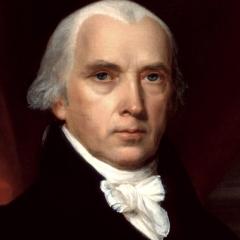
“Besides the advantage of being armed, which the Americans possess over the people of almost every other nation, the existence of subordinate governments, to which the people are attached, and by which the militia officers are appointed, forms a barrier against the enterprises of ambition, more insurmountable than any which a simple government of any form can admit of.”
Source: The Federalist, on the New Constitution, Written in the Year 1788
“I, sir, have always conceived - I believe those who proposed the constitution conceived,and it is still more fully known, and more material to observe, those who ratified the constitution conceived, that this is not an indefinite government deriving its powers from the general terms prefixed to the specified powers - but, a limited government tied down to the specified powers, which explain and define the general terms.”
Source: James Madison's
“In all the co-temporary discussions and comments, which the Constitution underwent, it was constantly justified and recommended on the ground, that the powers not given to the government, were withheld from it.”
Source: The Virginia Report of 1799-1800: Touching the Alien and Sedition Laws; Together with the Virginia Resolutions of December 21, 1798, Including the Debate and Proceedings Thereon in the House of Delegates of Virginia and Other Documents Illustrative of the Report and Resolutions
“It becomes all therefore who are friends of a Government based on free principles to reflect, that by denying the possibility of a system partly federal and partly consolidated, and who would convert ours into one either wholly federal or wholly consolidated, in neither of which forms have individual rights, public order, and external safety, been all duly maintained, they aim a deadly blow at the last hope of true liberty on the face of the Earth.”
Source: 1829-1836
“In the first place, it is to be remembered, that the general government is not to be charged with the whole power of making and administering laws. Its jurisdiction is limited to certain enumerated objects, which concern all the members of the republic, but which are not to be attained by the separate provisions of any.”
Source: The Federalist, on the new constitution, written in 1788, with an appendix, containing the letters of Pacificus and Helvidius on the proclamation of neutrality of 1793, also the original articles of confederation and the constitution of the United States
“But ambitious encroachments of the federal government, on the authority of the State governments, would not excite the opposition of a single State, or of a few States only. They would be signals of general alarm . . . But what degree of madness could ever drive the federal government to such an extremity.”
Source: The Federalist, on the New Constitution, Written in the Year 1788
“I wish not to be regarded as an advocate for the particular organizations of the several state governments . . . they carry strong marks of the haste, and still stronger marks of the inexperience, under which they were framed.”
Source: The Federalist: On the New Constitution, Written in 1788
“The appointment of senators by the state legislatures . . . is recommended by the double advantage of favoring a select appointment, and of giving to the state governments such an agency in the formation of the federal government, as must secure the authority of the former.”
Source: Selected Writings of James Madison
“That useful alterations will be suggested by experience, could not but be foreseen . . . . It moreover equally enables the general and state governments to originate the amendment of errors as they may be pointed out by the experience on one side or on the other.”
Source: The Federalist, on the New Constitution, Written in the Year 1788
“The proposed constitution, therefore, even when tested by the rules laid down by its antagonists, is, in strictness, neither a national nor a federal constitution; but a composition of both. In its foundation it is federal, not national; in the sources from which the ordinary powers of the government are drawn, it is partly federal, and partly national; in the operation of these powers, it is national, not federal; in the extent of them again, it is federal, not national; and finally, in the authoritative mode of introducing amendments, it is neither wholly federal, nor wholly national.”
Source: The Federalist, on the New Constitution, Written in the Year 1788
“In this relation, then, the proposed government cannot be deemed a national one; since its jurisdiction extends to certain enumerated objects only, and leaves to the several states, a residuary and inviolable sovereignty over all other objects.”
Source: The Federalist, on the New Constitution, Written in the Year 1788
“Is there no virtue among us? If there be not, we are in a wretched situation. No theoretical checks-no form of government can render us secure. To suppose that any form of government will secure liberty or happiness without any virtue in the people, is a chimerical idea, if there be sufficient virtue and intelligence in the community, it will be exercised in the selection of these men. So that we do not depend on their virtue, or put confidence in our rulers, but in the people who are to choose them.”
Source: James Madison's
“The great desideratum in Government is, so to modify the sovereignty as that it may be sufficiently neutral between different parts of the Society to controul one part from invading the rights of another, and at the same time sufficiently controuled itself, from setting up an interest adverse to that of the entire Society.”
Source: 1769-1793
“It has been said that all Government is an evil. It would be more proper to say that the necessity of any Government is a misfortune. This necessity however exists; and the problem to be solved is, not what form of Government is perfect, but which of the forms is least imperfect.”
Source: Selected Writings of James Madison
“A good government implies two things: first, fidelity to the object of government, which is the happiness of the people; secondly, a knowledge of the means by which that object can be best attained.”
Source: The Essential Federalist: A New Reading of the Federalist Papers
“Among the numerous advantages promised by a well-constructed Union, none deserves to be more accurately developed than its tendency to break and control the violence of faction.”
Source: The Federalist
“There is one view of the subject which ought to have its influence on those who espouse doctrines which strike at the authoritative origin and efficacious operation of the Government of the United States. The Government of the U.S. like all Governments free in their principles, rests on compact; a compact, not between the Government & the parties who formed & live under it; but among the parties themselves, and the strongest of Governments are those in which the compacts were most fairly formed and most faithfully executed.”
“It may be considered as an objection inherent in the principle, that as every appeal to the people would carry an implication of some defect in the government, frequent appeals would in great measure deprive the government of that veneration which time bestows on every thing, and without which perhaps the wisest and freest governments would not possess the requisite stability . . . a constitutional road to the decision of the people ought to be marked out and kept open, for certain great and extraordinary occasions”
“[I]t is the reason alone, of the public, that ought to control and regulate the government.”
Source: The federalist papers
“The most that the Convention could do in such a situation, was to avoid the errors suggested by the past experience of other countries, as well as of our own; and to provide a convenient mode of rectifying their own errors, as future experience may unfold them.”
Source: The Federalist, on the New Constitution, Written in the Year 1788
“We may be assured by past experience, that such a practice [as some states charging high taxes on goods from other states] would be introduced by future contrivances; and both by that and a common knowledge of human affairs, that it would nourish unceasing animosities, and not improbably terminate in serious interruptions of the public tranquility.”
“At first view it might seem not to square with the republican theory, to suppose either that a majority have not the right, or that a minority will have the force to subvert a government . . . . But theoretic reasoning in this, as in most other cases, must be qualified by the lessons of practice.”
Source: The Federalist Papers: A Collection of Essays Written in Favour of the New Constitution
“Experience assures us, that the efficacy of the provision has been greatly over-rated; and that some more adequate defense is indispensably necessary for the more feeble, against the more powerful members of the government.”
Source: The federalist papers
“Frequent elections are unquestionably the only policy by which this dependence and sympathy can be effectually secured. But what particular degree of frequency may be absolutely necessary for the purpose, does not appear to be susceptible of any precise calculation; and must depend on a variety of circumstances with which it may be connected. Let us consult experience, the guide that ought always to be followed, whenever it can be found.”
Source: The Federalist Papers: A Collection of Essays Written in Favour of the New Constitution
“Experience has instructed us that no skill in the science of government has yet been able to discriminate and define, with sufficient certainty, its three great provinces the legislative, executive, and judiciary; or even the privileges and powers of the different legislative branches.”
Source: The Federalist, on the New Constitution, Written in the Year 1788
“It is a melancholy reflection that liberty should be equally exposed to danger whether the government have too much power or too little power and that the line which divides these extremes should be so inaccurately defined by experience.”
Source: Selected Writings of James Madison
“A just security to property is not afforded by that government, under which unequal taxes oppress one species of property and reward another species.”
Source: Selected Writings of James Madison
“In civilized communities, property as well as personal rights is an essential object of the laws, which encourage industry by securing the enjoyment of its fruits; that industry from which property results, and that enjoyment which consists not merely in its immediate use, but in its posthumous destination to objects of choice, and of kindred affection. In a just and free government, therefore, the rights both of property and of persons ought to be effectually guarded.”
“If justice, good faith, honor, gratitude and all the other qualities which enoble the character of a nation, and fulfill the ends of Government be the fruits of our establishments, the cause of liberty will acquire a dignity and lustre, which it has never yet enjoyed, and an example will be set, which can not but have the most favorable influence on the rights of Mankind.”
Source: The debates in the several state conventions on the adoption of the Federal Constitution, as recommended by the general convention at Philadelphia in 1787: Together with the Journal of the Federal convention, Luther Martin's letter, Yates's minutes, Congressional opinions, Virginia and Kentucky resolutions of '98-'99, and other illustrations of the Constitution
“It is sufficiently obvious, that persons and property are the two great subjects on which Governments are to act; and that the rights of persons, and the rights of property, are the objects, for the protection of which Government was instituted. These rights cannot well be separated.”
Source: Selected Writings of James Madison
“The invasion of private rights is chiefly to be apprehended, not from acts of Government contrary to the sense of its constituents, but from acts in which the Government is the mere instrument of the major number of the Constituents.”
Source: Selected Writings of James Madison
“The definition of the right of suffrage is very justly regarded as a fundamental article of republican government.”
Source: The Federalist, on the new constitution, written in 1788, with an appendix, containing the letters of Pacificus and Helvidius on the proclamation of neutrality of 1793, also the original articles of confederation and the constitution of the United States
“The passions, therefore, not the reason, of the public would sit in judgment. But it is the reason, alone, of the public, that ought to control and regulate the government. The passions ought to be controlled and regulated by the government.”
Source: The Federalist: A Commentary on the Constitution of the United States
“The regulation of these various and interfering interests forms the principal task of modern legislation and involves the spirit of party and faction in the necessary and ordinary operations of government.”
Source: The Federalist Papers: A Collection of Essays Written in Favour of the New Constitution
“THE Constitution proposed by the convention may be considered under two general points of view. The FIRST relates to the sum or quantity of power which it vests in the government, including the restraints imposed on the States. The SECOND, to the particular structure of the government, and the distribution of this power among its branches.”
Source: The Federalist on the New Constitution
“[In a democracy] a common passion or interest will, in almost every case , be felt by a majority of the whole; a communication and concert results from the form of government itself; and there is nothing to check the inducements to sacrifice the weaker party or an obnoxious individual.”
Source: The Federalist, on the New Constitution, Written in 1788
“I regret, as much as any member, the unavoidable weight and duration of the burdens to be imposed; having never been a proselyte to the doctrine, that public debts are public benefits. I consider them, on the contrary, as evils which ought to be removed as fast as honor and justice will permit.”
Source: The Writings of James Madison: 1787-1790
“Attempts to enforce by legal sanctions, acts obnoxious to so great a proportion of Citizens, tend to enervate the laws in general, and to slacken the bands of Society. If it be difficult to execute any law which is not generally deemed necessary or salutary, what must be the case, where it is deemed invalid and dangerous? And what may be the effect of so striking an example of impotency in the Government, on its general authority?”
Source: Selected Writings of James Madison
“Public opinion sets bounds to every government, and is the real sovereign in every free one.”
Source: 1829-1836
“If we resort for a criterion to the different principles on which different forms of government are established, we may define a republic to be, or at least may bestow that name on, a government which derives all its powers directly or indirectly from the great body of the people, and is administered by persons holding their offices during pleasure for a limited period, or during good behavior.”
Source: The Federalist: With Letters of Brutus
“A republic, by which I mean a government in which the scheme of representation takes place, opens a different prospect and promises the cure for which we are seeking.”
Source: The Federalist, on the New Constitution, Written in the Year 1788
“It is a misfortune incident to republican government, though in a less degree than to other governments, that those who administer it, may forget their obligations to their constituents, and prove unfaithful to their important trust.”
Source: The Federalist: On the New Constitution, Written in 1788
“I go on the principle that a public debt is a public curse and in a republican government more than in any other.”
“In the extent and proper structure of the Union, therefore, we behold a republican remedy for the disease incident to republican government.”
Source: Selected Writings of James Madison
“The first question that offers itself is, whether the general form and aspect of the government be strictly republican? It is evident that no other form would be reconcileable with the genius of the people of America; with the fundamental principles of the revolution; or with that honourable determination which animates every votary of freedom, to rest all our political experiments on the capacity of mankind for self-government.”
Source: Selected Writings of James Madison
“I acknowledge, in the ordinary course of government, that the exposition of the laws and Constitution devolves upon the judicial. But I beg to know upon what principle it can be contended that any one department draws from the Constitution greater powers than another in marking out the limits of the powers of the several departments.”
Source: Selected Writings of James Madison
“[I]n the next place, to show that unless these departments be so far connected and blended as to give to each a constitutional control over the others, the degree of separation which the maxim requires, as essential to a free government, can never in practice be duly maintained.”
Source: The Federalist, on the New Constitution, Written in 1788
“A dependence on the people is, no doubt, the primary control on the government; but experience has taught mankind the necessity of auxiliary precautions.”
Source: Selected Writings of James Madison
“To what expedient then shall we finally resort, for maintaining in practice the necessary partition of power among the several departments, as laid down in the constitution? The only answer that can be given is, that as all these exterior provisions are found to be inadequate, the defect must be supplied, by so contriving the interior structure of the government, as that its several constituent parts may, by their mutual relations, be the means of keeping each other in their proper places.”
Source: The Federalist, on the New Constitution, Written in the Year 1788
“The danger of silent accumulations & encroachments by Ecclesiastical Bodies have not sufficiently engaged attention in the U.S. [...] Besides the danger of a direct mixture of Religion & civil Government, there is an evil which ought to be guarded against in the indefinite accumulation of property from the capacity of holding it in perpetuity by ecclesiastical Corporations. [...] The establishment of the chaplainship to Congs. is a palpable violation of equal rights, as well as of Constitutional principles.”