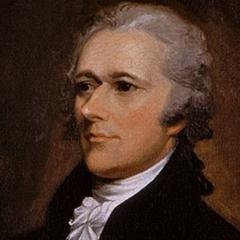
“It is by far the safer course to lay [considerations of the future] altogether aside; and to confine our attention wholly to the nature and extent of the powers as they are delineated in the constitution. Everything beyond this, must be left to the prudence and firmness of the people; who, as they will hold the scales in their own hands, it is to be hoped, will always take care to preserve the constitutional equilibrium between the General and State governments.”
“The instrument by which it [government] must act are either the AUTHORITY of the laws or FORCE. If the first be destroyed, the last must be substituted; and where this becomes the ordinary instrument of government there is an end to liberty!”
Source: The works of Alexander Hamilton: comprising his correspondence, and his political and official writings, exclusive of the Federalist, civil and military. Published from the original manuscripts deposited in the Department of State, by order of the Joint Library Committee of Congress
“If mankind were to resolve to agree in no institution of government, until every part of it had been adjusted to the most exact standard of perfection, society would soon become a general scene of anarchy, and the world a desert.”
Source: The Essential Federalist: A New Reading of the Federalist Papers
“I will venture to assert that no combination of designing men under heaven will be capable of making a government unpopular which is in its principles a wise and good one, and vigorous in its operations.”
Source: The Works of Alexander Hamilton: Miscellanies, 1774-1789: A full vindication; The farmer refuted; Quebec bill; Resolutions in Congress; Letters from Phocion; New-York Legislature, etc
“The true principle of government is this - make the system compleat in its structure; give a perfect proportion and balance to its parts; and the powers you give it will never affect your security.”
Source: The Works of Alexander Hamilton: Miscellanies, 1774-1789: A full vindication; The farmer refuted; Quebec bill; Resolutions in Congress; Letters from Phocion; New-York Legislature, etc
“The history of ancient and modern republics had taught them that many of the evils which those republics suffered arose from the want of a certain balance, and that mutual control indispensable to a wise administration. They were convinced that popular assemblies are frequently misguided by ignorance, by sudden impulses, and the intrigues of ambitious men; and that some firm barrier against these operations was necessary. They, therefore, instituted your Senate.”
“It is in vain to hope to guard against events too mighty for human foresight or precaution, and it would be idle to object to a government because it could not perform impossibilities.”
Source: The federalist papers
“[I]n framing a Government for a nation we ought, in those provisions which are designed to be permanent, to calculate not on temporary, but on permanent causes of expence.”
Source: The Federalist: A Commentary on the Constitution of the United States
“It will be forgotten, on the one hand, that jealousy is the usual concomitant of violent love, and that the noble enthusiasm of liberty is too apt to be infected with a spirit of narrow and illiberal distrust. On the other hand, it will be equally forgotten, that the vigour of government is essential to the security of liberty.”
Source: The Federalist: A Commentary on the Constitution of the United States. A Collection of Essays
“The means ought to be proportioned to the end; the persons from whose agency the attainment of any end is expected ought to possess the means by which it is to be attained.”
Source: The Federalist
“It will follow that that government ought to be clothed with all powers requisite to complete execution of its trust.”
Source: The Federalist Papers and the Constitution of the United States: The Principles of the American Government
“If we are in earnest about giving the Union energy and duration we must abandon the vain project of legislating upon the States in their collective capacities.”
Source: The Federalist, on the new constitution, written in 1788, with an appendix, containing the letters of Pacificus and Helvidius on the proclamation of neutrality of 1793, also the original articles of confederation and the constitution of the United States
“A government, the constitution of which renders it unfit to be trusted with all the powers which a free people ought to delegate to any government, would be an unsafe and improper depositary of the NATIONAL INTERESTS.”
Source: The federalist papers
“[A] power equal to every possible contingency must exist somewhere in the government . . .”
Source: The Federalist Papers: A Collection of Essays Written in Favour of the New Constitution
“A republic of this kind, able to withstand an external force, may support itself without any internal corruptions. The form of this society prevents all manner of inconveniences.”
Source: The federalist papers
“If the federal government should overpass the just bounds of its authority and make a tyrannical use of its powers, the people, whose creature it is, must appeal to the standard they have formed, and take such measures to redress the injury done to the Constitution as the exigency may suggest and prudence justify.”
Source: The Federalist, on the New Constitution, Written in the Year 1788
“What bitter anguish would not the people of Athens have often escaped if their government had contained so provident a safeguard against tyranny of their own passions? Popular liberty might then have escaped the indelible reproach of decreeing to the same citizens the hemlock on one day and statutes the next.”
Source: The Fœderalist: A Collection of Essays, Written in Favor of the New Constitution, as Agreed Upon by the Fœderal Convention, September 17, 1787. Reprinted from the Original Text. With an Historical Introduction and Notes
“As to Taxes, they are evidently inseparable from Government. It is impossible without them to pay the debts of the nation, to protect it from foreign danger, or to secure individuals from lawless violence and rapine.”
Source: Political essays [etc., 1792-1804] Contents. Index
“There is no part of the administration of government that requires extensive information and a thorough knowledge of the principles of political economy, so much as the business of taxation. The man who understands those principles best will be least likely to resort to oppressive expedients, or sacrifice any particular class of citizens to the procurement of revenue. It might be demonstrated that the most productive system of finance will always be the least burdensome.”
Source: The Federalist Papers and the Constitution of the United States: The Principles of the American Government
“It is an unquestionable truth, that the body of the people in every country desire sincerely its prosperity. But it is equally unquestionable that they do not possess the discernment and stability necessary for systematic government. To deny that they are frequently led into the grossest of errors, by misinformation and passion, would be a flattery which their own good sense must despise.”
Source: The Works of Alexander Hamilton: Miscellanies, 1774-1789: A full vindication; The farmer refuted; Quebec bill; Resolutions in Congress; Letters from Phocion; New-York Legislature, etc
“[W]e must extend the authority of the Union to the persons of the citizens - the only proper objects of government.”
Source: The Federalist, on the new constitution, written in 1788, with an appendix, containing the letters of Pacificus and Helvidius on the proclamation of neutrality of 1793, also the original articles of confederation and the constitution of the United States
“Of all the cares or concerns of government, the direction of war most peculiarly demands those qualities which distinguish the exercise of power by a single hand. The direction of war implies the direction of the common strength; and the power of directing and employing the common strength, forms a usual and essential part in the definition of the executive authority.”
Source: The federalist papers
“That there may happen cases in which the national government may be necessitated to resort to force, cannot be denied.”
Source: The Federalist Papers: A Collection of Essays Written in Favour of the New Constitution
“The standard of good behavior for the continuance in office of the judicial magistracy is certainly one of the most valuable of the modern improvements in the practice of government.”
Source: The Federalist, on the New Constitution, Written in 1788
“Whoever attentively considers the different departments of power must perceive, that, in a government in which they are separated from each other, the judiciary, from the nature of its functions, will always be the least dangerous to the political rights of the Constitution; because it will be least in a capacity to annoy or injure them.”
Source: The Federalist on the New Constitution, Written in the Year 1788, with an Appendix Containing the Letters of Pacificus and Helvidius on the Proclamation of Neutrality of 1793
“If there are such things as political axioms, the propriety of the judicial power of a government being co-extensive with its legislative, may be ranked among the number.”
Source: The Federalist, on the New Constitution, Written in 1788
“Government implies the power of making laws. It is essential to the idea of a law, that it be attended with a sanction; or, in other words, a penalty or punishment for disobedience.”
“Wise politicians will be cautious about fettering the government with restrictions that cannot be observed, because they know that every break of the fundamental laws, though dictated by necessity, impairs that sacred reverence which ought to be maintained in the breast of rulers towards the constitution of a country.”
“It may be said that the power of preventing bad laws includes that of preventing good ones; and may be used to the one purpose as well as to the other. But this objection will have little weight with those who can properly estimate the mischiefs of that inconstancy and mutability in the laws, which form the greatest blemish in the character and genius of our governments.”
Source: The Federalist Papers: Alexander Hamilton, James Madison, John Jay
“The idea of governing at all times by the simple force of law (which we have been told is the only admissible principle of republican government) has no place but in the reveries of those political doctors whose sagacity disdains the admonitions of experimental instruction.”
Source: The Federalist Papers: A Collection of Essays Written in Favour of the New Constitution
“The regular distribution of power into distinct departments; the introduction of legislative balances and checks; the institution of courts composed of judges holding their offices during good behavior; the representation of the people in the legislature by deputies of their own election . . . They are means, and powerful means, by which the excellences of republican government may be retained and its imperfections lessened or avoided.”
Source: The Essential Federalist: A New Reading of the Federalist Papers
“Good constitutions are formed upon a comparison of the liberty of the individual with the strength of government: If the tone of either be too high, the other will be weakened too much. It is the happiest possible mode of conciliating these objects, to institute one branch peculiarly endowed with sensibility, another with knowledge and firmness. Through the opposition and mutual control of these bodies, the government will reach, in its regular operations, the perfect balance between liberty and power.”
Source: The Political Writings of Alexander Hamilton:
“But as the plan of the convention aims only at a partial union or consolidation, the State governments would clearly retain all the rights of sovereignty which they before had, and which were not, by that act, EXCLUSIVELY delegated to the United States.”
Source: The Federalist, on the New Constitution, Written in the Year 1788
“It is one thing to be subordinate to the laws, and another [for the Executive] to be dependent on the legislative body. The first comports with, the last violates, the fundamental principles of good government; and, whatever may be the forms of the Constitution, unites all power in the same hands.”
Source: The Federalist on the New Constitution
“When a government betrays the people by amassing too much power and becoming tyrannical, the people have no choice but to exercise their original right of self-defense — to fight the government.”
“The true principle of a republic is that the people should choose whom they please to govern them. Representation is imperfect, in proportion as the current of popular favor is checked. The great source of free government, popular election, should be perfectly pure, and the most unbounded liberty allowed.”
Source: The works of Alexander Hamilton: comprising his correspondence, and his political and official writings, exclusive of the Federalist, civil and military. Published from the original manuscripts deposited in the Department of State, by order of the Joint Library Committee of Congress
“That instability is inherent in the nature of popular governments, I think very disputable … A representative democracy, where the right of election is well secured and regulated & the exercise of the legislature, executive, and judiciary authorities, is vested in select persons, chosen really and not nominally by the people, will in my opinion be most likely to be happy, regular and durable.”
“A feeble executive implies a feeble execution of the government. A feeble execution is but another phrase for a bad execution; and a government ill executed, whatever may be its theory, must be, in practice, a bad government.”
Source: The federalist papers
“There are some who maintain that trade will regulate itself, and it is not to be benefited by the encouragements or restraints of government. Such persons will imagine that there is no need of a common directing power. This is one of those wild speculative paradoxes, which have grown into credit among us, contrary to the uniform practice and sense of the most enlightened nations.”
Source: The Federalist: A Commentary on the Constitution of the United States : a Collection of Essays
“The President, and government, will only control the militia when a part of them is in the actual service of the federal government, else, they are independent and not under the command of the president or the government. The states would control the militia, only when called out into the service of the state, and then the governor would be commander in chief where enumerated in the respective state constitution.”
“The great leading objects of the federal government, in which revenue is concerned, are to maintain domestic peace, and provide for the common defense.”
Source: The Works of Alexander Hamilton: Miscellanies, 1774-1789: A full vindication; The farmer refuted; Quebec bill; Resolutions in Congress; Letters from Phocion; New-York Legislature, etc
“A sacred respect for the constitutional law is the vital principle, the sustaining energy of a free government.”
Source: The works of Alexander Hamilton: comprising his correspondence, and his political and official writings, exclusive of the Federalist, civil and military. Published from the original manuscripts deposited in the Department of State, by order of the Joint Library Committee of Congress
“As you sometimes swear by him that made you, I conclude your sentiments do not correspond with his, in that which is the basis of the doctrine you both agree in: and this makes it impossible to imagine whence this congruity between you arises. "To grant that there is a supreme intelligence who rules the world and has established laws to regulate the actions of his creatures; and still to assert that man, in a state of nature, may be considered as perfectly free from all restraints of law and government, appears to a common understanding altogether irreconcilable.”
Source: The Works of Alexander Hamilton: Miscellanies, 1774-1789: A full vindication; The farmer refuted; Quebec bill; Resolutions in Congress; Letters from Phocion; New-York Legislature, etc
“Allow a government to decline paying its debts and you overthrow all public morality-you unhinge all the principles that preserve the limits of free constitutions. Nothing can more affect national prosperity than a constant and systematic attention to extinguish the present debt and to avoid as much as possibly the incurring of any new debt.”
“In so strong a light, nevertheless, do they appear to the Secretary, that, on their due observance, at the present critical juncture, materially depend, in his judgment, the individual and aggregate prosperity of the citizens of the United States; their relief from the embarrassments they now experience; their character as a people; the cause of good government.”
Source: Reports of the secretary of the Treasury of the United States
“Every power vested in a government is in its nature sovereign, and includes by force of the term a right to employ all the means requisite . . . to the attainment of the ends of such power.”
“Every individual of the community at large has an equal right to the protection of government.”
Source: The works of Alexander Hamilton: comprising his correspondence, and his political and official writings, exclusive of the Federalist, civil and military. Published from the original manuscripts deposited in the Department of State, by order of the Joint Library Committee of Congress
“All communities divide themselves into the few and the many. The first are the rich and well born, the other the mass of the people. The voice of the people has been said to be the voice of God; and however generally this maxim has been quoted and believed, it is not true in fact. The people are turbulent and changing; they seldom judge or determine right. Give therefore to the first class a distinct, permanent share in the government.”
“It may safely be received as an axiom in our political system, that the state governments will in all possible contingencies afford complete security against invasions of the public liberty by the national authority.”
Source: The Federalist Papers and the Constitution of the United States: The Principles of the American Government
“The vigour of government is essential to the security of liberty. . . . a dangerous ambition more often lurks behind the specious mask of zeal for the rights of the people, than under the forbidding appearance of zeal for the firmness and efficiency of government.”
Source: The Federalist